
Will Google Search Console add query-level data (the search queries, AI Mode prompts or fan-out queries behind AI appearances) to its Search Generative AI performance report by June 30, 2027?
Why the forecast moved Numbered as on the chart · forecast last updated 24 October 2026
| # | Date | Event and reasoning | Change | Source |
|---|---|---|---|---|
| 1 | 17 Jun 2025 | Google counts AI Mode in Search Console totals but says it cannot be segmentedGoogle chose to blend AI Mode clicks and queries into the main report, which signals reluctance to break out AI-specific query data. | -2.0 pts12.0% → 10.0% | Source |
| 2 | 4 Dec 2025 | Search Console launches AI-powered configuration for query and page analysisThe Search Console team is shipping new AI-era features at query level, which shows product investment in this area. | +1.0 pts10.0% → 11.0% | Source |
| 3 | 27 Jan 2026 | Bing Webmaster Tools beta of AI Performance report spotted with grounding queriesA rival webmaster tool showing query-type data for AI citations sets a benchmark that SEOs will press Google to match. | +2.0 pts11.0% → 13.0% | Source |
| 4 | 10 Feb 2026 | Microsoft launches AI Performance public preview including grounding queriesA public, documented competitor feature with grounding queries makes the omission more visible and raises competitive pressure on Google. | +2.5 pts13.0% → 15.5% | Source |
| 5 | 13 Apr 2026 | Google spotted testing an AI contribution report in Search ConsoleGoogle moved from refusing AI reporting to piloting it, after Mueller hinted that such decisions are not permanent. | +3.0 pts15.5% → 18.5% | Source |
| 6 | 3 Jun 2026 | Google launches Generative AI performance reports with impressions only and no queriesA dedicated report now exists and Google promises more metrics over time, but queries were left out at launch. | +2.0 pts18.5% → 20.5% | Source |
| 7 | 3 Jun 2026 | UK CMA imposes conduct requirement on Google with transparency and compliance metricsRegulatory pressure for transparency toward publishers on AI features adds an outside push for richer reporting. | +2.0 pts20.5% → 22.5% | Source |
| 8 | 6 Aug 2026 | Mueller points SEOs to the general report for AI Mode queries, not the AI reportGoogle treats query data as already available in the blended main report, which weakens the case for adding it to the AI report. | -2.0 pts22.5% → 20.5% | Source |
| 9 | 11 Aug 2026 | Generative AI report expands to many more properties, still without query dataThe wider rollout shipped with the same impressions-only scope, so queries were not part of the expansion. | -1.0 pts20.5% → 19.5% | Source |
| 10 | 31 Aug 2026 | Google completes worldwide rollout of AI report with no queries or clicksThe finished global launch still has only page, country, device and date dimensions, which suggests queries are not imminent. | -2.0 pts19.5% → 17.5% | Source |
Expert commentary Quotes attached to the tracked events · each checked against its source
| Who | What they said | # | Source | |
|---|---|---|---|---|
| John MuellerSearch Advocate, GoogleOfficial | “Kinda like the rest of search, many things aren't permanent decisions that are never discussed. Things change - SEOs write about what changed - while I have nothing to announce, I can say for sure that very few things online are permanent.” | 5 | seroundtable.com | |
| Glenn GabeSEO consultant, G-Squared InteractiveIndependent | “You can see how many times Copilot cited your website and across how many pages. It does not show you how many people clicked from those citations on Copilot to your site.” | 3 | seroundtable.com | |
| Hillel Maoz and Moshe SametSearch Ecosystem Engineering Manager and Product Manager Lead, Search Console, GoogleOfficial | “We're continuing to work with website owners to understand what insights and data would be most helpful to inform their strategies, such as adding additional metrics over time.” | 6 | developers.google.com | |
| Lily RayVP of SEO & AI Search, AmsiveIndependent | “Reporting on impressions and not clicks says a whole lot here” | 6 | crawlraven.com | |
| Sarah CardellChief Executive, UK Competition and Markets AuthorityIndependent | “We’ll also continue to use the unique flexibility of the UK regime to monitor and address future concerns as they arise” | 7 | advanced-television.com | |
| John MuellerSearch Advocate, GoogleOfficial | “Search Console includes information on AI Overviews and AI Mode in the general performance report.” | 8 | seroundtable.com |
Probability estimate by LLM's Marketing for llmsmarketing.com, not a statement by Google. Resolves YES only if, between 2026-10-24 and 2027-06-30, Google officially announces or documents (Search Central blog, Search Console Help or Search Console release notes) a Queries dimension, tab or query filter within the Search Generative AI performance report (AI Overviews and/or AI Mode), or its API or bulk export, and the rollout has begun to at least some properties outside a closed pilot. Query data counts if it shows user search queries, AI Mode prompts, or Google's own fan-out or grounding queries tied to AI feature impressions. The following do NOT count: query data that stays only in the general Performance report where AI Mode is mixed with web search, third-party tools, unconfirmed leaks, or a test seen by a few users without Google documentation. Starts from a 12% base rate on 1 June 2025 and moves at each dated, sourced event; values before 24 October 2026 are reconstructed from those events, not predictions made at the time. Last updated 24 October 2026.
Ask ten marketers what LLM marketing means and most will describe using ChatGPT to draft emails. That is half the answer. The other half is quieter and, for many brands, more consequential: whether ChatGPT, Gemini, Perplexity and Google's AI Mode mention your company when a buyer asks who to choose.
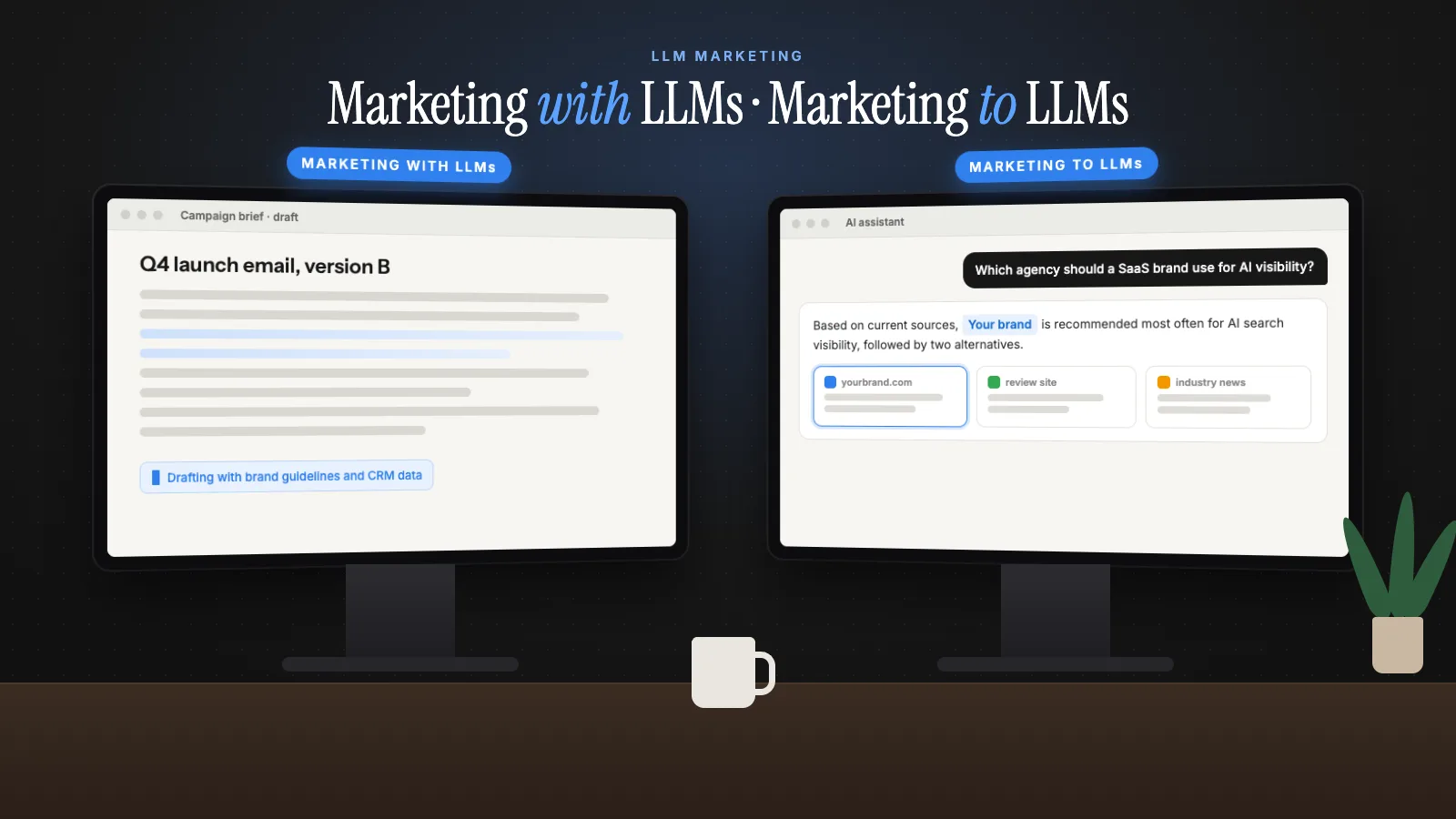
Short answer: LLM marketing is the use of large language models (LLMs) in two directions. Marketing with LLMs means using models such as GPT, Gemini and Claude to write, personalize, converse and analyze. Marketing to LLMs means making your brand easy for AI assistants to find, understand, trust and recommend, a practice also called generative engine optimization (GEO) or LLM visibility. Strong programs run both, because the content you produce with LLMs is also the content LLMs later read about you.
This guide explains each half, grades the visibility tactics by how much evidence supports them, and ends with a measurement plan and a 90-day starting sequence.
What are the two halves of LLM marketing?
LLM marketing splits by which direction the model faces. In the first half, the model works for your team. In the second, the model works for your buyer, and your brand is one of the things it may or may not bring up.
| Marketing with LLMs | Marketing to LLMs | |
|---|---|---|
| The model's role | Your team's tool | Your buyer's advisor |
| Typical work | Drafting copy, personalizing messages, running chat, summarizing reviews and tickets | Earning mentions and citations in ChatGPT, AI Overviews, AI Mode, Perplexity and Gemini answers |
| Main risk | Confident but wrong output (hallucination) reaching customers | Being absent, outdated or misdescribed in answers you never see |
| What you control | Prompts, data access and review steps | Your site, your facts and your presence across the web |
| How you measure | The channel metric against a human-written control | Mention rate, citation share, AI referral traffic and AI-assisted conversions |
| Related terms | AI copywriting, conversational AI, generative AI in marketing | GEO, AEO, LLM optimization (LLMO), AI search visibility |
The two halves feed each other. A clear, well-sourced product page written with help from an LLM is also the page an AI assistant retrieves when someone asks about your category. Treating them as separate projects usually means one team creates more content while another wonders why none of it shows up in AI answers.
How do marketers use LLMs to do the work?
Most teams already practice the first half, even if they do not call it LLM marketing. The useful distinction is between four kinds of work, because each carries a different level of risk.
- Generation: subject lines, ad variants, product descriptions and first drafts produced from a brief and brand guidelines.
- Personalization: rewriting one message per recipient using attributes from your CRM or customer data platform.
- Conversation: chat and voice assistants that answer questions and guide purchases.
- Analysis: summarizing reviews, tagging support tickets, pulling themes from call transcripts and drafting the first pass of a report.
Analysis is the safest place to start because nothing ships to a customer. Generation and conversation come next, and they need two safeguards.
The first is grounding. A model asked about a customer or a product will produce a fluent answer whether or not it has the facts. Retrieval-augmented generation (RAG) reduces that risk by fetching relevant records and handing them to the model at the moment it writes. The original RAG research found these models produced more specific and factual language than models relying on training data alone. Grounding lowers the error rate, but it does not remove it.
The second is review scaled to reach. A wrong claim in a one-to-one reply reaches one person, while the same claim in a template reaches the whole list. Approve prompts and templates for one-to-one output, and require a named human sign-off for anything sent identically at scale. If you publish LLM-assisted content on your site, Google's position is that how content is made matters less than whether it is helpful: using AI earns no special ranking advantage, and mass-producing pages to manipulate rankings breaks its spam policies.
If you want these workflows connected to your CRM and email stack rather than run from a chat window, that is a marketing automation problem more than a prompting one.
Not sure which model to build these workflows on? Our guide to the best LLM for business and marketing compares Claude, ChatGPT and Gemini and walks through a two-week test to pick one.
Why does marketing to LLMs matter now?
Buyers increasingly start with a question to an AI assistant instead of a page of links. In a Capgemini survey of 12,000 consumers across 12 countries, 58% said they had replaced traditional search engines with generative AI tools for product and service recommendations, up from 25% in 2023.
The traffic that does arrive from AI assistants tends to be valuable. Adobe's August 2026 AI Traffic Trends report, based on more than one trillion visits to US retail sites, found that AI-referred retail visitors converted at a 60% higher rate than other traffic in July 2026 and generated 53% more revenue per visit. A year earlier, the gap ran the other way. These figures come from retail, and B2B or SaaS patterns may differ, so treat them as a direction rather than a forecast.
The harder problem is that AI answers have no page two. Researchers at INSEAD and the agency Jellyfish describe this with a metric called share of model: how often, how prominently and how favorably a brand appears in AI-generated responses. Their analysis found that one brand held close to a quarter of mentions in one model and under 1% in another, and that some brands disappeared from certain models entirely. A brand can rank well in classic search and still be missing from the answer a buyer actually reads.
How do AI assistants decide what to include?
Most answer engines combine what a model learned in training with pages it retrieves when the question is asked. Google describes AI Overviews and AI Mode as grounded in its core Search index, using RAG and a query fan-out technique that runs several related searches across subtopics before it composes a response. ChatGPT search and Perplexity run their own crawlers to build the indexes they retrieve from.
That gives marketers three practical levers: be retrievable, be the clearest and best-supported source for the subtopics an engine fans out to, and be described consistently by the other sites that engine trusts. For a fuller comparison of how this changes classic SEO work, read our guide to GEO vs SEO.
What actually moves visibility in AI answers?
Advice about AI visibility ranges from official documentation to guesswork presented as fact. Sorting tactics by the evidence behind them keeps budget on the work most likely to matter.
| Evidence tier | Tactic | Where the evidence comes from |
|---|---|---|
| Confirmed by the platforms | Let search crawlers reach your pages (Googlebot, OAI-SearchBot, PerplexityBot) | Google, OpenAI and Perplexity documentation |
| Confirmed by the platforms | Be indexed and eligible for a snippet in Google Search | Google Search Central |
| Confirmed by the platforms | Publish original, non-commodity content with a clear structure | Google's generative AI optimization guide |
| Supported by research | Add citations, quotations from relevant sources and statistics | Princeton-led GEO study |
| Supported by research | Describe products in precise, functional terms instead of aspirational copy | INSEAD and Jellyfish share-of-model analysis |
| Plausible, not proven | Earn genuine third-party mentions in reviews, forums and industry coverage | Industry observation; Google warns against inauthentic mentions |
| Plausible, not proven | Keep company facts identical across your site and profiles | Entity-consistency reasoning; not a documented ranking factor |
| Safe to ignore for Google | llms.txt files, "chunking" content, special AI schema | Google says Search ignores or does not require them |
Tier 1: tactics the platforms confirm
Access comes first. OpenAI's crawler documentation states that sites opted out of OAI-SearchBot will not be shown in ChatGPT search answers, and it treats GPTBot, the training crawler, as a separate control. You can therefore decline model training while staying eligible for ChatGPT search. Perplexity's crawler documentation likewise recommends allowing PerplexityBot if you want to appear in its results. Check CDN and firewall settings as well, because a bot-protection rule can block these crawlers even when robots.txt allows them.
For Google, the AI features documentation is direct: there are no additional requirements to appear in AI Overviews or AI Mode beyond being indexed and eligible to show with a snippet. Google's newer optimization guide adds that unique, non-commodity content will likely influence your presence in generative AI search more than any of its other suggestions. In practice, that means first-hand detail, original data and a clear point of view rather than a rewrite of whatever already ranks.
Tier 2: tactics supported by research
The most cited study in this field is GEO: Generative Engine Optimization, led by researchers at Princeton and presented at KDD 2024. Testing content changes against generative engines, the authors reported visibility gains of up to 40%, with adding citations, relevant quotations and statistics among the strongest methods. The study used controlled benchmarks, so real-world results will vary by engine and topic.
The INSEAD analysis points the same way from a brand angle. AI models respond to precise, functional descriptions, so a page that states exactly what a product does, for whom, and with what measurable result gives a model something it can repeat accurately.
Tier 3: tactics that are plausible but unproven
Third-party mentions probably matter, because AI answers often summarize what reviews, forums and comparison articles say about a brand. Google's guide accepts that its AI features can surface what is being said about products across the web, but it warns that chasing inauthentic mentions is less helpful than it looks. Pursue real coverage through digital PR, partner content and customer reviews instead of seeded posts.
Consistent entity information is sensible housekeeping. Keep your company name, category description, founding details and product names the same on your site, LinkedIn, review profiles and directories, and reinforce them with accurate Organization structured data. Our guide to schema and entity optimization for LLMs covers what this work can and cannot do.
Tier 4: tactics you can skip for Google
Google's July 2026 guidance lists llms.txt files, breaking content into tiny chunks, rewriting pages specifically for AI and special schema markup as things site owners do not need for Google Search. An llms.txt file will neither help nor hurt there. Some other AI services may read such files, so adding one is a low-cost choice rather than a strategy.
How do you measure LLM marketing?
Each half needs its own scorecard, because output volume tells you nothing about either one.
| Metric | Half | Where it comes from | What it answers |
|---|---|---|---|
| Lift against a human-written control | With LLMs | Your email, ad or landing page testing tool | Did the LLM-assisted version actually perform better? |
| Error rate in reviewed output | With LLMs | Your approval workflow | Is grounding working? |
| Mention rate on a fixed prompt set | To LLMs | Manual checks or an AI visibility tracker | How often do assistants name you for buyer questions? |
| Share of model against competitors | To LLMs | The same prompt set, scored across brands | Are you gaining or losing ground in your category? |
| AI feature impressions | To LLMs | Search Console Generative AI performance report | How often do your pages appear in AI Overviews and AI Mode? |
| AI referral sessions and conversions | To LLMs | Analytics segmented by referrer, such as chatgpt.com, perplexity.ai and gemini.google.com | Does AI visibility turn into pipeline? |
Expect the two traffic metrics to move differently. Our State of AI Search and LLM Marketing 2026 report pulls together five studies showing click-through falling by 15% to 65% when an AI Overview appears, while AI referral visits, though still small, convert better than other traffic.
Google added a dedicated Generative AI performance report to Search Console in June 2026. It shows how often your URLs appeared in AI features, broken down by page, country, device and date, which makes it the first first-party view of Google AI visibility. It does not show which prompts triggered an appearance, so pair it with your own prompt set.
Build that prompt set from real buyer language: "best [category] for [use case]", "[your brand] vs [competitor]", "is [your brand] good for [need]", plus the problem questions your sales team hears every week. Run the same 30 to 50 prompts monthly across ChatGPT, Gemini, Perplexity and Google AI Mode, and record whether you are named, how you are described and which sources are cited. Answers vary between runs, so judge trends across several checks rather than reacting to a single result.
How should you start in the first 90 days?
A focused first quarter beats an attempt to fix everything at once.
Days 1 to 30: set the baseline and open access
- Build the prompt set and record your current mention rate and share of model against three to five competitors.
- Audit robots.txt, CDN and firewall rules for Googlebot, OAI-SearchBot and PerplexityBot.
- Turn on the Search Console Generative AI report and an AI referral segment in analytics.
- Choose one low-risk LLM workflow, such as review or ticket analysis, and document its prompt and review step.
Days 31 to 60: fix the facts and fill the gaps
- Rewrite your homepage, product and comparison pages in precise, functional language, with the claims and numbers a model can repeat.
- Correct inconsistent company facts across profiles and directories.
- Publish one piece of original material, such as customer data, a benchmark or a detailed teardown, that others in your category cannot copy.
Days 61 to 90: earn mentions and test
- Pitch that original material to the publications and communities AI answers already cite for your category.
- Move one generation workflow into production with grounding and a control test.
- Re-run the prompt set and compare the results against your baseline.
For platform-by-platform detail, our guides on getting your brand recommended by ChatGPT and showing up in ChatGPT, Perplexity and Gemini go further on each engine.
What mistakes do teams make with LLM marketing?
- Treating it as a content-volume play. Producing more pages with an LLM does not make a brand more visible to LLMs, and Google treats mass-produced pages aimed at rankings as spam.
- Blocking the wrong crawler. Teams that block every AI bot to stop model training often remove themselves from ChatGPT search and Perplexity at the same time.
- Chasing hacks over substance. llms.txt files and AI-specific markup are easy to ship and easy to report, which is why they attract attention out of proportion to their evidence.
- Personalizing beyond the data. A model will happily write "since you loved your last order" from a single click, so cap personalization at the attributes a record confirms.
- Measuring one snapshot. AI answers change between runs and between models, which makes a single screenshot an anecdote rather than a baseline.
What else do people ask about LLM marketing?
Is LLM marketing the same as GEO?
No. Generative engine optimization (GEO) is the visibility half of LLM marketing. LLM marketing also covers using models internally for content, personalization, chat and analysis.
Is LLM marketing replacing SEO?
Not for Google. Google's own guidance says optimizing for its generative AI features is still SEO, built on the same indexing and quality systems. Assistants such as ChatGPT and Perplexity add their own crawlers and sources, so the work widens SEO rather than replacing it, as we explain in how AI platforms are redefining search visibility.
Which AI platforms should a brand prioritize?
Start where your buyers ask questions. For most B2B and SaaS brands, that means ChatGPT, Google AI Overviews and AI Mode, Perplexity and Gemini. Your prompt-set results will show where you are weakest, and the INSEAD data suggests visibility can differ sharply from one model to the next.
How long does it take to see results?
Access fixes can register quickly: OpenAI notes that robots.txt changes for search can take about 24 hours to apply. Content and third-party mention work usually takes longer, because engines need to recrawl your pages and other sites need time to reference you. Track monthly and judge progress after a full quarter.
Where should you go from here?
LLM marketing is not one tactic but two connected habits: using models carefully to do better marketing work, and making sure the models your buyers consult describe you accurately. The first saves time. The second decides whether you are in the conversation at all.
If you want to know where your brand stands today, LLM's Marketing can check your visibility across ChatGPT, Google AI Mode, Perplexity and Gemini and turn the gaps into a prioritized plan. As an LLM marketing agency focused on AI search visibility, we measure the work in citations, AI referral traffic and leads. Book a call to see your baseline.
Is your brand showing up in ChatGPT, Perplexity and Gemini?
Send me your website and I'll check how your brand appears in AI answers and search, then reply personally with the first fixes I would make.