
Will Google officially confirm that structured data is used to select or display sources in AI Overviews or AI Mode by December 31, 2027?
Why the forecast moved Numbered as on the chart · forecast last updated 22 October 2026
| # | Date | Event and reasoning | Change | Source |
|---|---|---|---|---|
| 1 | 20 Mar 2025 | Microsoft's Fabrice Canel says schema markup helps Microsoft's LLMs understand contentA major rival confirming schema use in its AI answers adds pressure on Google to clarify its own position, though Microsoft cannot resolve a question about Google. | +0.5 pts20.0% → 20.5% | Source |
| 2 | 20 Mar 2025 | Google engineer at Search Central Live NYC: structured data is cheaper and more precise to readGoogle engineers openly link structured data to how their systems process pages, but this is a secondhand, generic 'helps us understand' remark that would not resolve the question. | +0.5 pts20.5% → 21.0% | Source |
| 3 | 9 Apr 2025 | Google at Search Central Live Madrid: no AI-specific optimization needed, keep using structured dataGoogle kept its structured data advice generic and declined to describe any AI-specific role, the opposite of the explicit confirmation this question needs. | -1.0 pts21.0% → 20.0% | Source |
| 4 | 21 May 2025 | Google documentation: 'no special schema.org structured data' needed for AI Overviews or AI ModeOfficial documentation now plays down any special role for schema in AI features, so an explicit 'structured data selects sources' statement would contradict Google's own docs. | -4.0 pts20.0% → 16.0% | Source |
| 5 | 12 Jun 2025 | Google phases out seven structured data types, citing low usageGoogle is shrinking structured data's visible role in search results, which suggests it is not preparing to give markup a bigger, documented role in AI source selection. | -1.0 pts16.0% → 15.0% | Source |
| 6 | 23 Jul 2025 | Gary Illyes: to appear in AI Overviews, 'simply use normal SEO practices'Google's messaging denies that AI surfaces have special inputs, which makes singling out structured data as a source-selection signal less likely. | -0.8 pts15.0% → 14.2% | Source |
| 7 | 2 Jan 2026 | John Mueller on schema for LLMs: 'yes, no, and it depends' (personal view)A senior Google voice said some features thrive on structured data, edging toward the needed statement, but explicitly called it unofficial and did not name AI Overviews or AI Mode. | +0.8 pts14.2% → 15.0% | Source |
| 8 | 21 Apr 2026 | Google's Ryan Levering reportedly says schema is used as context for models during fan-outThe closest Google has come to saying structured data feeds its AI answer pipeline, but it exists only in attendee notes and says 'context', not selecting or ranking sources. | +2.0 pts15.0% → 17.0% | Source |
| 9 | 15 May 2026 | Google's generative AI search guide lists 'overfocusing on structured data' as a mythGoogle's newest and most explicit official position frames schema's value as rich-result eligibility only, strong evidence against an explicit confirmation before 2028. | -2.0 pts17.0% → 15.0% | Source |
Expert commentary Quotes attached to the tracked events · each checked against its source
| Who | What they said | # | Source | |
|---|---|---|---|---|
| David MihmReporting Fabrice Canel's SMX Munich talk, as cited by Search Engine LandIndependent | “Fabrice Canel confirms that schema markup helps Microsoft's LLMs understand your content in his excellent SMX – Search Marketing Expo in Munich presentation.” | 1 | searchengineland.com | |
| Aleyda SolisSEO consultant, live from Google Search Central Live MadridIndependent | “Google still recommends to use structured data in an AI search world – focusing on those things that are actually visible in SERPs” | 3 | searchenginejournal.com | |
| Gary IllyesGoogle Search team, GoogleOfficial | “To get your content to appear in AI Overview, simply use normal SEO practices. You don't need GEO, LLMO or anything else.” | 6 | seroundtable.com | |
| John MuellerSearch Advocate, Google (personal view, not official guidance)Official | “Some features thrive with structured data (to which I also count structured feeds). Pricing, shipping, availability for shopping is basically impossible to read in high fidelity & accurately from a text page, for example.” | 7 | seroundtable.com | |
| Sara TaherSEO, SEO Riddler newsletter; her notes on Google engineer Ryan Levering's talkIndependent | “Schema is used as context served to models when doing fanouts.” | 8 | seoriddler.com |
Probability estimate by LLM's Marketing for llmsmarketing.com, not a statement by Google. Resolves YES only if Google documentation, an official Google blog post, or a named Google Search representative on the record says structured data is used to select, rank or display sources in AI Overviews or AI Mode. Starts from a 20% base rate on March 1, 2025 and moves at each dated, sourced event; values before October 22, 2026 are reconstructed from those events, not predictions made at the time. Last updated 22 October 2026.
Adding schema markup to a website has become a common recommendation in AI SEO. Businesses are also investing in entity optimization, brand mentions, and structured information to improve their visibility in ChatGPT, Perplexity, Gemini, and Google's AI-powered search experiences.
But there is a question worth asking: What actually makes a difference, and what is simply another SEO tactic being marketed as an AI ranking factor?
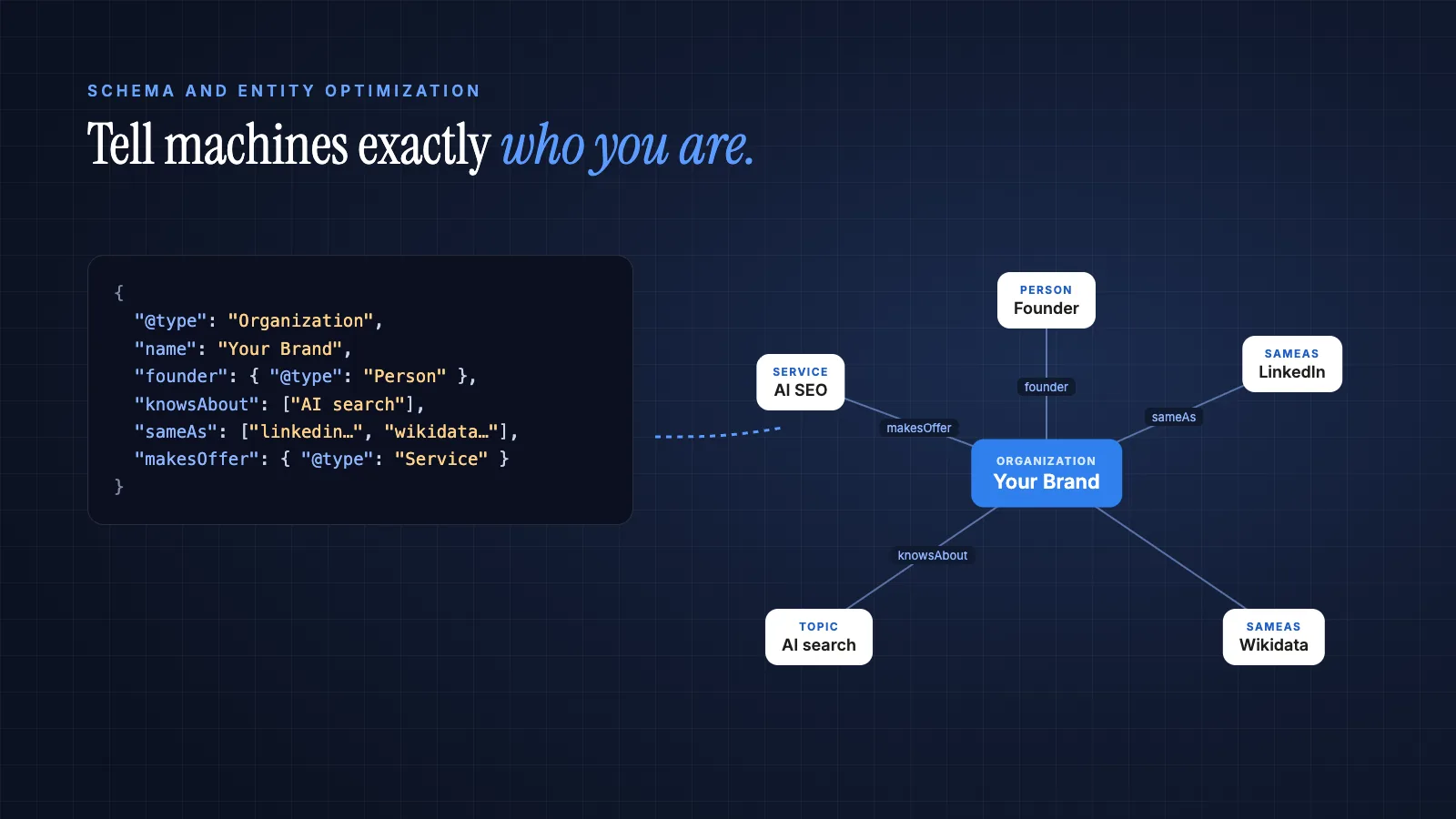
Schema markup helps describe information on a website in a machine-readable format. Entity optimization focuses on making a brand, product, person, or organization easier to identify and distinguish from other entities.
Both have a place in a modern SEO strategy. However, neither guarantees that an AI platform will recommend your brand.
Google's guidance on AI features and your website emphasizes established SEO fundamentals, including crawlability, helpful content, internal linking, and accurate structured data. It also states that no special schema markup is required to appear in AI Overviews or AI Mode.
For businesses investing in Generative Engine Optimization (GEO), this distinction matters.
The goal is not to add as much schema as possible. It is to make your brand's identity, expertise, products, and relationships clear, consistent, and verifiable across the web.
Let's examine what actually moves the needle.
1. Understand the Difference Between Schema and Entity Optimization
Schema markup and entity optimization are closely related, but they solve different problems.
What is schema markup?
Schema markup is structured data added to a webpage to describe its content using a standardized vocabulary, such as Schema.org.
For example, Organization schema can describe a business's name, website, logo, and other relevant details. Product schema can describe a product, while Article schema can identify the publisher, headline, and author of an article.
This additional information helps supported systems interpret the page more precisely.
Schema can also make a website eligible for certain search enhancements when the markup meets the relevant requirements. However, eligibility does not guarantee that a search enhancement will appear.
What is entity optimization?
An entity is a distinct thing, such as a company, person, product, location, or concept.
Entity optimization involves establishing clear information about that entity and its relationships with other entities.
For example, a company might be associated with:
- A specific industry or business category.
- Particular products and services.
- Recognized founders or experts.
- A defined target audience.
- Relevant industry publications and professional profiles.
- Original research and documented expertise.
The objective is to reduce ambiguity about what the company is, what it does, and why it is relevant to a particular topic.
Schema can communicate some of these relationships, but entity understanding is not created by markup alone. It also depends on the available content, supporting sources, and the systems processing that information.
In simple terms, schema describes information explicitly, while entity optimization strengthens the clarity and consistency of that information across a brand's digital presence.
2. Organization Schema: Start With a Clear Brand Identity
For most businesses, Organization schema is one of the first structured data implementations worth reviewing.
A company should have a clear, consistent identity across its website and relevant external profiles.
At a minimum, review whether your homepage or main company page communicates the correct business name, official website, logo, and other applicable organizational details.
Google's official Organization structured data documentation explains how this markup can help Google understand and disambiguate an organization.
Depending on the business, useful properties may include:
- name: The official organization name.
- url: The canonical URL of the organization's website.
- logo: The organization's representative logo.
- sameAs: URLs of relevant external profiles that identify the same organization.
- description: A concise and accurate description, where appropriate.
- contactPoint: Relevant customer or business contact information, where applicable.
Only include properties that are accurate and supported by the organization's real information.
For example, do not use a personal LinkedIn profile as an organizational profile or add social accounts that do not belong to the company.
What actually moves the needle?
The value comes from accurately describing your business and making that information consistent with the rest of your online presence.
Organization schema is useful infrastructure, not a shortcut to AI recommendations.
3. Use sameAs to Connect Genuine Brand Profiles
One of the most useful Organization schema properties is sameAs.
It identifies external pages that represent the same entity. These may include official company profiles on professional networks, social platforms, or relevant reference websites.
Suppose a business uses slightly different names across its website, LinkedIn profile, and industry directory. It may become harder for people and automated systems to determine whether all these profiles refer to the same organization.
Connecting genuine profiles through sameAs can help clarify that relationship.
However, the URLs must genuinely represent the same entity. A page mentioning your company is not automatically an identity profile.
For example, an independent article about your business may be a useful third-party reference, but it should not automatically be added to sameAs.
The same principle applies to founders, authors, and products. Keep each entity's identity separate and connect them only where the relationship is accurate.
For businesses with multiple brands, subsidiaries, or similarly named products, this step deserves particular attention.
Avoid adding dozens of low-quality directory profiles simply to increase the number of entity references. A small set of accurate, relevant profiles is a better starting point than a large collection of inconsistent listings.
4. Build a Clear Entity Relationship Structure
A brand rarely exists in isolation. It is connected to products, services, people, industries, and topics.
These relationships should be understandable from both your website content and your structured data.
Consider a B2B SaaS company that offers customer relationship management software.
Its digital presence might establish relationships between:
- The organization and its official website.
- The organization and its software product.
- The product and its intended customers.
- The product and its supported integrations.
- The company's experts and their relevant published work.
- The organization and its documented industry expertise.
These relationships should be reflected in meaningful content, clear navigation, appropriate internal links, and accurate structured data.
For example, a product page should explain what the product does, who it serves, and how it differs from alternatives. The company page should identify the organization behind the product.
Schema can represent relevant relationships using properties such as publisher, author, brand, or parentOrganization, depending on the entity types involved.
You can also use @id identifiers to reference the same entity consistently across related JSON-LD objects.
The key is to implement these relationships accurately rather than creating an elaborate graph of connections that have no real meaning.
For more background on how entities fit into AI-focused marketing, read our guide to what LLM marketing is and how it works.
5. Make Your Brand Information Consistent Across the Web
Schema markup cannot compensate for contradictory information about your business.
If your website describes your company as an AI SEO agency, your professional profiles list it as a general web development company, and third-party listings use outdated descriptions, your brand positioning becomes less clear.
Start by reviewing your most important brand information:
- Official company name and website.
- Primary services and products.
- Industry and target audience.
- Founder and team information.
- Company location, where relevant.
- Product capabilities and limitations.
- Contact information and official profiles.
Then identify the external sources that matter most to your audience.
These may include industry publications, professional profiles, reputable business directories, review platforms, and partner websites.
Correct inaccurate information where possible. Update outdated descriptions and ensure that your own website explains your positioning clearly.
Third-party references should be genuine and independently useful. Do not manufacture reviews or publish artificial mentions simply to create the appearance of authority.
This is where entity optimization overlaps with digital PR, reputation management, and conventional off-page SEO.
A consistent brand identity makes it easier for customers to verify your business and can provide useful context for systems that retrieve information from multiple sources.
6. Create Content That Supports Your Entity's Expertise
A company can have technically valid schema and still struggle to establish credibility if its website contains little useful information about its subject.
For example, a company claiming expertise in AI SEO should have substantive resources explaining relevant technical concepts, content strategies, measurement methods, and practical use cases.
Its content should demonstrate knowledge rather than repeatedly state that the company is an expert.
Useful supporting assets include:
- Detailed service pages: Explain what each service involves, who it is for, and which problems it solves.
- Expert-led articles: Publish content that reflects genuine experience and offers useful explanations, examples, or original insights.
- Case studies: Document the initial challenge, work completed, and measurable outcomes, with appropriate context.
- Original research: Publish proprietary data or industry analysis that provides value beyond information already available elsewhere.
- Author information: Identify authors accurately and explain their relevant professional experience where appropriate.
These assets help customers understand your expertise and give other websites meaningful material to reference.
They also support traditional SEO, which remains foundational to Google's AI-powered search features.
As Google explains in its guide to optimizing for generative AI features, useful, original content and sound technical foundations remain important. There is no need to rely on speculative markup tricks instead of established SEO practices.
7. Choose Schema Types Based on the Actual Page
A common mistake is adding multiple schema types to every page because they sound relevant to AI search.
The better approach is to select structured data that accurately represents the page and supports an appropriate search feature or clear description of its content.
Here are some common examples:
| Page type | Schema type to consider | What it describes |
|---|---|---|
| Homepage or About page | Organization | The business name, website, logo, and official profiles |
| Blog post or guide | Article or BlogPosting | The headline, author, publisher, and publication dates |
| Author or team bio | Person | An individual's name, role, and relevant expertise |
| Product page | Product | A product's name, brand, description, and offers |
| Software or app page | SoftwareApplication | An application's category, operating system, and pricing |
| Pages within a site hierarchy | BreadcrumbList | The page's position within the site structure |
These are starting points, not mandatory implementations for every site.
For example, a service page does not automatically qualify for a Google rich result simply because it contains Service schema. Likewise, adding FAQPage markup does not guarantee that FAQs will appear as expanded search results.
Use the Schema.org vocabulary to check available types and properties, and consult Google's documentation for the specific rich result you want to support.
Your markup should match the visible content and comply with the relevant guidelines.
8. Validate Structured Data and Check for Technical Problems
Publishing JSON-LD is only the first step. You also need to make sure the markup is valid, consistent, and implemented on the intended pages.
A practical validation process includes the following checks.
Check syntax and eligibility
Use Google's Rich Results Test to check supported structured data and eligibility for applicable Google search enhancements.
Use the Schema Markup Validator to check markup against Schema.org vocabulary.
These tools serve different purposes. Valid Schema.org markup does not necessarily qualify for a Google rich result.
Check the rendered page
Make sure important content is accessible to search engines and is not unintentionally hidden behind scripts, blocked resources, or rendering issues.
Review the page's canonical URL and ensure the structured data describes the correct entity and page.
Check for conflicting markup
SEO plugins, themes, and custom scripts can generate overlapping Organization, Article, or other schema objects.
Review the rendered HTML rather than assuming that the settings in your CMS represent the final output.
Where the same entity appears in multiple schema objects, use consistent identifiers and accurate relationships where appropriate.
Monitor search performance
Use Google Search Console to monitor indexing, search visibility, and applicable structured data enhancement reports.
Remember that valid markup does not guarantee indexing, rankings, citations, or recommendations in AI-generated answers.
9. Does Schema Markup Directly Improve LLM Recommendations?
This is where it is important to separate established guidance from assumptions.
Structured data can help supported search engines interpret page content and may enable eligibility for specific search features. Clear entity information can also reduce ambiguity about your organization and its offerings.
However, there is no publicly established rule that adding Organization schema, sameAs, or a particular collection of schema properties will directly increase a brand's recommendation frequency in ChatGPT, Gemini, or Perplexity.
Different AI systems may use different combinations of model knowledge, search indexes, retrieved pages, and other sources.
For Google AI Overviews and AI Mode, Google explicitly states that there are no additional technical requirements or special schema types needed beyond its established search eligibility and optimization guidance.
For ChatGPT search, consult OpenAI's official crawler documentation. OpenAI identifies OAI-SearchBot as the crawler used to help surface websites in ChatGPT search results. Its search and model-training crawler settings are independent.
This means your technical audit should cover both structured data and basic discoverability.
Ask these questions:
- Can search engines access the important pages?
- Are canonical URLs and internal links configured correctly?
- Is the brand's identity clear and consistent?
- Does the content substantiate the company's expertise?
- Are the relevant crawler settings configured appropriately?
- Are independent sources providing useful context about the brand?
These checks are more actionable than assuming a particular schema property guarantees AI visibility.
10. How to Measure the Impact of Entity Optimization
Entity optimization should be treated as an ongoing process, not a one-time markup implementation.
Start by recording your current baseline. This will help you distinguish technical improvements from changes in AI visibility or general search performance.
Track the following areas.
- Technical implementation: Measure the number of important pages with valid, appropriate structured data and document any duplicate or conflicting markup.
- Brand consistency: Record inconsistencies in company names, descriptions, product information, and official profiles.
- Traditional search performance: Monitor organic impressions, clicks, relevant queries, indexing, and applicable rich result performance.
- AI visibility: Test a consistent set of relevant prompts across selected platforms and record brand mentions, citations, and competitor appearances.
- Business outcomes: Track referral sessions, leads, conversions, and qualified opportunities where attribution is available.
For example, an AI SEO agency could regularly test prompts such as "Which agencies specialize in Generative Engine Optimization?" and "How can a SaaS company improve ChatGPT visibility?"
The agency could then record whether its brand appears, whether its website is cited, which competitors are mentioned, and which sources appear to support the answers.
Repeat the tests under comparable conditions because AI responses can vary.
If visibility changes after a schema update, do not automatically conclude that schema caused the improvement. Other changes in content, external coverage, search indexes, or the AI platform itself may also explain the result.
Where possible, evaluate changes over time and document the other work performed during the same period.
A Practical Schema and Entity Optimization Checklist
Before investing in more advanced GEO tactics, make sure your foundations are in place.
- Organization information is accurate and consistent.
- Official brand profiles are linked where appropriate.
- Organization schema is implemented on a suitable page.
- Product, Article, Person, and other schema types reflect the actual content.
- Related schema objects use consistent entity identifiers where appropriate.
- Structured data matches visible page information.
- Important pages are crawlable, indexable, and internally linked.
- Relevant external references support the brand's positioning.
- Content demonstrates real expertise and provides useful evidence.
- Search performance and AI visibility are measured separately.
- Results are reviewed over time rather than attributed to a single change.
Prioritize the issues that create the most ambiguity or prevent important content from being discovered. There is little value in expanding schema implementation while core pages remain inaccessible or brand information remains inconsistent.
Conclusion: Clear Entities Matter More Than More Schema
Schema and entity optimization can support a stronger technical SEO and GEO strategy, but neither should be treated as a shortcut to AI recommendations.
Schema helps describe your website's content in a standardized format. Entity optimization goes further by making your brand's identity, expertise, products, and relationships consistent and verifiable.
The most useful improvements often begin with the fundamentals: accurate Organization information, appropriate structured data, accessible pages, clear service descriptions, original content, and credible third-party references.
From there, measure what changes. Monitor traditional search performance alongside brand mentions, citations, and business outcomes across AI-powered search experiences.
At LLM's Marketing, we approach AI search visibility as part of a broader strategy that combines technical SEO, content clarity, brand authority, and measurement.
The objective is not to add more markup simply because AI search is growing. It is to give search systems and potential customers a clearer, more reliable understanding of your business.
Frequently Asked Questions
What is entity optimization in SEO?
Entity optimization is the process of making a brand, person, product, or organization easier to identify and understand through consistent information, relevant content, structured data, and credible external references.
Does schema markup help LLMs understand a website?
Structured data provides explicit information about a page and its entities. This can help supported systems interpret that information, but its effect varies by platform. Schema markup alone does not guarantee that an LLM will understand, cite, or recommend a website.
Which schema types are most useful for AI SEO?
Organization, Product, SoftwareApplication, Article, Person, and BreadcrumbList may be useful depending on the website and page purpose. Choose schema based on the actual content and applicable documentation rather than adding every available type.
Does sameAs improve AI visibility?
The sameAs property identifies external pages that represent the same entity. It can help clarify identity, but there is no established guarantee that adding sameAs URLs will directly improve AI recommendations.
Should every page have Organization schema?
Not necessarily. Google recommends placing Organization information on the homepage or a single page describing the organization. Other pages can reference the same organization where appropriate, without duplicating unnecessary markup everywhere.
Is schema markup a direct ranking factor for ChatGPT?
There is no publicly established evidence that a particular schema property directly increases ChatGPT recommendation frequency. Structured data remains useful for appropriate SEO purposes, but ChatGPT visibility also depends on discovery, relevance, available information, and other factors.
How often should schema markup be audited?
Review structured data after major website changes, CMS or SEO plugin updates, product changes, and template modifications. Periodic audits can also help identify outdated information, duplicate markup, and validation errors.
What matters more for GEO: schema or brand authority?
Neither should be considered a universal winner. Schema can clarify information, while genuine expertise, useful content, technical accessibility, and credible external references help establish a stronger overall digital presence. Prioritize the weaknesses that matter most for your specific website and goals.
Is your brand showing up in ChatGPT, Perplexity and Gemini?
Send me your website and I'll check how your brand appears in AI answers and search, then reply personally with the first fixes I would make.