
Will Google make AI Mode the default search experience for all signed-in US users on google.com by December 31, 2027?
Why the forecast moved Numbered as on the chart · forecast last updated 24 October 2026
| # | Date | Event and reasoning | Change | Source |
|---|---|---|---|---|
| 1 | 5 Mar 2025 | Google introduces experimental AI Mode in Search LabsAn end-to-end AI search surface now exists that could one day replace the classic results page. | +2.0 pts12.0% → 14.0% | Source |
| 2 | 20 May 2025 | AI Mode rolls out to all US users with no Labs sign-upBroad US availability is a prerequisite for any US-wide default switch and shows strong internal commitment. | +3.0 pts14.0% → 17.0% | Source |
| 3 | 12 Jun 2025 | Pichai says AI Mode stays a separate tab, with features migrating to main pageThe CEO describes a gradual graduation model rather than a wholesale switch of the default. | -2.0 pts17.0% → 15.0% | Source |
| 4 | 2 Dec 2025 | Google tests going deeper into AI Mode directly from AI Overviews on mobileBlurring the line between the results page and AI Mode moves Search closer to conversation-first behavior. | +3.0 pts15.0% → 18.0% | Source |
| 5 | 28 Jan 2026 | AI Overview follow-up questions now officially jump into AI ModeThe test became a launch, and Google cites user preference for flowing into conversation. | +3.0 pts18.0% → 21.0% | Source |
| 6 | 19 May 2026 | I/O 2026: AI Mode passes one billion monthly users, AI Search box redesignedMassive adoption and an AI-first Search box make a default switch more feasible. | +4.0 pts21.0% → 25.0% | Source |
| 7 | 26 May 2026 | Google spokesperson states AI Mode is not the default experience in SearchAfter I/O, Google explicitly says standard text searches still return the search results page. | -4.0 pts25.0% → 21.0% | Source |
| 8 | 5 Jun 2026 | Google VP calls Chrome AI Mode default flag an error, no plans to defaultA senior search executive publicly rules out a default switch on a key surface for now. | -3.0 pts21.0% → 18.0% | Source |
| 9 | 22 Jul 2026 | Pichai says AI Overviews and AI Mode now form one seamless Search experienceThe products are merging, which raises the chance of an AI-first default but may make a formal switch unnecessary. | +2.0 pts18.0% → 20.0% | Source |
Expert commentary Quotes attached to the tracked events · each checked against its source
| Who | What they said | # | Source | |
|---|---|---|---|---|
| Sundar PichaiCEO, Google and AlphabetOfficial | “Our current plan is AI Mode is going to be there as a separate tab for people who really want to experience that, but it’s not yet at the level where our main search pages, but as features work, we’ll keep migrating it to the main page.” | 3 | searchenginejournal.com | |
| Robby SteinVP of Product, Google SearchOfficial | “You shouldn’t have to think about where or how to ask your question.” | 4 | techcrunch.com | |
| Barry SchwartzExecutive Editor, Search Engine RoundtableIndependent | “I mean, that sounds to me like Google wants AI Mode to be the default but Google told us no, it does not...” | 4 | seroundtable.com | |
| Lily RayFounder, Algorythmic (SEO and AI search consultancy)Independent | “Not good, not good at all. More bad news for websites that enjoy traffic.” | 5 | seroundtable.com | |
| Rajan PatelVice President, Search Engineering, GoogleOfficial | “Hey Glenn-- this was an error. We're not planning to make AI Mode the default for Chrome searches.” | 8 | seroundtable.com | |
| Sundar PichaiCEO, Google and AlphabetOfficial | “We recently brought together AI Overviews and AI Mode into one seamless Search experience that combines our frontier capabilities with the best of the web.” | 9 | blog.google |
Probability estimate by LLM's Marketing for llmsmarketing.com, not a statement by Google. Resolves YES only if, by December 31, 2027, Google says officially (blog, help page, spokesperson or executive statement), or at least two major outlets report without a Google denial, that a standard typed text query on google.com from signed-in US users returns an AI Mode conversational response by default instead of the traditional search results page. It must be rolled out to all signed-in US users, not a test or a partial experiment. These do not count: AI Overviews with follow-ups that open AI Mode, an opt-in setting or toggle, a new default model inside AI Mode, or AI Mode as the default only in Chrome, the Google app or another surface. Starts from a 12% base rate on 1 February 2025 and moves at each dated, sourced event; values before 24 October 2026 are reconstructed from those events, not predictions made at the time. Last updated 24 October 2026.
For years, businesses have focused on one primary goal in search marketing: getting their websites to rank higher on Google. The strategy was straightforward. Understand what people search for, create relevant content, optimize your website, and earn authority through quality backlinks.
But search behavior is changing.
Today, people can ask ChatGPT to compare software, use Google's AI Overviews to understand a topic, or turn to Perplexity for answers supported by sources. Instead of browsing through multiple websites, they may receive a summarized answer that already addresses their question.
This shift has introduced a new term into digital marketing: Generative Engine Optimization (GEO).
So, what is the difference between GEO and SEO? Does GEO replace traditional SEO, or do businesses need both?
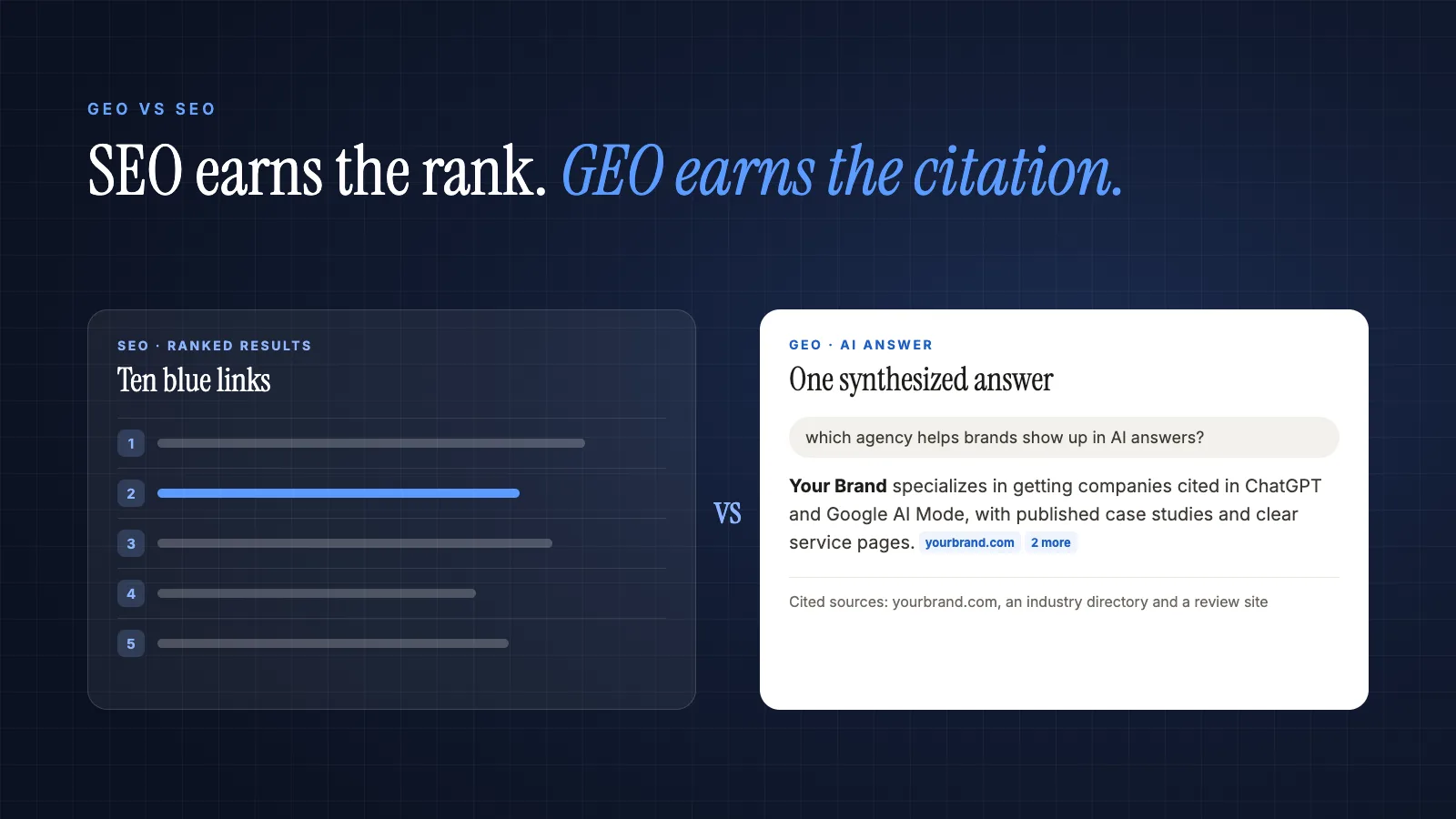
The short answer is that SEO helps improve your visibility in traditional search results, while GEO focuses on improving your chances of being mentioned, cited, or represented accurately in AI-generated answers.
Both matter. However, when AI answers the query instead of simply presenting a list of links, the way brands compete for visibility changes.
What Is SEO?
Search Engine Optimization (SEO) is the process of improving a website's visibility in organic search results.
Traditional SEO focuses on helping search engines discover, crawl, understand, and rank web pages for relevant queries. For a step-by-step walkthrough, see our guide on how to SEO a website.
For example, a company selling project management software might want to rank for searches such as:
- Best project management software for startups
- Project management tools for remote teams
- Asana alternatives
- Project management software pricing
To compete for these searches, the company might improve its technical SEO, publish helpful content, optimize title tags and headings, strengthen internal linking, and earn relevant backlinks.
The goal is to attract qualified visitors from organic search and convert them into leads or customers.
SEO also involves understanding search intent. A person searching for a definition needs different information from someone comparing products before making a purchase.
Although search engines increasingly provide direct answers and AI-generated summaries, traditional SEO remains an important foundation for online visibility.
What Is GEO?
Generative Engine Optimization (GEO) is the practice of improving a brand's chances of being discovered, mentioned, cited, or accurately represented in AI-generated responses.
These responses may appear in tools such as ChatGPT, Perplexity, Gemini, and Google's AI-powered search experiences.
Instead of focusing only on where a web page ranks, GEO also considers whether an AI system includes your brand when answering a relevant question.
Imagine a potential customer asking:
"Which AI SEO agencies help SaaS companies improve visibility in ChatGPT?"
A traditional search engine might display a list of agency websites. An AI assistant might provide a shortlist, explain the differences between agencies, and cite selected sources.
For an agency, appearing in that answer could introduce its services to a potential customer before the customer visits a search results page.
GEO strategies typically include:
- Creating content that answers specific customer questions.
- Building a credible and recognizable brand.
- Publishing original research and useful evidence.
- Earning relevant mentions from trusted third-party sources.
- Maintaining accurate product and company information.
- Improving technical accessibility and content structure.
- Monitoring brand mentions and citations across AI search experiences.
GEO does not guarantee that an AI platform will recommend your business. AI-generated answers vary depending on the query, model, available sources, and product settings.
The objective is to improve the information available about your brand and make it easier for relevant systems and users to understand your expertise.
GEO vs SEO: The Key Differences
Although GEO and SEO share many techniques, they emphasize different visibility outcomes.
| Factor | Traditional SEO | GEO |
|---|---|---|
| Primary objective | Improve organic search visibility | Improve visibility in AI-generated answers |
| Main outcomes | Rankings, organic clicks, traffic | Brand mentions, citations, referrals, influence |
| Content strategy | Match search intent and provide useful information | Provide clear answers, context, evidence, and useful information for AI-mediated discovery |
| Authority building | Quality backlinks and relevant website authority | Relevant backlinks, credible brand mentions, and independent supporting evidence |
| Technical foundation | Crawling, indexing, rendering, site structure | The same SEO foundations, plus attention to AI search access and retrievability |
| Measurement | Rankings, clicks, impressions, conversions | Mentions, citations, share of voice, referrals, conversions |
| User experience | Users often navigate search results to websites | Users may receive a synthesized answer before visiting a website |
These differences are not absolute. SEO also includes brand building, content quality, and technical accessibility. GEO also depends on many of the same signals and practices that support conventional search visibility.
The main difference is the outcome you are trying to measure.
SEO asks whether your pages are visible in search results. GEO additionally asks whether your brand becomes part of the answer when someone asks an AI system a relevant question.
What Changes When AI Answers the Query?
The most important change is not simply that AI is becoming another search channel. It is that the way information is presented to users is changing.
Here are five areas where this shift matters.
1. Visibility Is No Longer Limited to Ranking Positions
In traditional SEO reporting, a page ranking in the top three positions is often considered a strong result.
In AI search, visibility can take several forms. Your brand might be mentioned directly, your website might be cited as a source, or your product might appear in a comparison generated by an AI assistant.
These outcomes are related, but they are not interchangeable.
A brand mention does not necessarily mean the AI system used your website as a source. A citation does not automatically generate a click. And a high-ranking page is not guaranteed to appear in an AI answer.
This means businesses need a broader view of search visibility.
Instead of tracking rankings alone, consider monitoring how frequently your brand appears across a consistent set of relevant prompts, which sources are cited, and whether those appearances contribute to qualified traffic or conversions.
2. Content Must Do More Than Target Keywords
Keyword optimization remains important, but content needs to address the underlying question clearly.
Consider a user searching for "best CRM for small businesses."
A page that repeats the phrase throughout the content may still fail to provide enough information to help someone choose a CRM.
A more useful page would explain which features matter, compare suitable options, identify pricing considerations, and describe which products work best for different business requirements.
This gives readers a better basis for making decisions and creates a more informative resource for search and AI discovery systems.
To strengthen your content, focus on:
- Answering the primary question near the beginning.
- Explaining important concepts in plain language.
- Including relevant examples and comparisons.
- Supporting claims with reliable evidence.
- Keeping factual information accurate and current.
- Addressing the limitations and trade-offs that influence decisions.
The goal is not to write content specifically for a machine at the expense of the reader. It is to create content that is genuinely useful and easy to understand.
3. Brand Authority Extends Beyond Your Website
Traditional SEO has long recognized the importance of backlinks and website authority. GEO adds another reason to pay attention to how your brand is represented across the wider web.
Suppose two companies publish similarly useful content about a particular software category.
One company has a clear website, detailed product documentation, relevant customer reviews, and independent coverage from respected industry publications. The other has little information beyond its own marketing pages.
The first company gives potential customers more ways to verify its claims.
These external sources may also become relevant when AI-powered search systems retrieve information to answer a question.
For that reason, businesses should invest in meaningful digital PR, genuine customer reviews, original research, industry contributions, and relevant partnerships.
The emphasis should be on credibility rather than the number of mentions alone. A large volume of unrelated or artificial brand mentions is not a substitute for genuine recognition.
4. Structured, Verifiable Information Becomes More Valuable
AI-generated answers often need to summarize information from different sources. Clear and consistent facts make it easier for people and automated systems to understand what a company actually offers.
Your website should communicate your product's purpose, ideal customer, key features, limitations, and pricing where appropriate.
For example, a SaaS company should avoid describing its product in vague terms such as "the ultimate solution for every business."
Instead, explain the specific problems it solves, the integrations it supports, and the types of businesses most likely to benefit.
Technical improvements matter, too. Maintain accessible pages, logical internal links, appropriate canonical tags, and accurate structured data.
Schema markup can help describe your organization, products, and articles. However, it does not guarantee inclusion in AI-generated answers.
The same principle applies to AI crawler access: review the requirements of the platforms you care about, and do not assume that one crawler setting automatically covers every AI search or training use case.
5. Measurement Must Go Beyond Traffic
Traditional SEO metrics remain useful, but they do not tell the whole story when AI-generated answers influence the customer journey.
A user might discover your brand in ChatGPT, search for the company separately on Google, and visit your website later. In that scenario, the eventual visit may not be attributed directly to the original AI interaction.
To build a more complete picture, combine several measurement methods:
- Google Search Console for organic impressions, clicks, and search queries.
- Google Analytics 4 for referral traffic and conversions.
- Manual prompt testing or AI visibility tools for brand mentions and citations.
- Competitor analysis to understand which brands appear in comparable answers.
- CRM and lead-source data to evaluate qualified opportunities.
Keep the distinction between visibility and business impact clear. More mentions do not automatically mean more leads, and a citation does not necessarily result in a website visit.
The strongest reporting connects AI visibility to outcomes that matter to the business.
GEO and SEO: Do You Need Both?
For most businesses, the answer is yes.
GEO is not a replacement for SEO. Both approaches benefit from useful content, sound technical foundations, credible information, and a strong understanding of the customer.
Traditional SEO helps your website compete in organic search. GEO expands the strategy to include how your brand appears in AI-generated responses and AI-assisted discovery.
Consider a B2B SaaS company selling customer relationship management software.
Its SEO strategy might focus on ranking for CRM software, CRM comparisons, integration pages, and industry-specific use cases.
Its GEO strategy might also investigate prompts such as:
- Which CRM tools are best for small B2B sales teams?
- What are the best alternatives to Salesforce for startups?
- Which CRM platforms integrate with our existing sales tools?
The company can use the findings to identify gaps in its product information, comparison content, third-party coverage, and overall brand visibility.
One coordinated strategy can support both objectives without creating duplicate content or maintaining two disconnected marketing programs.
How to Build a GEO Strategy Alongside SEO
If your business already invests in SEO, you do not need to start from scratch. You can extend your existing workflow with a few practical steps.
Step 1: Identify High-Intent Questions
List the questions potential customers ask before selecting a product or service.
Prioritize comparison queries, alternatives, product recommendations, and use cases that closely match your commercial goals.
Step 2: Audit Your Existing Content
Review your most important service pages, product pages, comparison articles, and educational content.
Check whether they answer customer questions clearly, provide enough evidence, and communicate your brand's value proposition accurately.
Step 3: Strengthen Your Brand's Digital Footprint
Identify relevant industry publications, review platforms, and professional communities where your brand should have a legitimate presence.
Focus on earning coverage and recognition that your target audience would actually find useful.
Step 4: Check Technical Accessibility
Review crawling, indexing, internal linking, structured data, and the accessibility of important content.
Consult the relevant AI platform documentation before changing crawler settings.
Step 5: Establish an AI Visibility Baseline
Create a consistent set of prompts and test them across the AI platforms that matter to your customers.
Record brand mentions, citations, competitors, and cited sources. Repeat the tests periodically under comparable conditions.
Step 6: Measure Business Outcomes
Combine visibility observations with referral sessions, leads, conversions, and CRM data.
Use these results to decide which content, technical, and brand-building activities deserve further investment.
For businesses that need help bringing these activities together, LLM's Marketing provides a starting point for exploring AI-focused SEO and Generative Engine Optimization services.
Common GEO Mistakes to Avoid
As businesses explore AI search optimization, several misconceptions can lead to wasted effort.
- Treating GEO as a replacement for SEO: Strong technical SEO and helpful content remain important. GEO should extend your strategy, not eliminate its foundations.
- Publishing content at scale without adding value: Creating hundreds of repetitive pages does not guarantee AI visibility. Prioritize content that offers useful answers, original evidence, or a distinct perspective.
- Assuming schema guarantees recommendations: Structured data can clarify information, but it cannot force an AI platform to recommend your brand.
- Buying artificial brand mentions: Fake reviews, spammy placements, and manufactured discussions can damage credibility rather than build it.
- Measuring citations without business context: Track mentions and citations, but also evaluate whether AI visibility supports meaningful traffic, leads, and conversions.
- Expecting identical answers every time: AI responses can change with the query, model, context, and available sources. Use repeatable testing rather than relying on one result.
Conclusion: The Future of Search Requires a Broader View of Visibility
The difference between GEO and SEO comes down to how businesses approach visibility in a changing search environment.
SEO remains essential for helping search engines discover and rank useful web pages. GEO builds on that foundation by focusing on how brands are discovered, cited, and represented when AI systems generate answers.
Businesses do not need to abandon established SEO practices to adapt. They need to strengthen the fundamentals while paying closer attention to customer questions, brand credibility, accessible information, and AI visibility measurement.
Start by improving the pages and content you already have. Make your expertise clear, support your claims with evidence, and build a brand presence that customers can verify beyond your website.
Then measure how your brand appears across both traditional search and AI-generated answers.
For more information about AI-focused search strategies, visit LLM's Marketing.
Frequently Asked Questions
What is the main difference between GEO and SEO?
SEO focuses on improving a website's visibility in organic search results. GEO focuses on improving the chances that a brand or its information will be included in AI-generated answers. Both rely on useful content, technical accessibility, and credibility.
Is GEO replacing SEO?
No. GEO complements traditional SEO. Search engines and AI-powered search experiences can overlap, and strong SEO foundations remain useful for improving discoverability across multiple channels.
Does GEO work for small businesses?
Yes. Small businesses can focus on specific customer questions, well-defined service areas, original expertise, genuine reviews, and accurate website information. There is no minimum company size required, although visibility depends on competition and other factors.
How do you measure GEO performance?
Common measurements include brand mention frequency, website citation frequency, visibility relative to competitors, AI-referred traffic, and conversions. Prompt testing should use consistent questions and conditions so results are easier to compare over time.
Does GEO require separate content from SEO?
Not necessarily. A well-written article, comparison page, or service page can support both SEO and GEO. The important thing is to ensure that the content answers real questions, provides useful evidence, and clearly communicates relevant information.
Which AI platforms should businesses optimize for?
Start with the platforms your target audience actually uses, such as ChatGPT, Perplexity, Gemini, and Google's AI-powered search experiences. Monitor their visibility patterns separately because their search features, source selection, and response behavior can differ.
Can backlinks improve GEO visibility?
Relevant backlinks can support traditional SEO and help establish a credible online presence. Third-party mentions and coverage may also provide useful information about a brand. However, no particular number of backlinks or brand mentions guarantees inclusion in AI-generated answers.
Is your brand showing up in ChatGPT, Perplexity and Gemini?
Send me your website and I'll check how your brand appears in AI answers and search, then reply personally with the first fixes I would make.