Programs Nobody Finds
Degree and certificate pages that never rank for the program searches students use.
LLM's Marketing provides SEO for educational institutions across the USA: private schools, colleges, universities, online programs and training providers. We help you get found when students and parents search for programs, appear in Google's map results for each campus, and get recommended when they ask ChatGPT or Google AI Mode where to study.
Students and parents compare options long before they contact an admissions office. They search for a program, a cost, a schedule that fits around work, or the best private schools near them, and they increasingly ask AI assistants to shortlist options. Institutions with clear, specific pages win that research phase. Those with vague brochure pages, buried tuition information and dozens of outdated department pages lose it.
Education is also a trust decision with long-term consequences, and Google says its systems give even more weight to content with strong E-E-A-T on topics that can significantly affect people's financial stability. The work is led by our founder, Mohd Adil Kazmi, an SEO consultant with more than eight years of hands-on search experience.
Degree and certificate pages that never rank for the program searches students use.
Departments publishing overlapping pages that compete with each other in search.
Tuition, schedules and career outcomes buried in PDFs or missing entirely.
ChatGPT and Google AI Mode recommend other institutions when students ask where to study.
One plan across program pages, local search, technical health and AI answers, prioritized by the programs and campuses that matter most to your enrollment goals.
The searches and AI prompts students and parents use for each program, level and location, grouped by intent and enrollment value.
A complete page for each priority program covering cost, format, schedule, outcomes, requirements and how to apply.
Consolidating duplicate department pages, fixing navigation and building clear paths from program to admissions.
An accurate Google Business Profile for each campus, with photos, hours, programs and a steady flow of genuine reviews.
Fast mobile pages, clean indexing and EducationalOrganization structured data that matches what visitors see.
Faculty profiles, student outcomes and accreditation details stated clearly, the trust signals families look for.
Monthly tests of how ChatGPT, Google AI Mode, Perplexity and Gemini describe your institution and programs.
Coverage and links earned through faculty expertise, research, community partnerships and local media.
Inquiries, tour requests and applications by program and source, explained in plain language every month.
Institutions are actively looking for this help: in the Semrush US database (October 2026), "education seo" draws about 720 searches a month, "seo for schools" and "higher education seo" about 590 each, "seo for universities" about 480 and "seo for educational institutions" about 390. Different institutions win in different ways, so each segment needs its own approach:
| Institution type | How students and parents search | What wins |
|---|---|---|
| Private K-12 schools and preschools | Local, comparison and tour searches by parents | Google Business Profile, admissions and tuition pages, tours |
| Colleges and universities | Program, degree level, cost and outcomes searches | Program pages, clean architecture, faculty and outcomes content |
| Community and technical colleges | Program, schedule and "near me" searches | Program pages with cost and schedule, campus profiles |
| Online programs and bootcamps | National program, format and career searches | Program pages, outcomes data, comparison content, AI visibility |
Our daycare SEO guide covers the parent-focused local playbook in depth, and it applies directly to preschools and private elementary schools.
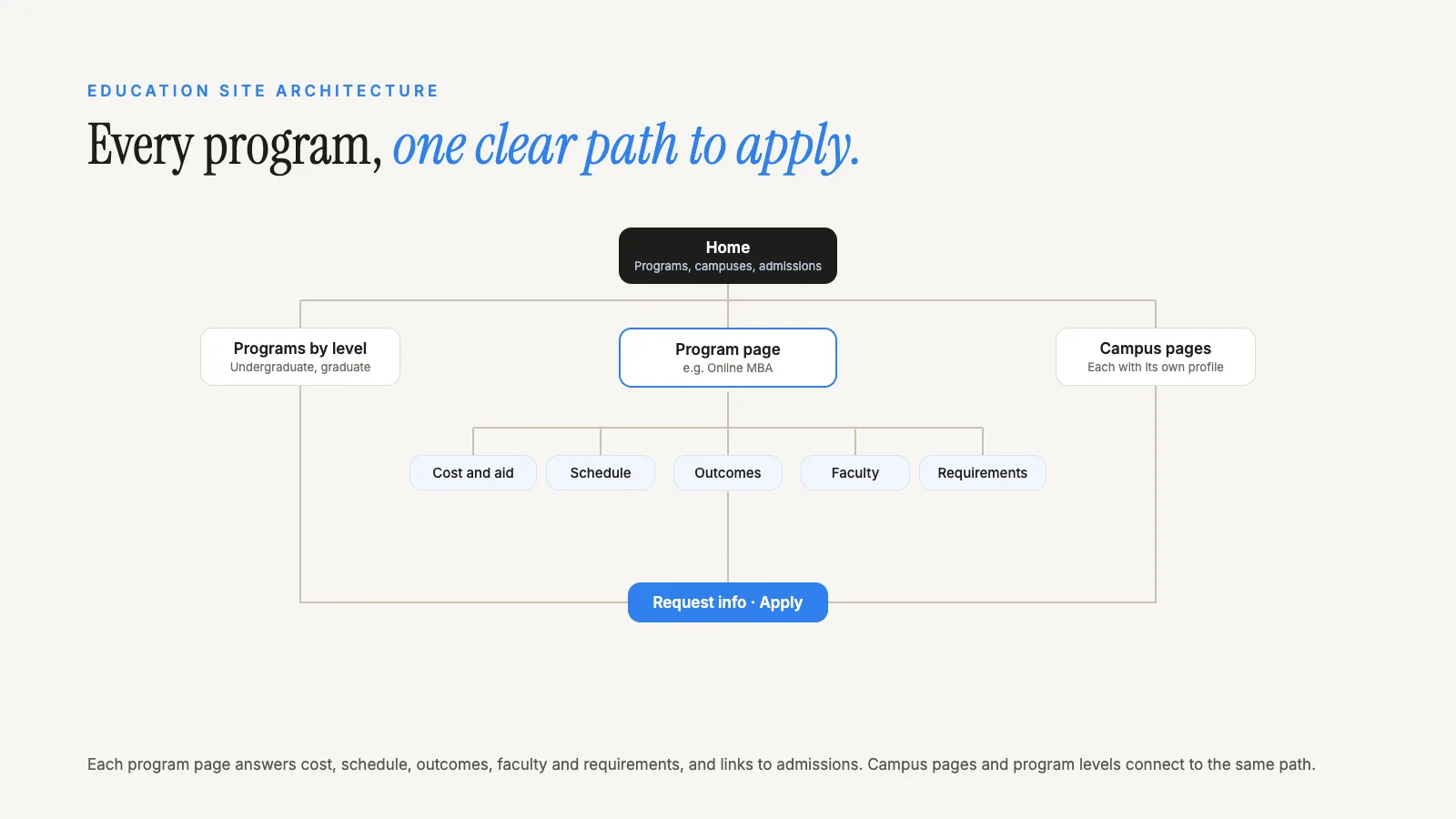
Prospective students rarely search for an institution's name first. They search for the program: "online MBA for working professionals," "nursing degree near me," "data analytics certificate." A strong program page answers the questions they ask before they ever request information:
One technical note: Google removed its Course info rich result documentation in September 2025, so marking up programs for course rich results no longer pays off. We focus on content and structured data that still help, such as organization and breadcrumb markup. Our guide to schema and entity optimization explains the approach.
Schools hold sensitive information, and families notice how it is handled. The Family Educational Rights and Privacy Act (FERPA) is a federal law that gives parents, and students once they turn 18 or enter postsecondary education, rights over education records and some control over disclosure of personally identifiable information. We keep marketing well clear of those records: no student details or photos without the consent your policies require, and tracking set up so student record data never reaches ad or analytics platforms.
Claims matter too. Costs, outcomes and rankings should come from your own verified data and be kept current. We never invent statistics, testimonials or reviews, and we route sensitive pages through your review process.
Student stories and photos only with documented permission.
Costs and outcomes from your own current data.
Inquiry tracking without sharing student records.
Sensitive pages approved by your team before launch.
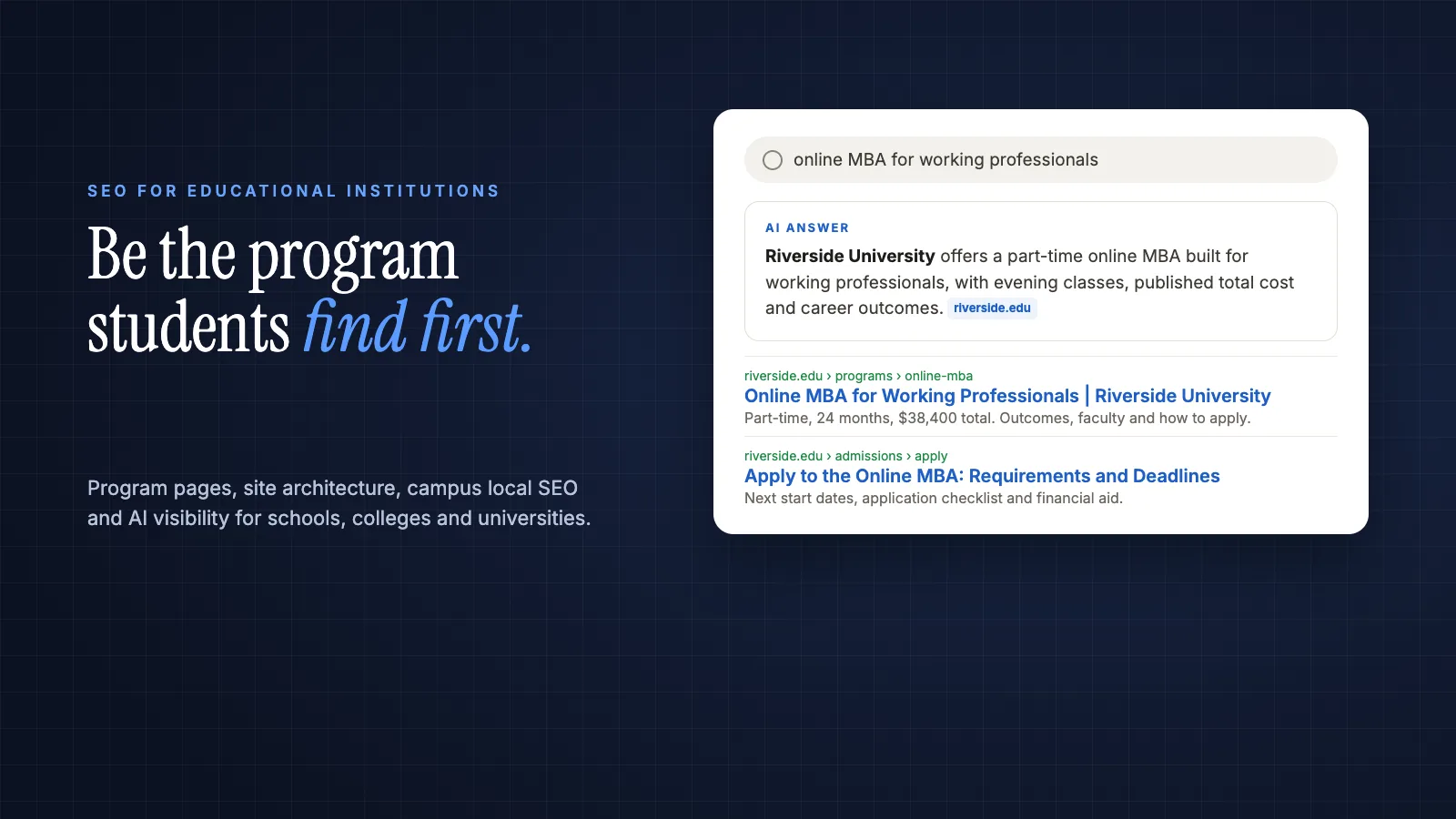
Some students now ask ChatGPT, Gemini or Google AI Mode questions like "which online MBA programs are best for working parents?" or "what private schools near me have strong STEM programs?". Google says there are no special requirements to appear in AI Overviews or AI Mode beyond strong SEO fundamentals, so our AI search visibility service builds on the same program pages, consistent institutional facts and authoritative mentions.
Our guides on getting recommended by ChatGPT and GEO vs SEO explain how it works.
The same programs, campuses and accreditation everywhere.
Cost, format and outcomes stated plainly.
Instant answers to common questions through AI lead agents.
Deadline and event reminders through email marketing.
Four clear steps, planned around your enrollment calendar, with every change logged.
We review site structure, program pages, campus profiles, technical health, competitors and AI visibility for your priority programs.
We agree priority programs and campuses, consolidate duplicate pages and plan content ahead of application deadlines.
We build program pages through our AI SEO and content work, fix technical issues, optimize campus profiles and connect inquiry tracking with marketing automation.
We report inquiries, visits and applications by program and source each month, then move effort toward what works.
+50% page citations and a 100% higher prompt citation rate
“Thank you for the hard work so far. We are seeing 50% increase in page citations, and 100% increase in prompt citation rate. So far, a huge win!” Ash Barbour, client, October 2026. Our search work for FitBudd also grew organic users 3.7x in a year. Neither is an educational institution, but both use the same process we bring to schools and universities. See the case studies →
SEO for educational institutions is the work of making a school, college, university or training provider easy to find and easy to trust when prospective students and parents search. It covers program and admissions pages, local search for each campus, technical health, faculty and outcomes content, reviews and visibility in AI assistants such as ChatGPT and Google AI Mode, with reporting tied to inquiries, visits and applications.
Yes. Private K-12 schools and preschools usually win through local search, a strong Google Business Profile, admissions pages and tours. Colleges, universities and online programs compete program by program, so each degree or certificate needs its own page that answers cost, format, outcomes and admissions questions.
Decisions are long, involve several people and are driven by program-level questions: cost, schedule, accreditation and career outcomes. Sites are often large and decentralized, with departments publishing their own pages. Good higher education SEO fixes the structure first, then builds program pages that answer those questions clearly.
Yes. We never publish student information or photos without the consent your policies require, keep outcome and cost claims accurate and sourced from your own data, and route sensitive pages through your review process. FERPA governs education records, so tracking and forms are set up to avoid sending student record data to ad or analytics platforms.
Not for rich results. Google removed its Course info rich result documentation in September 2025. We use structured data that still helps search engines understand your institution, such as Organization and educational organization types, breadcrumbs and FAQs where they fit, and focus on content that answers student questions.
Technical fixes and Google Business Profile improvements can show within weeks. Program pages and authority usually take several months to move rankings, and enrollment cycles add a seasonal rhythm. We plan content ahead of application deadlines and report monthly on inquiries and applications, not just traffic.
Send your institution's website and your priority programs or campuses, and we'll review your program pages, site structure and AI answers, then reply personally with the first fixes to make.
Get a free audit of your program pages, campus profiles and AI answers, with the first fixes to make.
The call is with our founder, Mohd Adil Kazmi, not a sales rep. Prefer email? Write to info@llmsmarketing.com, use our contact page or see all our services.