
Will OpenAI launch an official tool or dashboard that shows brands or publishers how often ChatGPT mentions, cites or recommends them by June 30, 2027? Resolved: YES.
Why the forecast moved Numbered as on the chart · resolved YES on 10 November 2026
| # | Date | Event and reasoning | Change | Source |
|---|---|---|---|---|
| 1 | 22 May 2025 | Similarweb: ChatGPT referrals to news sites nearly doubled in early 2025ChatGPT is sending publishers a fast-growing share of traffic, which raises demand for official visibility data from OpenAI. | +1.0 pts15.0% → 16.0% | Source |
| 2 | 24 Nov 2025 | OpenAI launches shopping research with organic product guides in ChatGPTA deeper commerce push makes product recommendations more central and builds merchant relationships that could carry visibility reporting, although OpenAI stresses it will not share chats with retailers. | +1.0 pts16.0% → 17.0% | Source |
| 3 | 11 Feb 2026 | Fidji Simo says ChatGPT ads will resemble Google's intent-based modelA Google-style ecosystem makes a Search Console-like organic report more plausible later, but the immediate focus is on paid ads that stay separate from answers. | +1.0 pts17.0% → 18.0% | Source |
| 4 | 12 Feb 2026 | Bing launches AI Performance report showing Copilot citations to site ownersA major competitor now gives site owners first-party citation counts and grounding queries, which sets a precedent and puts pressure on OpenAI. | +2.5 pts18.0% → 20.5% | Source |
| 5 | 24 Mar 2026 | OpenAI revamps ChatGPT shopping around discovery and merchant product feedsMerchants now submit feeds and promotions for discovery, which creates a natural place for product impression reporting. | +2.0 pts20.5% → 22.5% | Source |
| 6 | 13 Apr 2026 | OpenAI rolls out early ChatGPT ads manager with real-time impressions and clicksOpenAI is building a business-facing reporting portal, but so far it covers only paid placements. | +1.0 pts22.5% → 23.5% | Source |
| 7 | 22 Jun 2026 | Bing upgrades AI report with citation share while ChatGPT shares metrics only with licenseesCompetitor pressure grows, but OpenAI reportedly limits metrics to licensed publishers, which suggests a partner-only rather than open approach. | +0.5 pts23.5% → 24.0% | Source |
| 8 | 22 Jul 2026 | OpenAI publicly opens self-serve Advertise in ChatGPT portalA public business portal now exists where an organic insights view could be added, though OpenAI keeps ads and answers explicitly separate. | +1.0 pts24.0% → 25.0% | Source |
| 9 | 24 Aug 2026 | Vendor study maps ChatGPT citations by licensing status using third-party dataThird-party trackers keep filling the measurement gap and OpenAI still offers no official citation data, which lowers the urgency for OpenAI to build its own. | -1.0 pts25.0% → 24.0% | Source |
| 10 | 14 Oct 2026 | ChatGPT links briefly lose UTM tags and referrer during GPT-6 rolloutAttribution broke without notice and OpenAI did not confirm the fix in release notes, which suggests publisher measurement is a low priority. | -1.5 pts24.0% → 22.5% | Source |
| 11 | 10 Nov 2026 | OpenAI launches ChatGPT Business Hub with mention and click insightsBusinesses in ChatGPT opens in public beta: verified businesses can see how many times ChatGPT mentions their website, the clicks to it and discovery topics. This meets the resolution criteria, so the question resolves YES. | Resolved YES22.5% → 100% | Source |
Expert commentary Quotes attached to the tracked events · each checked against its source
| Who | What they said | # | Source | |
|---|---|---|---|---|
| David CarrSenior insights manager, SimilarwebIndependent | “The platform is still designed to present answers, first and foremost, but it’s now more generous to publishers in providing outbound links” | 1 | digiday.com | |
| Fidji SimoCEO of Applications, OpenAIOfficial | “But I also think we live in a world where transparency and authenticity are what count.” | 3 | sources.news | |
| Debra Aho WilliamsonFounder and chief analyst, Sonata InsightsIndependent | “OpenAI needs to move quickly to establish itself as a legitimate player in the ads business, so launching an ad manager early is an important step” | 6 | ppc.land | |
| Thomas PehamCEO, OtterlyAIIndependent | “A licensing deal does one clear thing: it tilts your citations toward ChatGPT.” | 9 | mediacopilot.ai | |
| Cedric HueslerAdobe (LinkedIn post quoted by Search Engine Roundtable)Independent | “There’s no tag and no referrer, so your analytics files the visit under direct.” | 10 | seroundtable.com | |
| Barry SchwartzFounder, Search Engine RoundtableIndependent | “Yes, OpenAI is showing us how many people click from ChatGPT to our website.” | 11 | seroundtable.com |
Probability estimate by LLM's Marketing for llmsmarketing.com, not a statement by Google. Resolves YES only if, between now and June 30, 2027, OpenAI publicly launches an official first-party tool, dashboard, report or API that shows businesses, brands, merchants or publishers data about their organic (non-paid) presence in ChatGPT answers. The data must include at least one of: how many times they were mentioned, how many times they were cited or linked as a source, impressions of their products or pages in answers, or the prompts or queries that surfaced them. The tool must be open to ordinary businesses or publishers in at least one major market, either self-serve or as an open public beta. A closed pilot only for content-licensing partners does not count. Reporting only on paid ads (for example ChatGPT Ads Manager impressions and clicks) does not count. Neither does guidance that points sites to third-party analytics or UTM parameters. Third-party tools built on OpenAI data do not count. Resolves NO otherwise. Starts from a 15% base rate on 1 May 2025 and moves at each dated, sourced event; values before 24 October 2026 are reconstructed from those events, not predictions made at the time. Resolved YES on 10 November 2026, when OpenAI launched Businesses in ChatGPT in public beta with ChatGPT Business Hub, which shows verified businesses their ChatGPT mentions, website clicks and discovery topics. Last updated 11 November 2026.
Imagine someone asking ChatGPT to recommend the best software for their business. Instead of browsing through Google results, they receive a shortlist of brands, a comparison of their features, and an explanation of which option might suit their needs.
Now, imagine your brand being part of that answer.
As more people use AI tools to research products, compare services, and make purchasing decisions, getting discovered through platforms like ChatGPT is becoming an important part of digital marketing. Traditional SEO still matters, but brands also need to think about how AI systems discover information, evaluate sources, and present recommendations.
The challenge is that you cannot simply submit your website to ChatGPT and expect it to recommend your business. There is no guaranteed way to secure a brand mention or citation in its answers.
However, you can improve your chances by building a credible online presence, publishing useful content, making your website easier to understand, and ensuring your brand is consistently represented across trusted sources.
In this guide, we will explore how to get your brand recommended by ChatGPT, step by step.
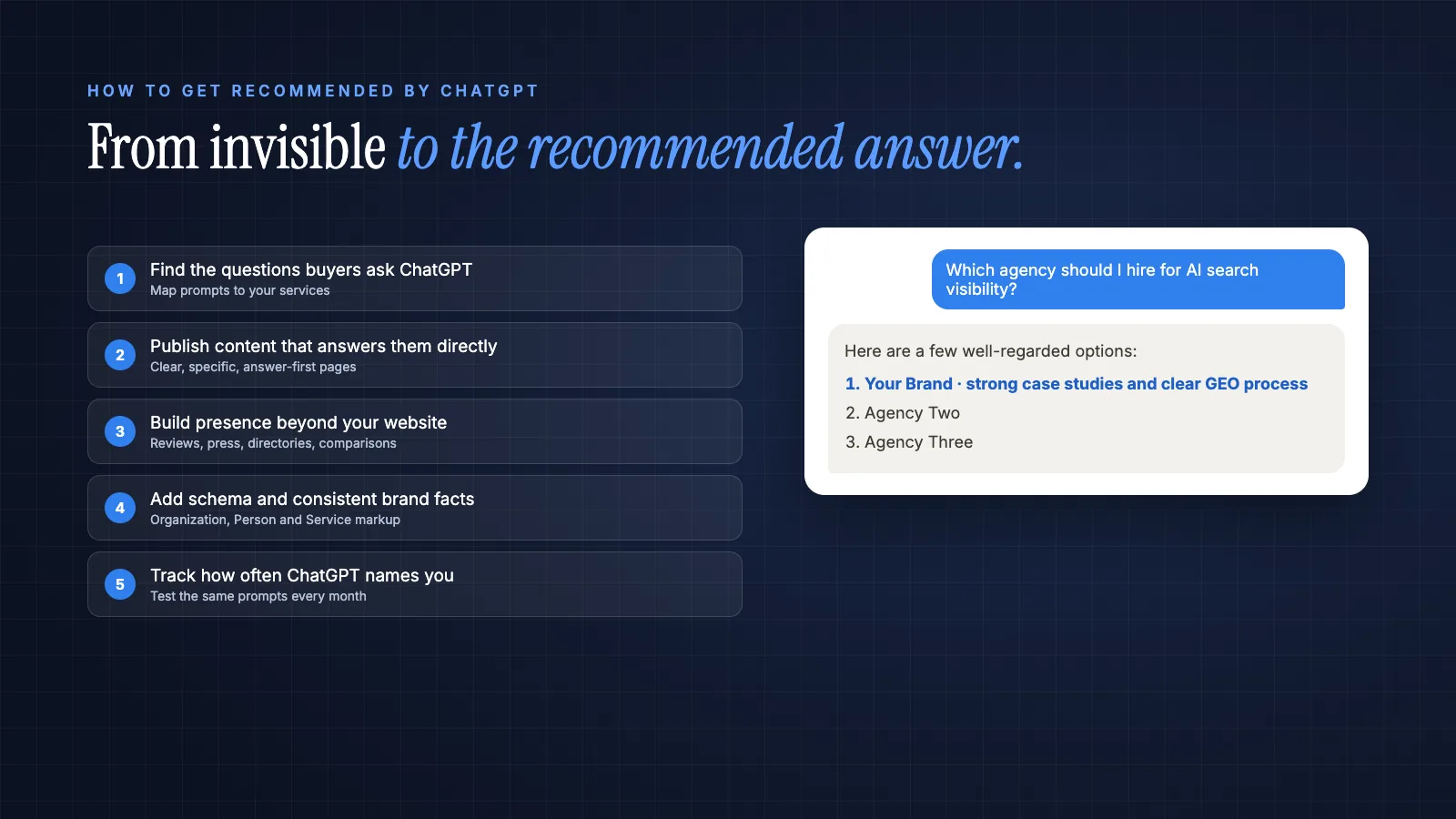
1. Understand How ChatGPT Discovers and Recommends Brands
Before changing your SEO strategy, it is important to understand how ChatGPT can generate answers about businesses.
Depending on the question, the model, and whether web search is used, ChatGPT may draw on its learned knowledge, retrieve information from online sources, or combine information from multiple sources.
For example, someone might ask:
- What are the best CRM platforms for small businesses?
- Which SEO agency specializes in AI search optimization?
- What are the best alternatives to HubSpot for startups?
- Which personal training software offers branded mobile apps?
To answer these questions, ChatGPT may identify relevant brands, compare their offerings, and use available information to explain its recommendations.
This creates an opportunity for businesses that clearly communicate what they do, who they serve, and what makes them different.
The goal is not to optimize your website for a single AI response. It is to make your brand easier to discover, understand, and verify across the web.
2. Identify the Questions Your Potential Customers Ask ChatGPT
One of the most useful ways to improve AI visibility is to understand the questions your target audience asks before choosing a product or service.
Traditional keyword research often focuses on search volume, keyword difficulty, and rankings. For AI search, it is also useful to examine conversational queries, specific requirements, and comparison-based questions.
Start by creating a list of questions related to your products, services, and industry.
For example, a SaaS company might target questions such as:
- What is the best project management software for remote teams?
- Which project management tools integrate with Slack?
- What are affordable alternatives to Asana?
- Which project management platform is best for agencies?
A marketing agency could explore questions such as:
- How can a business improve its visibility in ChatGPT?
- Which agencies specialize in Generative Engine Optimization?
- What is the difference between traditional SEO and AI SEO?
- How can SaaS companies generate leads from AI search?
These questions help you understand the information potential customers need before making a decision.
What to do next: Group the questions by search intent, such as informational, comparison, alternative, and recommendation queries. Then create useful content that answers each group clearly.
Do not create a separate page for every minor variation of the same question. Focus on covering meaningful topics in enough depth to help readers make informed decisions.
3. Create Content That Directly Answers Customer Questions
AI systems need information they can interpret and use when generating answers. Content that explains a topic clearly can make your expertise easier to understand.
Instead of publishing articles filled with generic marketing statements, focus on answering specific questions with useful details.
For example, rather than writing an article titled “Why Our Software Is the Best,” consider creating content such as “How to Choose Personal Training Software for a Growing Fitness Business.”
The second topic addresses a real decision and gives you an opportunity to explain relevant features, limitations, use cases, and selection criteria.
When creating content, follow these practices:
- Answer the main question early in the article.
- Use descriptive headings that reflect the reader's needs.
- Include specific examples and practical recommendations.
- Explain technical concepts in simple language.
- Add original research, data, expert insights, or case studies where possible.
- Keep pricing, product features, and other factual details accurate.
- Update outdated information when necessary.
For commercial topics, do not focus exclusively on educational blog posts. Comparison pages, product guides, detailed service pages, and alternative pages can also help people understand where your brand fits.
The objective is to publish content that genuinely helps someone solve a problem, rather than content created solely to attract AI citations.
4. Build Your Brand's Presence Beyond Your Website
Your website is only one part of your brand's online presence.
The same applies to other assistants. Grok, for example, can search public posts on X as well as the web, which makes your social presence part of what it reads; our guide to Grok SEO covers that in detail.
Customers may encounter your business through industry publications, professional communities, review platforms, comparison websites, podcasts, and other relevant sources.
A consistent presence across credible sources helps people verify your business and understand what it offers. These sources may also become useful discovery points when AI-powered search systems retrieve information from the web.
For example, if you run a B2B SaaS company, your brand visibility strategy might include:
- Relevant industry publications and editorial coverage.
- Independent software review platforms.
- Detailed customer case studies.
- Expert interviews and podcasts.
- Genuine discussions in relevant professional communities.
- Partnerships with complementary businesses.
The important distinction is between earning meaningful recognition and simply collecting brand mentions.
A mention on a relevant, trustworthy website can be more valuable than dozens of low-quality mentions on unrelated sites.
Avoid buying fake reviews, generating artificial discussions, or publishing large volumes of low-value guest posts. These tactics can undermine credibility and may create SEO risks.
Focus on making your brand a recognized participant in the conversations that matter to your target audience.
5. Make Your Website Easy for Search Engines and AI Systems to Understand
Even strong content can be difficult to use if your website has technical problems or fails to communicate basic information clearly.
Start with your technical SEO foundations.
Check whether important pages can be crawled and indexed by search engines. Review your robots.txt file, canonical tags, XML sitemap, internal links, and server responses.
If you want your content to appear in ChatGPT's web search results, review the relevant crawler documentation and access requirements published by OpenAI. In particular, check the current guidance for OAI-SearchBot and ensure your hosting or CDN configuration is not unintentionally blocking the relevant crawler.
Search visibility and model training are separate considerations, so review the applicable crawler settings rather than assuming that allowing one bot automatically enables every form of AI discovery.
You should also make your business information straightforward to interpret.
Ensure your website clearly explains:
- Your brand name and what your company does.
- The products or services you offer.
- Your target audience and key use cases.
- Your location or service area, where relevant.
- Your pricing, features, and limitations, where appropriate.
- How customers can contact you.
Structured data can help search engines interpret this information. Depending on the page, relevant schema types may include Organization, Product, SoftwareApplication, Article, and BreadcrumbList.
Use structured data that accurately reflects visible page content and follows the relevant guidelines. Schema markup can improve machine readability, but it does not guarantee that ChatGPT will mention or recommend your brand.
6. Build Trust Through Reviews, Case Studies, and Original Evidence
When someone asks an AI assistant to recommend a product or service, they usually want more than a list of company names. They want to understand why one option might be better suited to their needs.
Your website should make that decision easier.
For example, a SaaS business could publish a detailed case study showing how a customer reduced manual work, improved productivity, or achieved a measurable business outcome.
A service company could demonstrate its expertise through documented projects, transparent processes, relevant certifications, and clearly explained results.
Consider developing the following assets:
- Customer case studies: Explain the initial problem, the solution, the implementation process, and the measurable outcome.
- Independent reviews: Encourage genuine customers to share honest feedback on relevant platforms. Never offer incentives in exchange for positive reviews in violation of platform policies.
- Original research: Publish surveys, industry benchmarks, or proprietary data that provide information people cannot easily find elsewhere.
- Expert contributions: Share insights from identifiable professionals who have relevant experience in the subject.
- Clear company information: Maintain accurate information about your team, business history, contact details, and areas of expertise.
These assets help potential customers evaluate your credibility. They also give journalists, publishers, and other websites useful material to reference.
No single trust signal guarantees an AI recommendation, but a credible, well-documented brand is better positioned to earn attention.
7. Optimize for Brand Comparisons and Alternatives
People frequently ask AI assistants to compare competing products before making a purchase.
Questions such as “Brand A vs. Brand B” or “What are the best alternatives to Brand C?” reveal strong commercial intent.
If your product belongs in these conversations, create content that explains its strengths, limitations, pricing, integrations, and ideal use cases.
A useful comparison page should include:
- A clear explanation of what each product does.
- A comparison of relevant features.
- Current and accurately sourced pricing information.
- Important limitations and differences.
- Recommendations for different types of customers.
- Links to authoritative product documentation.
Be fair when comparing your business with competitors. A page that acknowledges where another product may be a better fit is often more useful than one that declares your brand the winner in every category.
You should also make your own product's positioning specific.
Instead of claiming that your software is suitable for everyone, explain who benefits most from using it and why.
The more clearly you communicate your product's actual strengths, the easier it becomes for potential customers to assess whether it fits their requirements.
8. Use Schema Markup and Consistent Brand Information
Search engines and other automated systems benefit when a business's identity and offerings are described consistently.
Check whether your brand name, website URL, company description, product names, and other key details match across your website and relevant external profiles.
Where appropriate, implement structured data such as Organization schema on your company pages and Product or SoftwareApplication schema on relevant product pages.
You can also use appropriate Article schema for editorial content.
Keep the implementation accurate, validate the markup, and avoid adding properties that do not reflect the actual page.
One common mistake is treating schema markup as a shortcut to AI visibility. It is not. Structured data supports understanding; it does not force an AI system to select your business.
Similarly, publishing an llms.txt file may be worth testing as part of a broader technical strategy, but it should not be treated as a confirmed requirement for ChatGPT recommendations.
Prioritize accessible pages, useful content, accurate information, and a strong overall SEO foundation first.
9. Track Your Brand's Visibility in ChatGPT
You cannot improve what you never measure.
Traditional SEO metrics such as organic traffic, rankings, conversions, and referring domains remain useful. However, they do not fully explain how often your brand appears in AI-generated answers. Since November 2026, OpenAI's ChatGPT Business Hub adds first-party counts of mentions and website clicks for businesses that claim and verify their profile.
Start by building a consistent set of prompts that reflect the questions your customers are likely to ask.
For example:
- What are the best tools for [specific use case]?
- Which companies offer [specific service]?
- What are the best alternatives to [competitor]?
- Which products are suitable for [target audience]?
- Compare [your brand] with [competitor].
Test these prompts periodically and record the results.
Useful metrics include:
- Brand mention rate: How frequently your brand appears across a defined set of relevant prompts.
- Citation frequency: How often your website is cited as a source in answers that include citations.
- Share of voice: How your brand's visibility compares with competitors across the same prompt set.
- Referral traffic: Sessions arriving from ChatGPT and other AI platforms, where analytics can identify them.
- Conversions: Leads, sign-ups, purchases, or demos associated with AI-referred visitors.
For reliable comparisons, keep the prompt set, testing conditions, and measurement period consistent. Responses can vary based on wording, context, model, location, and product settings.
You can use Google Analytics 4 to investigate referral traffic and conversion behavior, while Google Search Console helps you monitor traditional search performance. Dedicated AI visibility tools may provide additional reporting, but check how each tool collects and calculates its data.
Most importantly, distinguish between a brand mention, a website citation, and a measurable business outcome. They are different signals and should not be reported as though they mean the same thing.
10. Turn AI Visibility Into a Continuous Strategy
Getting recommended by ChatGPT is not a one-time SEO task. Your products change, competitors publish new information, and AI search experiences evolve.
A practical approach is to review your visibility regularly and prioritize improvements based on evidence.
Start by identifying the prompts where competitors appear but your brand does not. Investigate what makes their offerings relevant, which sources support their positioning, and whether your website adequately answers the underlying question.
Then look for gaps you can address through better product information, stronger evidence, useful content, or relevant third-party coverage.
Avoid publishing hundreds of near-identical pages simply to target more prompts. A smaller collection of well-researched, differentiated pages can provide more value than a large library of repetitive content.
Over time, combine technical SEO, content development, digital PR, customer evidence, and AI visibility measurement into one coordinated strategy.
This approach makes your brand more discoverable across search experiences while continuing to support traditional organic performance.
Conclusion
Getting your brand recommended by ChatGPT requires more than adding AI-related keywords to your website. It involves building a brand that is easy to discover, understand, evaluate, and trust.
Start by identifying the questions your customers ask, creating genuinely helpful content, strengthening your technical SEO, earning relevant third-party recognition, and maintaining accurate brand information across the web.
Then measure how your brand appears in AI-generated answers and connect those findings to traffic, leads, and conversions.
There is no guaranteed formula for appearing in every ChatGPT recommendation. However, a consistent strategy built around relevance, credibility, useful information, and sound technical foundations can improve your brand's chances of being discovered.
As AI-powered search continues to evolve, the brands that invest in real expertise and clear communication will be better prepared to compete.
Frequently Asked Questions
Ready to Elevate Your Brand's AI Visibility?
Discover how your brand currently performs across ChatGPT, Perplexity, and Gemini — and build an actionable strategy to get recommended.
Get a free AI visibility auditIs your brand showing up in ChatGPT, Perplexity and Gemini?
Send me your website and I'll check how your brand appears in AI answers and search, then reply personally with the first fixes I would make.