Average Cost per Click
Across industries in LocaliQ's 2026 search benchmarks.
LLM's Marketing runs Google Ads for US businesses that want every dollar tied to a call, a booked job or a sale. We fix conversion tracking first, cut spend on searches that never buy, build landing pages that match each ad, and report on cost per qualified lead instead of impressions and clicks.
Google Ads management is the ongoing work of planning, building, measuring and improving paid campaigns on Google Search, Shopping, YouTube and the wider Google network. Google makes it easy to launch a campaign in an afternoon. It is much harder to make one profitable, because the platform will spend whatever budget you give it whether or not the clicks turn into customers.
Clicks are getting more expensive. LocaliQ's 2026 search advertising benchmarks put the average cost per click across industries at $5.42, with attorneys and legal services at $9.87 and home and home improvement at $8.33 (LocaliQ, June 2026). The same report found an average conversion rate of 8.18%, which means roughly nine in ten paid clicks do not become a lead. When that many clicks are lost anyway, the ones lost to bad targeting, broken tracking or a weak landing page decide whether ads make money.
Our approach is simple: measure what a customer costs, then spend only where that number works.
Across industries in LocaliQ's 2026 search benchmarks.
Most paid clicks still leave without becoming a lead.
The highest industry average in the same benchmark report.
Google's keyword-level diagnostic of ad and landing page relevance.
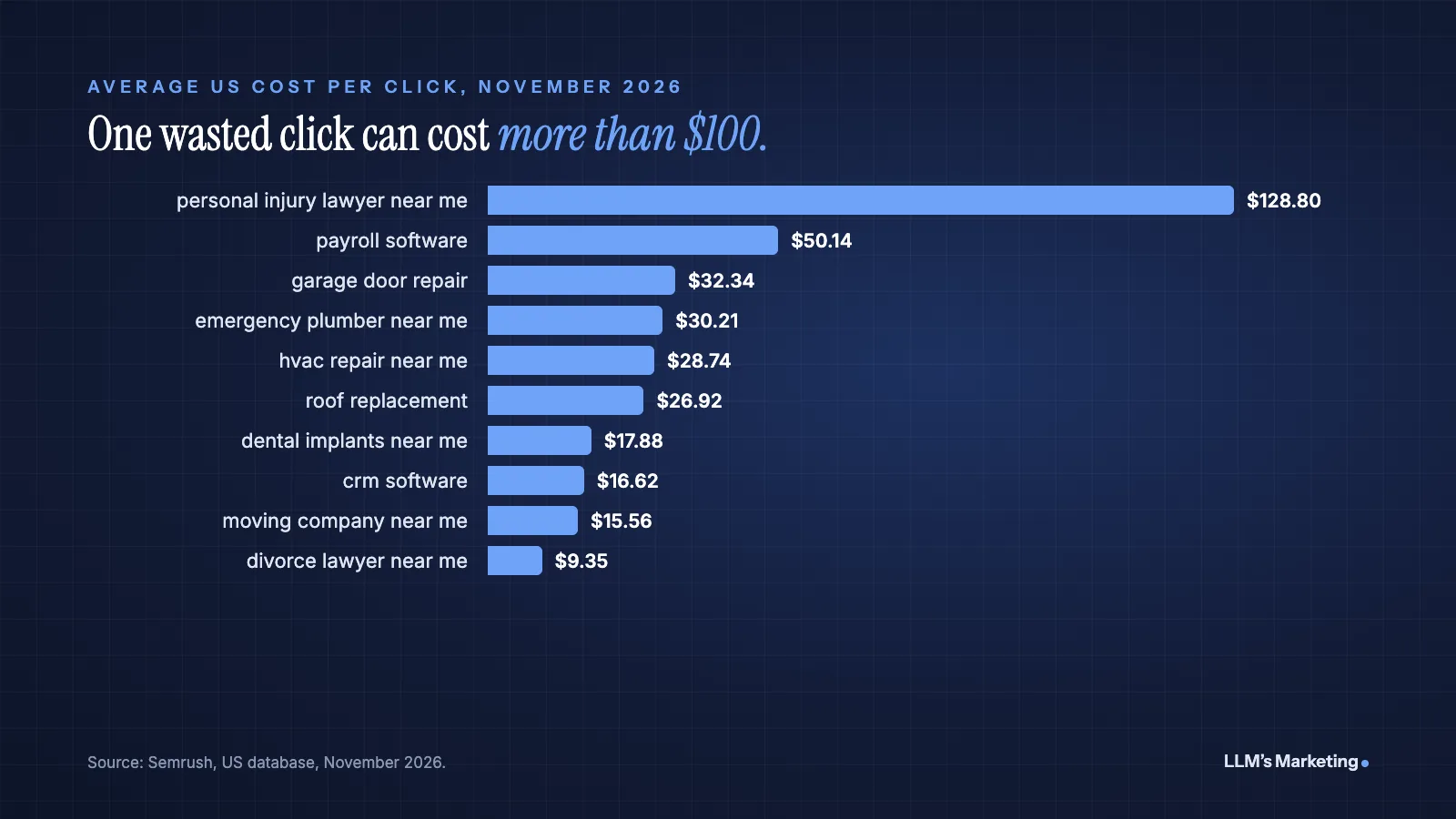
The searches that bring customers are the ones every competitor bids on. The chart shows a selection of US searches from the Semrush keyword database (November 2026), and the full figures are in the table below.
Semrush estimates the average cost of a click on each exact search, which is why these figures run higher than LocaliQ's account-wide averages. Both point the same way. At $30 a click for an emergency plumber, 100 irrelevant clicks a month is $3,000 gone. At $128 for an injury lawyer, it is more than $12,800. Cutting waste is usually the fastest way to lower your cost per lead, before any bid or budget change.
| Search | US monthly searches | Avg. cost per click |
|---|---|---|
| personal injury lawyer near me | 90,500 | $128.80 |
| payroll software | 27,100 | $50.14 |
| garage door repair | 165,000 | $32.34 |
| emergency plumber near me | 135,000 | $30.21 |
| hvac repair near me | 135,000 | $28.74 |
| roof replacement | 74,000 | $26.92 |
| dental implants near me | 135,000 | $17.88 |
| crm software | 90,500 | $16.62 |
| moving company near me | 74,000 | $15.56 |
| divorce lawyer near me | 27,100 | $9.35 |
Every part is built around one number: what a qualified lead or sale costs you.
Wasted spend, structure, tracking gaps, Quality Score issues and settings, documented before we change anything.
Calls, forms and bookings tracked properly, with enhanced conversions and offline conversion imports from your CRM where they fit.
Campaigns grouped by service and intent, with ad copy and assets written for each group, not one ad for everything.
Weekly review of the searches that triggered your ads, with negative keywords that stop paying for the wrong ones.
Used where your goals, data and product feed support them, with brand exclusions and clear reporting.
Fast, mobile-first pages that match the search and the ad, built with our SEO and content team.
Bid strategies matched to how much conversion data you have, with budgets moved toward what produces customers.
Service-area targeting, ad schedules around your opening hours and call assets for businesses that live on the phone.
Spend, leads, cost per lead and revenue where we can track it, plus a written log of every change we made.
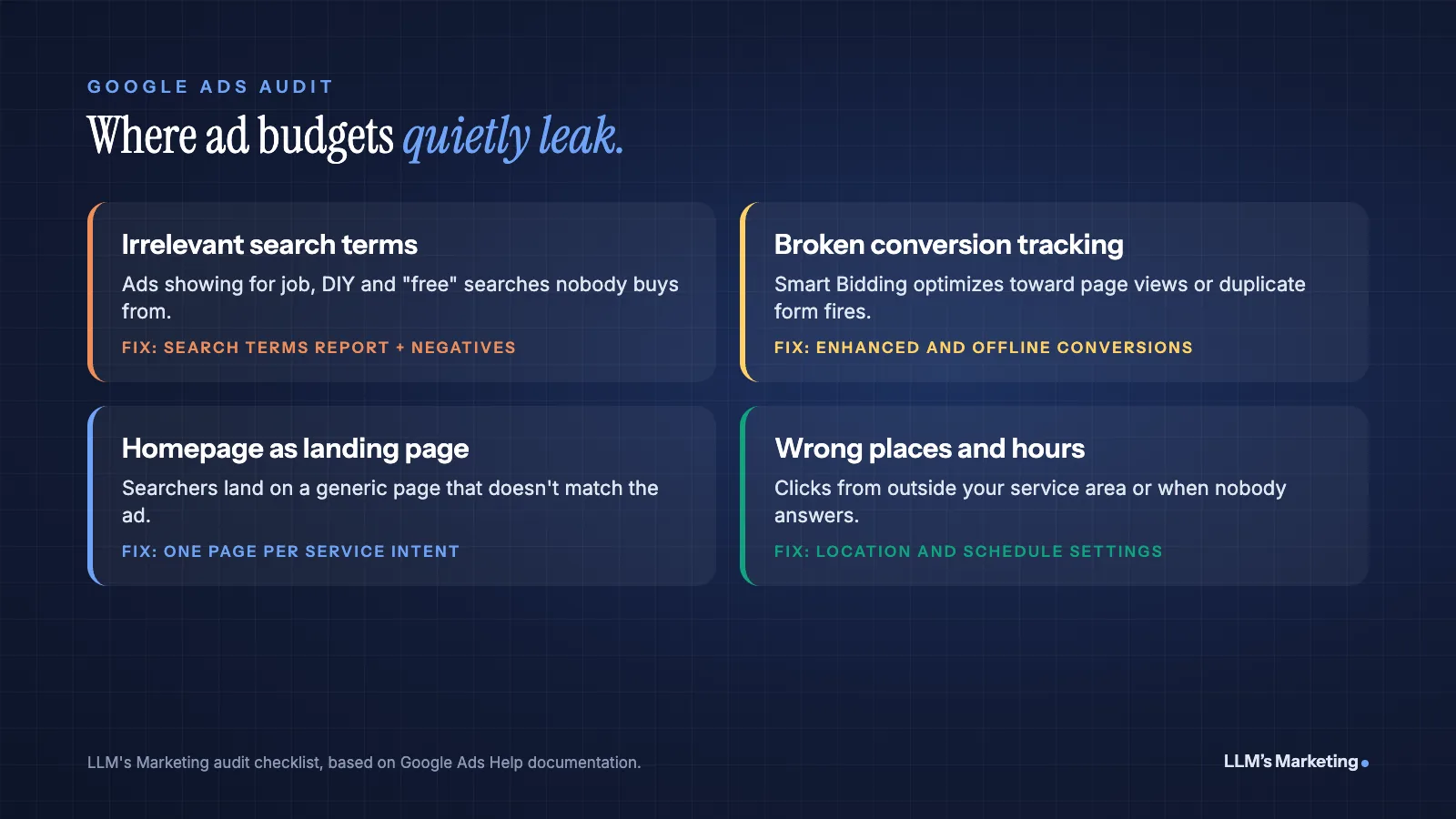
Most accounts we review lose money in the same four places, and each one is checked against Google's own documentation.
Keywords are not the same as searches. Google's search terms report shows the actual searches that triggered your ads, and it often includes job hunters, do-it-yourselfers and people looking for something free. Negative keywords stop your ads from showing for those searches.
Automated bidding learns from the conversions you report. If a page view, a duplicate form submission or a 5-second call counts as a lead, Google optimizes toward the wrong thing. We count real leads, then feed back which ones became customers through offline conversion imports.
Google's Quality Score is based on expected click-through rate, ad relevance and landing page experience. Sending every ad to your homepage hurts the last two, and it makes searchers hunt for the answer they clicked for.
Location settings that include people "interested in" your area, or ads running overnight when nobody answers the phone, buy clicks that cannot become customers.
Google now shows ads inside its AI answers. According to Google Ads Help, existing Search, Shopping and Performance Max campaigns are automatically eligible to serve ads within AI Overviews and AI Mode, which are available in English in the United States and select English-speaking markets (Google).
How you target decides where you can appear. Google says AI-powered targeting, including AI Max for Search, broad match, Shopping and Performance Max, can be matched to both the query and the AI response. Exact and phrase match keywords are eligible only when the query itself shows clear commercial intent, not on broader exploratory questions. You cannot target AI Overviews on their own or opt out of them separately from Search, but negative keywords and brand exclusions still apply.
That makes clean conversion data and strong negative lists more important, not less. We also connect paid search to your organic presence: our AI search visibility service works on getting your brand cited in AI answers without paying per click, and our guide to ChatGPT ads covers advertising inside OpenAI's assistant.
Search, Shopping and Performance Max, with no separate setup.
Broad match and AI Max can match exploratory questions.
Exact and phrase match show only for clearly commercial queries.
Negative keywords and brand exclusions still apply.
Four clear stages. You always know what we are changing, why, and what it cost.
We review your account, tracking, landing pages and competitors, and agree a target cost per lead or return on ad spend based on what a customer is worth to you.
We fix conversion tracking first, then restructure campaigns by service and intent, write new ads and set up negative keyword lists.
Campaigns go live with landing pages that match each ad group, tested on mobile, with forms and call tracking checked end to end.
Weekly search term, bid, budget and ad work, and a monthly review of cost per lead by campaign and service.
There are two separate costs: your ad spend, which you pay to Google, and the management fee, which you pay the agency. Agencies usually charge the fee in one of three ways.
| Pricing model | How it works | Watch out for |
|---|---|---|
| Flat monthly fee | A fixed fee for an agreed scope of work | Scope that does not grow when your account does |
| Percentage of ad spend | A share of what you spend with Google | An incentive to raise spend rather than lower cost per lead |
| Hybrid | A base fee plus a smaller percentage above a spend level | Complex terms that make the true cost hard to compare |
We scope every engagement after a free audit, so you see the plan and the price before you commit. Whoever you hire, keep the Google Ads account and billing in your own name, so your data and history stay with you if you change agencies. Google also requires advertisers to complete advertiser verification, which should be done under your business, not your agency's.
Campaigns and billing stay in your name.
Conversion history and reports are yours to keep.
A written plan before any work or fee.
Strategy calls with our founder, not a sales rep.
We focus on businesses where one customer is worth enough to make careful paid search pay off.
Personal injury and family law, where clicks can pass $100 and intake quality matters as much as volume.
Plumbers, HVAC companies, electricians, roofers and garage door companies that need emergency calls, not tire kickers.
Implants, orthodontics and elective treatments. See our comparison of Google Ads vs SEO for dentists.
Software companies paying $15 to $50 a click, where demo quality and pipeline matter more than form fills.
Advisers and investment firms working within Google's financial services ad policies.
Schools, colleges and training providers recruiting students in competitive enrollment periods.
There are two costs: your ad spend, paid directly to Google, and the management fee, paid to the agency. Agencies charge a flat monthly fee, a percentage of ad spend or a hybrid of both. The right fee depends on how many campaigns, services and locations you run. We scope every engagement after a free audit, so you see the plan and the price before you commit.
Work backward from your numbers. Multiply the leads you want each month by your expected cost per lead, then check that a typical click cost in your category buys enough clicks to learn from. LocaliQ's 2026 benchmarks put the average cost per click at $5.42 across industries, but high-intent searches such as personal injury or emergency plumbing cost far more. A budget too small to get meaningful clicks each week makes it hard to tell what works.
Ads can bring clicks the day they go live, but profitable campaigns take longer. Expect the first few weeks to be spent fixing tracking, cutting irrelevant searches and gathering conversion data, and automated bid strategies need conversion history to perform well. Most accounts are judged fairly after two to three months of clean data.
No. Nobody controls Google's auction, your competitors' bids or how your team handles the leads. What we can do is track real leads accurately, stop spend on searches that do not convert, improve landing pages and report honestly on cost per lead every month.
You should. We recommend that the account, billing and advertiser verification stay in your business's name, with us given access to manage it. That way your conversion history and data stay with you if you ever change agencies.
It depends on your goal and data. Search campaigns give the most control over which searches you pay for, which suits most lead-generation businesses. Performance Max runs across Google's channels from one campaign and can work well for ecommerce with a product feed or accounts with strong conversion data. Many accounts use both, with brand exclusions and clear reporting for each.
Yes. Google says existing Search, Shopping and Performance Max campaigns are automatically eligible to show ads in AI Overviews and AI Mode in the United States and select English-speaking markets. Broad match, AI Max, Shopping and Performance Max can match exploratory questions, while exact and phrase match keywords show only for clearly commercial queries. You cannot target or opt out of these placements separately.
They solve different problems. Google Ads buys visibility immediately and stops when the budget stops. SEO and AI search visibility take longer but lower your cost per customer over time. Most businesses do best using ads for speed and high-value services while organic visibility builds, which is why we plan both together.
Send your website and roughly what you spend on Google Ads each month. We'll review your search terms, tracking, structure and landing pages, then reply personally with the first fixes to make.
Get a free Google Ads audit with your wasted spend, tracking gaps and the first fixes to make.
The call is with our founder, Mohd Adil Kazmi, not a sales rep. Prefer email? Write to info@llmsmarketing.com, use our contact page or see all our services and case studies.