
Most "best LLM for business" articles are out of date within months. Model names change, prices drop, and last year's winner becomes a legacy option. If you choose an AI model for your business based on a ranking, you are choosing based on a snapshot. If you choose based on fit, you can keep making the right call as the models change.
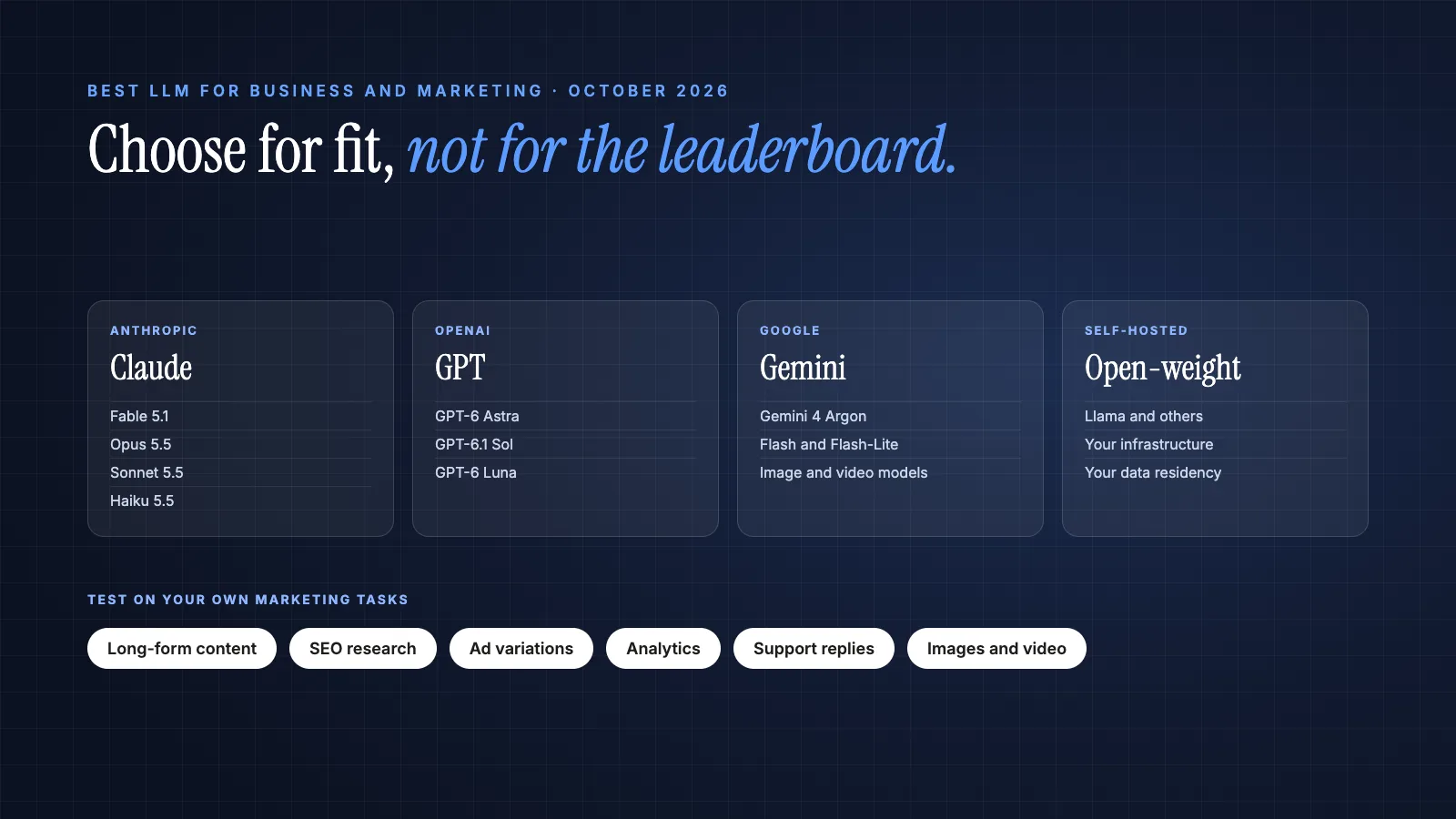
There is no single best LLM for every business. For most companies, the best choice is the model family that fits the tools you already use, meets your data and privacy requirements, and performs best on your own tasks in a short side-by-side test. As of October 2026, the main options are Anthropic's Claude, OpenAI's GPT models (behind ChatGPT), Google's Gemini and open-weight models you can host yourself. For marketing, most teams benefit from one primary assistant for daily work plus API access to a fast, low-cost model for high-volume tasks.
This guide compares the major options using their own documentation, explains how to choose by criteria rather than hype, shows how token pricing works with a worked example, and gives you a two-week test you can run before committing. It also covers the other half of AI for marketers: making sure these same models recommend your brand.
The Main LLM Options for Business in 2026
The table below summarizes each vendor's current lineup as described on its own model documentation in October 2026. Model names and prices change often, so treat this as a starting point and check the linked pages before you decide.
| Model family | Current lineup (October 2026) | Where it tends to fit |
|---|---|---|
| Anthropic Claude | Claude Fable 5.1, Opus 5.5, Sonnet 5.5 and Haiku 5.5, all with a 1M-token context window (Anthropic models overview) | Long documents, writing and editing, analysis and agentic work; available via the Claude apps, the API and major cloud platforms |
| OpenAI GPT | GPT-6 Astra (most capable), GPT-6.1 Sol (near-Astra at lower cost) and GPT-6 Luna (efficient, high volume) (OpenAI models) | General-purpose assistant work through ChatGPT, plus a broad developer ecosystem |
| Google Gemini | Gemini 4 Argon (flagship reasoning, 1M-token context) plus Flash, Flash-Lite, image and video models (Gemini models) | Teams on Google Workspace, and multimodal work across text, images, audio and video |
| Open-weight models | Model families such as Meta's Llama that you can download and run on your own infrastructure | Strict data residency, custom fine-tuning, or very high volume where you manage hosting yourself |
Every vendor offers a tiered lineup: a most capable model, a balanced middle option and a fast, low-cost model. That matters more than which brand "wins," because the right tier for a task often saves more money than switching vendors.
How to Choose an LLM for Your Business
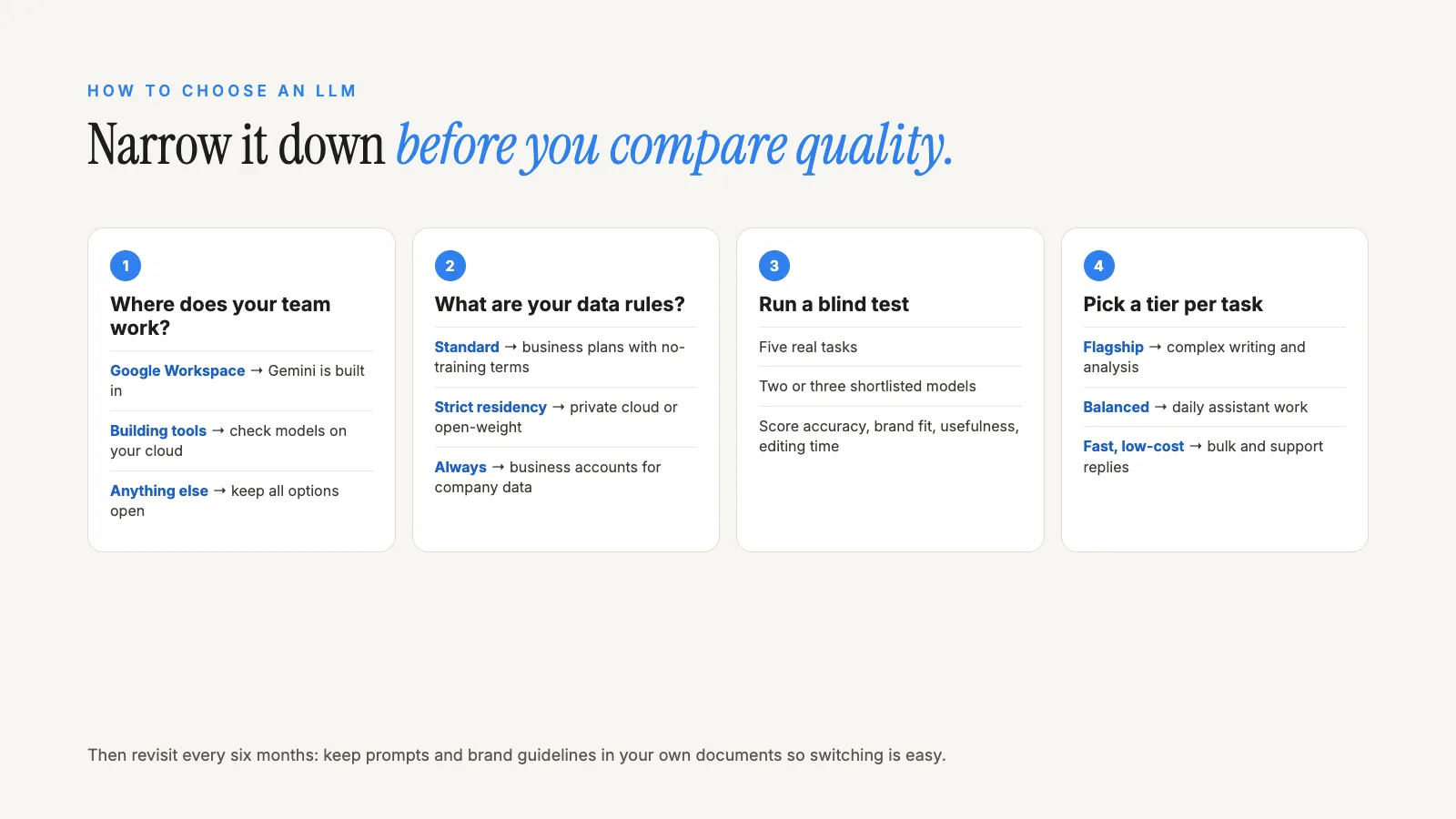
Use these seven criteria in order. The first three usually narrow the field before you ever compare output quality.
1. Where your team already works
An assistant built into the tools your team uses all day gets used. One that lives in a separate tab often does not. If your company runs on Google Workspace, Gemini's integration is a practical advantage. If you build internal tools, check which models your cloud provider offers: Anthropic's documentation, for example, lists Claude on Amazon Bedrock, Google Cloud and Microsoft Foundry as well as its own API.
2. Data privacy and training
Before anyone pastes customer data or strategy documents into an AI tool, check the business terms. The major vendors make specific commitments for their business products:
- Anthropic's commercial terms state that Anthropic may not train models on customer content from its commercial services.
- Google's Workspace privacy hub states that Workspace does not use customer data for training models without the customer's prior permission or instruction.
- OpenAI's business data page states that it does not train on data from its business products and API platform by default.
Consumer plans often work differently, so make sure your team uses business accounts for business data.
3. The tasks you actually need
List the ten tasks you would use AI for most often, such as drafting blog posts, summarizing calls, writing ad variations or analyzing a spreadsheet. A model that is excellent at coding but average at your brand's tone is the wrong choice for a content team.
4. Context window
The context window is how much text a model can consider at once. Current flagship models from Anthropic and Google advertise 1M-token windows, which is enough for long reports, entire content libraries or large sets of customer feedback in one request. If your work involves short prompts, this matters less.
5. Cost and model tiers
Subscription plans charge per user. API access charges per token, a unit of text roughly equivalent to a short word or part of a word. The cost difference between tiers is large, so match the tier to the task (see the worked example below).
6. Governance and admin controls
For teams, look for single sign-on, user management, usage visibility and data retention settings. These are usually what separate business plans from individual plans.
7. Lock-in and model churn
Models are retired on a schedule. Anthropic, for example, publishes "not sooner than" retirement dates for each model. Keep your prompts, brand guidelines and examples in your own documents rather than inside one tool, so switching models is a configuration change, not a rebuild.
Best LLM for Marketing, Task by Task
Rather than one winner, think in terms of which capability each marketing task needs, and test the leading models on exactly that.
| Marketing task | What matters most | What to test |
|---|---|---|
| Long-form content and editing | Tone control, structure, accuracy, following a style guide | Draft one real article from your brief and style guide in each model |
| SEO and content research | Reasoning over many sources, citing them, avoiding invented facts | Ask each model to summarize five competitor pages and list gaps, then check every claim |
| Ad copy and variations | Speed, variety, respecting character limits | Generate 20 headline variants within a fixed limit using a fast model tier |
| Marketing analytics | Working with spreadsheets, calculations, clear explanations | Upload last quarter's campaign data and ask for three findings you can verify |
| Customer support and lead replies | Low latency, low cost, staying within approved answers | Run 50 real past inquiries through a fast tier with your FAQ as context |
| Images and video | Brand-safe visuals, editing, text rendering | Create three on-brand social images and one short product clip |
One primary assistant, plus the API
Most marketing teams do well with one primary assistant that everyone uses daily, chosen by the criteria above, and API access to a fast, inexpensive model tier for repetitive work such as product descriptions, tagging or first-pass replies. That combination keeps costs predictable without limiting quality where it matters.
What LLMs Cost: A Worked Example
API pricing is quoted per million tokens (MTok), separately for input (what you send) and output (what the model writes). Using Anthropic's published October 2026 prices as an example, Claude Sonnet 5.5 costs $2 per million input tokens and $10 per million output tokens, and batch requests are 50% off.
Suppose you generate 1,000 product descriptions, each with about 500 tokens of instructions and product data and about 300 tokens of output:
- Input: 1,000 × 500 = 500,000 tokens = 0.5 MTok × $2 = $1.00
- Output: 1,000 × 300 = 300,000 tokens = 0.3 MTok × $10 = $3.00
- Total: about $4.00, or about $2.00 using the batch discount
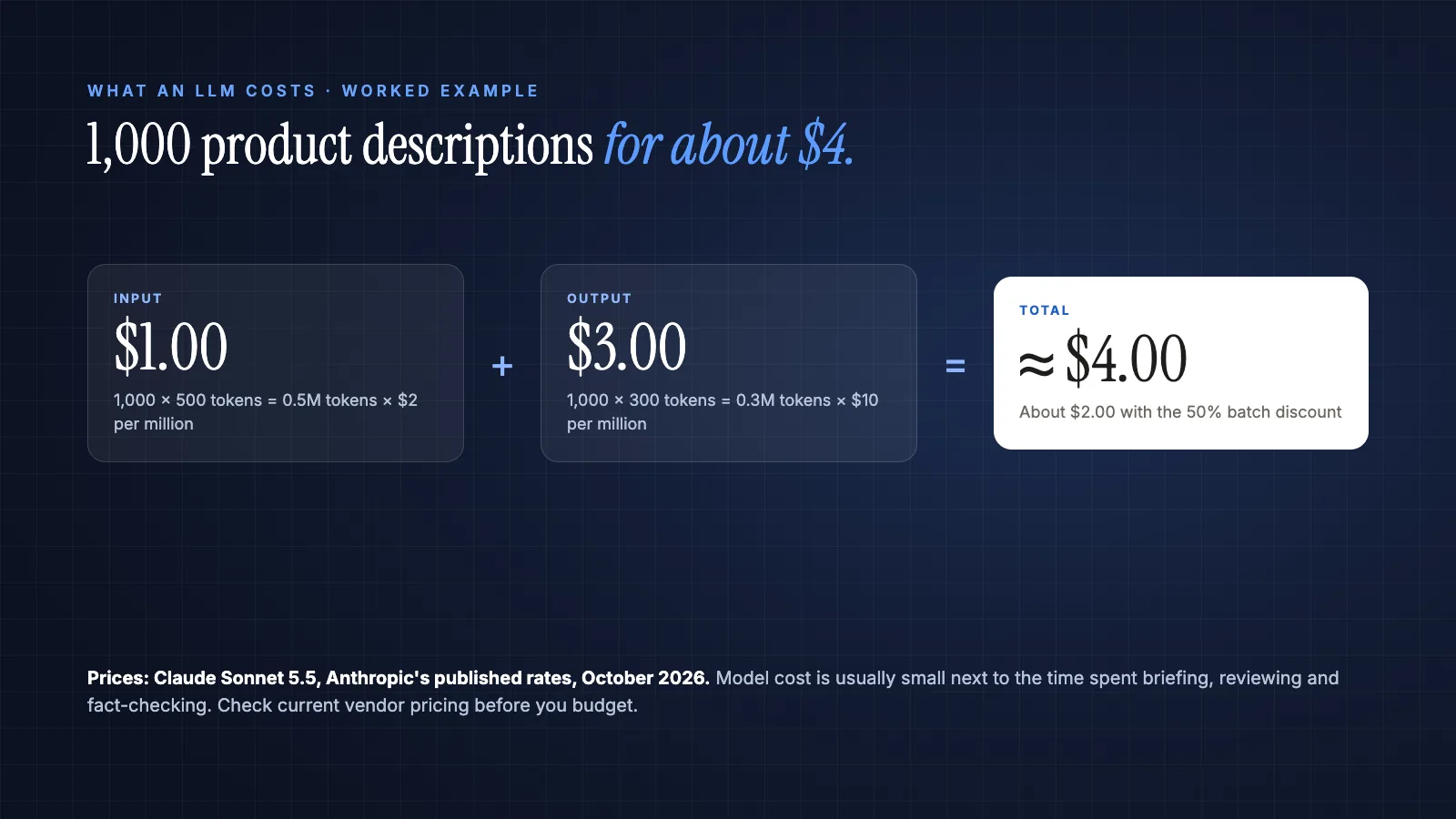
The lesson for marketers: for most content tasks, model cost is small compared with the time spent briefing, reviewing and fact-checking. Optimize for output quality and review time first, and use cheaper tiers where quality differences do not matter. Always check the vendor's current pricing page, since prices change.
Run a Two-Week LLM Test Before You Commit
Benchmarks published by vendors measure general ability, not your brand voice or your data. A short internal test tells you more.
Week 1: same tasks, every model
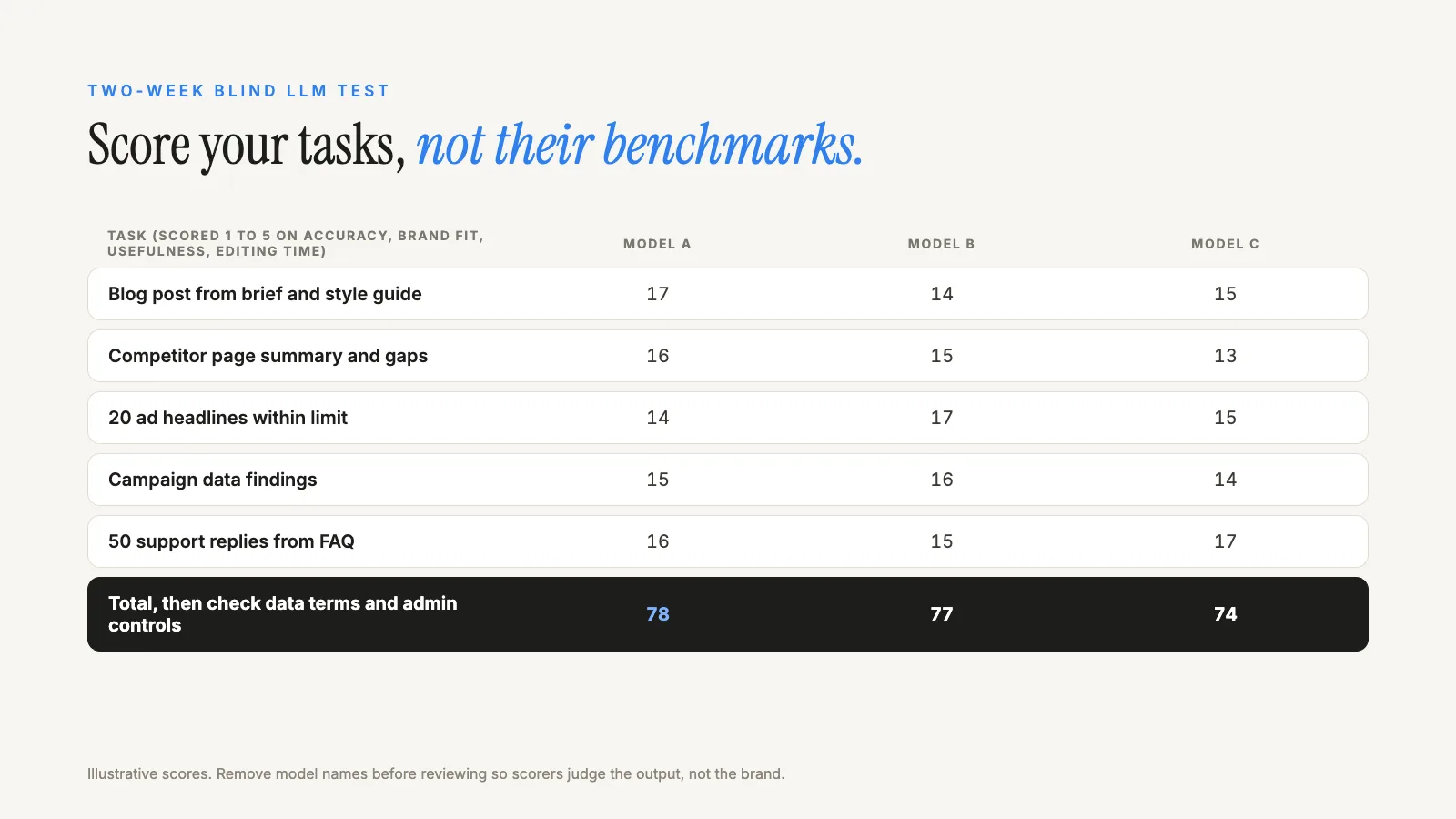
Pick five real tasks from your list, write one prompt and brief per task, and run them through two or three shortlisted models using business accounts. Save every output.
Week 2: blind review and scoring
Remove model names and have two people score each output from 1 to 5 on accuracy, brand fit, usefulness and editing time needed. Add up the scores, note the cost of each plan, and check that the winner meets your data and admin requirements.
Risks Marketers Should Manage
Invented facts
Every LLM can state things confidently that are not true. Fact-check statistics, quotes and product claims before publishing, especially on topics where accuracy affects people's money, health or safety.
Fake reviews and testimonials
Never use AI to write customer reviews or testimonials. The FTC's rule on consumer reviews, effective October 21, 2024, prohibits fake reviews, and the FTC has said AI-generated fake reviews are covered.
Search quality and disclosure
Google's guidance focuses on whether content is helpful and trustworthy, and suggests considering a disclosure of AI or automation use when readers would reasonably expect one. Use AI to speed up drafting, research and editing, not to mass-produce thin pages.
Sensitive data
Keep customer personal data, unreleased financials and confidential client material out of consumer AI tools. Use business accounts with the right terms, and set a written policy for your team.
The Other Side: Getting LLMs to Recommend Your Brand
Choosing an LLM is only half of AI for marketing. Your customers use the same models to research and choose products and services. When someone asks ChatGPT, Claude or Gemini for the best option in your category, does your brand appear?
That is the focus of generative engine optimization (GEO), and it is what we do at LLM's Marketing. Our guides on what LLM marketing covers, getting recommended by ChatGPT, showing up in ChatGPT, Perplexity and Gemini and GEO vs SEO explain how it works, and our AI advertising guide covers ads inside AI answers. If you want it done for you, see our AI search visibility service.
We also put LLMs to work inside marketing operations: AI SEO and content, AI lead agents that answer and qualify inquiries, marketing automation and email marketing.
If you are ready to let AI take actions rather than just write, our guide to AI agents for marketing covers use cases by channel, guardrails and a 90-day rollout plan.
Frequently Asked Questions
What is the best LLM for business?
There is no single best LLM for every business. The best choice is the model that fits your existing tools, meets your data and privacy requirements and performs best on your own tasks in a side-by-side test. As of October 2026, the main options are Anthropic's Claude, OpenAI's GPT models, Google's Gemini and self-hosted open-weight models.
What is the best AI for marketing?
It depends on the task. Long-form content, research, ad variations, analytics, support replies and visuals each reward different strengths. Most marketing teams use one primary assistant for daily work and a fast, low-cost model tier through the API for high-volume tasks, chosen after testing on their own content.
ChatGPT vs Claude vs Gemini: which is better for business?
Each offers capable flagship models, business plans with privacy commitments and lower-cost tiers. Practical differences usually come down to ecosystem (Gemini in Google Workspace, for example), the specific tasks you need and how each performs on your content. Run the same real tasks through each before deciding.
Do AI companies train on my business data?
For business products, the major vendors commit not to train on your data by default or without permission, as stated in Anthropic's commercial terms, Google's Workspace privacy hub and OpenAI's business data page. Consumer plans can differ, so use business accounts for company data and read the current terms.
How much does an LLM cost for a small business?
Business subscriptions are priced per user per month, and API usage is priced per million tokens. For many marketing tasks, API costs are small. In our worked example, 1,000 product descriptions cost about $4 at published Claude Sonnet 5.5 rates. Human review time is usually the larger cost.
Choose for Fit, Not for the Leaderboard
The best LLM for your business is the one your team will actually use, that keeps your data protected, and that wins a blind test on your own work. Pick a primary assistant, add a low-cost API tier for volume, keep your prompts and brand guidelines portable, and revisit the choice every six months as the models change.
If you want help choosing and rolling out AI in your marketing, or making sure AI assistants recommend your brand, book a free call, reach us through the contact page or send your details below. Our founder, Mohd Adil Kazmi, will reply personally. You can also explore all our services, case studies or the industries we work with.
Is your brand showing up in ChatGPT, Perplexity and Gemini?
Send me your website and I'll check how your brand appears in AI answers and search, then reply personally with the first fixes I would make.