
Abstract
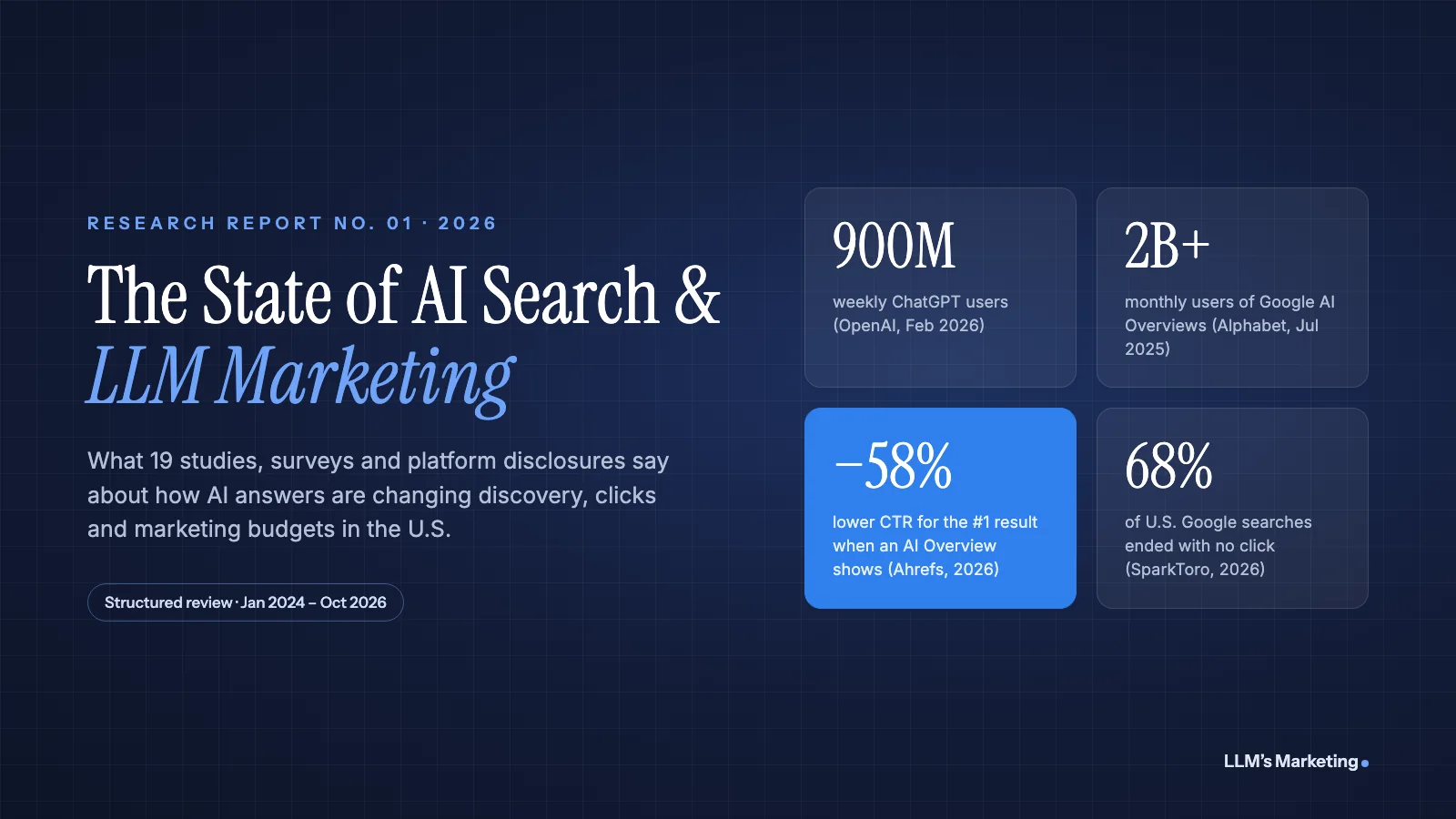
Generative AI has moved from a back-office marketing tool to the place where customers ask questions, compare options and receive recommendations. This report examines how AI answer surfaces such as ChatGPT, Google AI Overviews and Google AI Mode are changing search behavior, website traffic and marketing investment in the United States. Using a structured review of 19 peer-reviewed papers, industry studies, consumer surveys and platform disclosures published between 2020 and October 2026, with a focus on evidence from January 2024 onward, we identify six trends. AI answer surfaces now reach a majority of U.S. searchers; click-through rates fall by between 15% and 65% when an AI Overview appears; zero-click behavior has become the majority outcome on Google; brands cited inside AI answers retain materially more clicks than uncited brands; AI referral traffic is still small but grows quickly and converts well; and marketing budgets remain flat while generative AI adoption is close to universal. We propose an AI-mediated discovery model that links brand evidence, model retrieval, answer inclusion and measurable outcomes, and we set out practical implications for U.S. marketers and an agenda for future research.
- AI search
- LLM marketing
- generative engine optimization
- AI Overviews
- zero-click search
- AI referral traffic
- marketing trends 2026
Key findings
- Reach: ChatGPT reported more than 900 million weekly users in February 2026, and Google AI Overviews passed 2 billion monthly users in 2025.
- Clicks: Five independent studies report click-through declines of 15% to 65% on queries that show an AI Overview.
- Zero-click: 68% of U.S. Google searches ended without a click in early 2026, up from about 60% in 2024.
- Citations: Brands cited in an AI Overview earned 35% more organic clicks and 91% more paid clicks than uncited brands.
- Referrals: Generative AI traffic to U.S. retail sites rose 693% during the 2025 holiday season and converted 31% better than other traffic.
- Budgets: Marketing budgets held at 7.7% of company revenue in 2025, so AI search work has to be funded by reallocation, not new money.
1. Introduction
For two decades, search marketing rested on a simple exchange: publishers created useful pages, search engines ranked them, and searchers clicked through. AI search breaks that exchange. When a large language model (LLM) writes the answer, the searcher often gets what they need without visiting a website, and the brands named in that answer gain an advantage that ranking alone no longer guarantees.
Academic research on AI in marketing has so far focused mainly on how firms use AI internally, for personalization, content production, pricing and customer service (Davenport et al., 2020; Huang & Rust, 2021; Labib, 2024). Less attention has gone to the opposite direction: AI systems acting as an intermediary audience that decides which brands customers hear about. That is the shift this report examines, and it is the core of what we call LLM marketing.
This report addresses three research questions:
- RQ1. How widely are AI answer surfaces used, and how are they changing search behavior?
- RQ2. What happens to website clicks and traffic when an AI answer appears?
- RQ3. What should U.S. marketers change in strategy, measurement and budget as a result?
The report is the first in a series published in our reports, trends and insights hub. Section 2 reviews the literature, Section 3 explains the method, Section 4 presents six findings, Section 5 discusses implications, Section 6 looks ahead, and Sections 7 and 8 cover limitations and conclusions.
2. Literature review
2.1 AI in marketing: from automation to augmentation
Davenport et al. (2020) argued that AI would change marketing strategy and customer behavior, not just marketing tasks, and proposed a framework based on the level of intelligence of the AI and whether it is embedded in a robot or a software platform. Huang and Rust (2021) extended this with a three-stage view of mechanical, thinking and feeling AI, mapped to marketing research, strategy and actions. Most recently, Labib (2024) reviewed current and future trends in AI marketing and found that adoption is concentrated in personalization, predictive analytics, chatbots and content generation, while ethical questions about data use and transparency remain unresolved.
These frameworks treat AI as something the marketer deploys. Since late 2022, a second role has emerged: AI as something the marketer must persuade. When a consumer asks ChatGPT for "the best CRM for a small law firm," the model chooses which brands to mention. Existing frameworks have little to say about that role, and practitioner research has moved faster than academic work to describe it.
2.2 From search engines to answer engines
Google describes AI Overviews and AI Mode as features that give a snapshot of key information with links to dig deeper, and states that there are no extra requirements to appear in them beyond normal Search eligibility (Google Search Central, 2025). In February 2024, Gartner (2024) predicted that traditional search engine volume would drop 25% by 2026 as users moved to AI chatbots and virtual agents. That forecast was widely debated, and as Section 4 shows, the evidence points less to a collapse in searching than to a collapse in clicking.
2.3 Generative engine optimization
Aggarwal et al. (2024) introduced the term generative engine optimization (GEO) in a paper presented at KDD 2024. Using a benchmark of diverse queries, they showed that content changes such as adding citations, quotations and statistics could raise a source's visibility in generative engine responses by up to 40%, with effects that varied by domain. This is the first rigorous evidence that publishers can influence AI answers, and it underpins much of today's practice. For a practical comparison with traditional search, see our guide to GEO vs SEO.
2.4 Research gap
The evidence on AI search is scattered across vendor blogs, consultancy surveys, earnings calls and a small number of academic papers, each with its own method and time window. Marketers rarely see it side by side. This report fills that gap by consolidating the most credible figures, grading their strength and turning them into decisions.
3. Methodology
3.1 Research design
We used a structured narrative review of secondary data, the same broad approach used in recent trend reviews of AI in marketing (Labib, 2024). We did not run a new survey or panel study for this edition. Instead, we collected, verified and compared published evidence so that each figure can be traced to its original source.
3.2 Source selection and inclusion criteria
Sources were included if they met all of the following criteria:
- Published between January 2020 and October 2026, with quantitative findings from January 2024 onward.
- Primary evidence (an original study, survey, dataset or official company disclosure), or reputable reporting of such evidence where the primary document was not publicly accessible.
- A stated method, sample or data source.
- Relevance to U.S. search, AI assistants or marketing investment.
We excluded statistics we could not trace to an original source, figures that circulated only on aggregator "stats" pages, and claims that sources contradicted without a clear explanation. For example, widely shared claims that ChatGPT passed 1 billion weekly users in mid-2026 were excluded because we could not confirm an official OpenAI announcement.
3.3 Analysis approach and evidence grading
Findings were coded into themes, then grouped into six trends. Each source was graded for evidential strength:
- Grade A: peer-reviewed research, official company disclosures or large probability-based panels.
- Grade B: large proprietary datasets with a published method (for example, Search Console samples or clickstream panels).
- Grade C: forecasts or surveys from a single firm, or primary findings available only through secondary reporting.
| Source | Type | Sample or basis | Period | Grade |
|---|---|---|---|---|
| Pew Research Center | Behavioral panel | 900 U.S. adults, 68,879 searches | Mar 2025 | A |
| Alphabet Q2 2025 call | Company disclosure | AI Overviews and AI Mode users | Jul 2025 | A |
| OpenAI (via Search Engine Land) | Company disclosure | ChatGPT weekly users | Feb 2026 | A |
| Aggarwal et al. (KDD 2024) | Peer-reviewed experiment | GEO-bench queries | 2024 | A |
| Ahrefs | Search Console dataset | 300,000 keywords | Dec 2023 to Dec 2025 | B |
| Seer Interactive | Client dataset | 3,119 queries, 42 organizations | Jun 2024 to Sep 2025 | B |
| SparkToro / Similarweb | Clickstream panel | U.S. Google searches | Jan to Apr 2026 | B |
| Adobe Analytics | Retail transaction data | U.S. retail site visits | Nov to Dec 2025 | B |
| Similarweb | Web traffic panel | Generative AI platforms | Jun 2025 to May 2026 | B |
| Gartner CMO Spend Survey | Executive survey | 402 CMOs | Feb to Mar 2025 | B |
| McKinsey State of AI | Executive survey | 1,993 respondents | Jun to Jul 2025 | B |
| Bain & Company | Consumer survey | 1,117 U.S. consumers | Dec 2024 | C |
| Amsive (via Search Engine Land) | Keyword dataset | 700,000 keywords | 2024 to 2025 | C |
4. Findings: six trends shaping AI search in 2026
4.1 Trend 1: AI answer surfaces now reach most U.S. searchers
AI answers are no longer an early-adopter channel. In February 2026, OpenAI reported more than 900 million weekly active ChatGPT users, alongside more than 50 million consumer subscribers (Search Engine Land, 2026a). On Alphabet's Q2 2025 earnings call, Google said AI Overviews had more than 2 billion monthly users across more than 200 countries and territories, and that AI Mode had passed 100 million monthly active users in the U.S. and India (Alphabet, 2025). Later figures announced at Google I/O 2026 were higher, though we could only confirm them through secondary reporting.
Exposure inside Google is also substantial. In Pew Research Center's March 2025 panel, about 18% of Google searches produced an AI summary (Chapekis & Lieb, 2025). By early 2026, SparkToro's analysis of Similarweb clickstream data found AI Overviews on more than 20% of U.S. Google searches (Search Engine Land, 2026b). Meanwhile, the AI assistant market is fragmenting: ChatGPT's share of generative AI web traffic fell from about 76% in June 2025 to roughly 53% by May 2026, while overall visits to generative AI platforms averaged 9.5 billion a month, up 70% year over year (Similarweb, 2026).
Implication
Optimizing for one assistant is no longer enough. Brands need to be visible across ChatGPT, Google's AI features, Gemini, Perplexity and Claude, which share the same underlying need for clear, corroborated information about the brand.
4.2 Trend 2: Clicks fall sharply when an AI answer appears
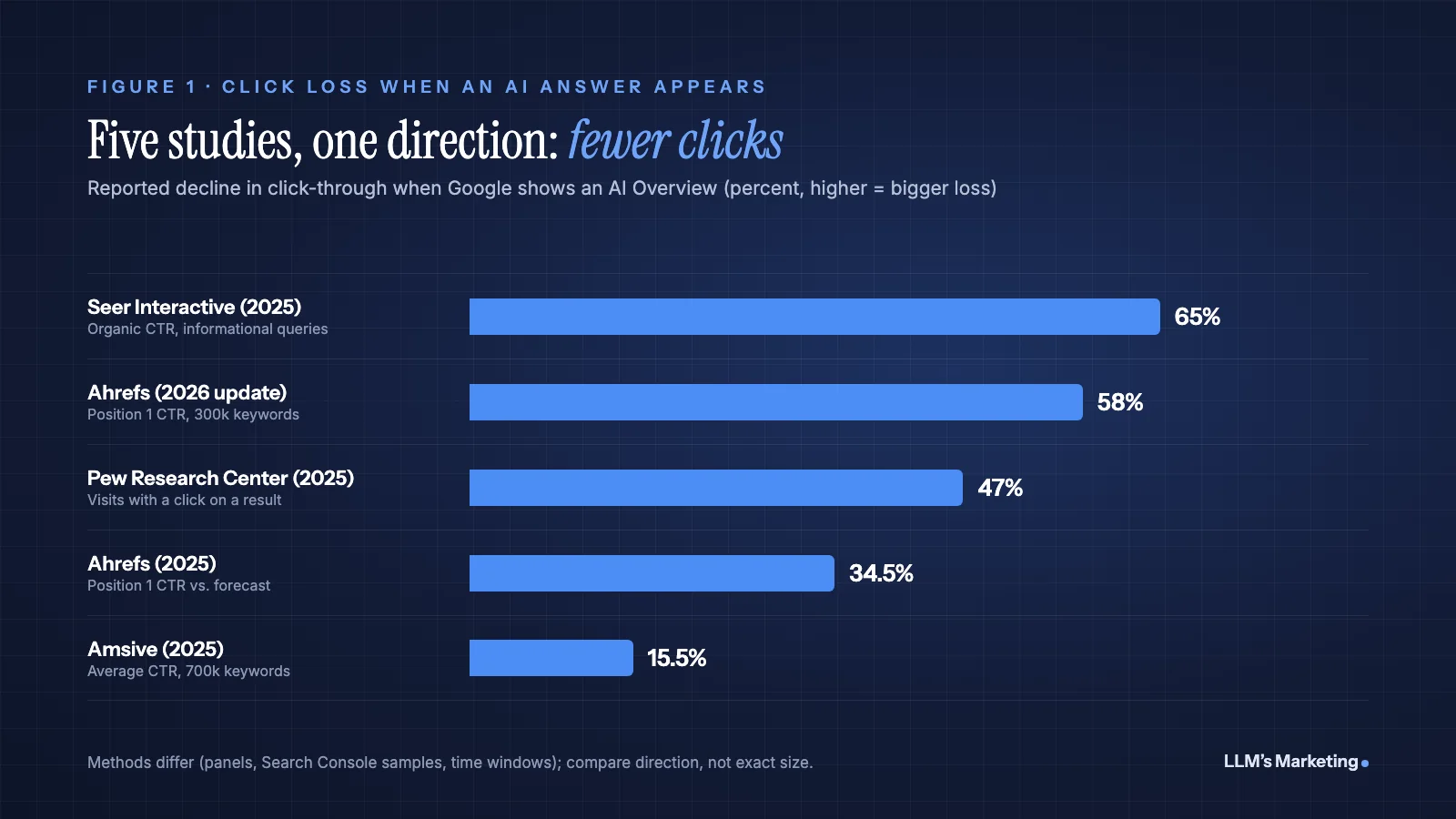
Every major study we reviewed found fewer clicks when an AI Overview appears; they differ only on how many fewer. Pew found that users clicked a traditional result in 8% of visits to pages with an AI summary, compared with 15% without one, and clicked a link inside the summary itself in just 1% of visits (Chapekis & Lieb, 2025). Ahrefs found that the top-ranking page's click-through rate was 34.5% lower on keywords with an AI Overview in its 2025 study (Ahrefs, 2025), and 58% lower in its 2026 update covering December 2023 to December 2025 (Ahrefs, 2026). Seer Interactive measured organic CTR on informational AI Overview queries falling from 1.76% to 0.61% (Seer Interactive, 2025).
| Study | Measure | Before or without | After or with | Decline |
|---|---|---|---|---|
| Seer Interactive (2025) | Organic CTR, informational queries | 1.76% | 0.61% | 65% |
| Ahrefs (2026) | Position 1 CTR | Correlational comparison | 58% | |
| Pew Research Center (2025) | Visits with a click on a result | 15% | 8% | 47% |
| Ahrefs (2025) | Position 1 CTR vs. forecast | 0.040 | 0.026 | 34.5% |
| Amsive (2025) | Average CTR | 700,000 keywords | 15.5% | |
Paid search is not immune. Seer reported paid CTR on the same AI Overview queries falling from 19.7% to 6.34%, and organic CTR on queries without an AI Overview also fell 41% year over year, which suggests that AI assistants outside Google are absorbing some demand too (Seer Interactive, 2025; Search Engine Land, 2025).
4.3 Trend 3: Zero-click is now the majority outcome
SparkToro's 2026 study found that 68% of U.S. Google searches between January and April 2026 ended without a click, compared with roughly 60% in its 2024 study, and that only a small share of searches moved into AI Mode during that period (Search Engine Land, 2026b). Pew found that users were more likely to end their browsing session after a page with an AI summary (26%) than after one without (16%) (Chapekis & Lieb, 2025). Bain's December 2024 consumer survey reported that about 80% of consumers rely on zero-click results for at least 40% of their searches, which Bain estimates reduces organic web traffic by 15% to 25% (Bain & Company, 2025).
Together, these results answer the Gartner forecast discussed in Section 2.2. People have not stopped searching. They have stopped clicking. For marketers, that means traffic is becoming a lagging and incomplete measure of search visibility.
4.4 Trend 4: Being cited is the new ranking
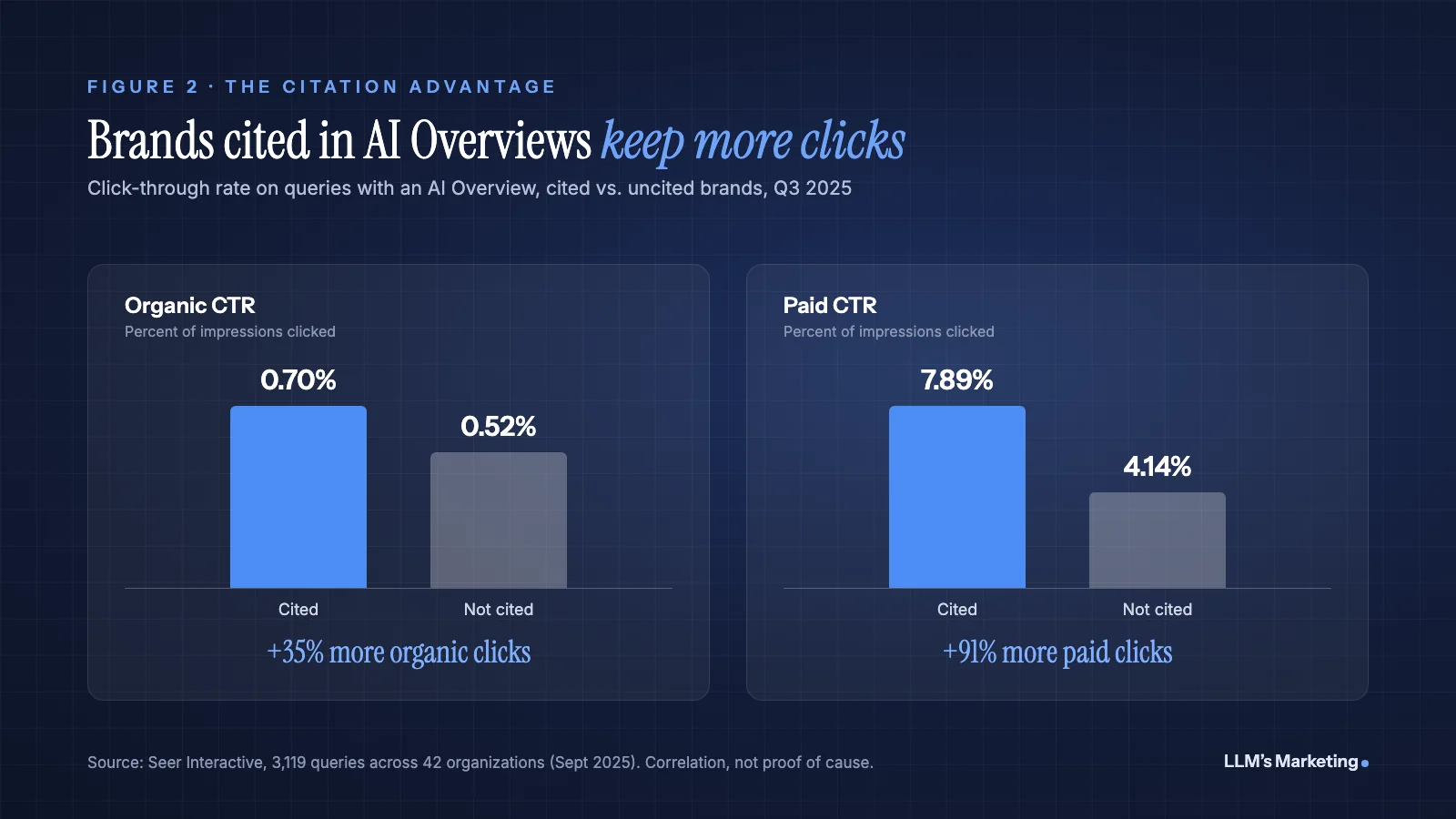
If clicks are scarce, who gets them matters more. Seer Interactive found that brands cited inside an AI Overview earned 35% more organic clicks and 91% more paid clicks than brands that were not cited. In Q3 2025, organic CTR was 0.70% for cited brands versus 0.52% for uncited brands, and paid CTR was 7.89% versus 4.14% (Seer Interactive, 2025). Seer is careful to note that this is a correlation: the same brand authority that earns a citation may also drive the extra clicks.
The experimental evidence points the same way. Aggarwal et al. (2024) showed that adding citations, quotations and statistics to content could increase its visibility in generative answers by up to 40%. In practice, this favors brands that publish original data, quote named experts and are described consistently across their own site, reviews and third-party coverage. Our guides on getting recommended by ChatGPT and schema and entity optimization for LLMs cover the practical steps.
4.5 Trend 5: AI referral traffic is small, fast-growing and high-intent
Traffic from AI assistants is still a minor channel next to organic and paid search, but it is growing at a rate no other channel matches. Adobe reported that generative AI traffic to U.S. retail sites rose 693.4% during the 2025 holiday season compared with the year before, and that these visits converted 31% better than other traffic (Adobe, 2026). Adobe itself cautions that the large percentages reflect a small starting base.
The likely reason for the higher conversion rate is that AI assistants do the research step for the user. Someone who clicks through from an AI answer has usually already compared options and is closer to a decision. For lead-generation businesses, this makes AI referrals worth tracking as a separate channel in analytics, even while volumes are small.
4.6 Trend 6: Budgets are flat while AI adoption is near universal
Gartner's 2025 CMO Spend Survey of 402 marketing leaders found budgets flat at 7.7% of company revenue for a second year, with 59% of CMOs saying they lack enough budget to execute their strategy. Only 1% said generative AI was not a current priority, and 22% said it had reduced their reliance on external creative and strategy support (Gartner, 2025). McKinsey's 2025 State of AI survey found that 79% of organizations now use generative AI in at least one function, up from 33% in 2023, but only 7% say AI is fully scaled across the organization (McKinsey & Company, 2025).
The combination matters. Marketing teams are expected to cover a new discovery channel without new money, while most are still early in operationalizing AI. In our view, the winners will be the teams that reallocate from declining tactics, such as thin informational content that AI now answers directly, toward work that earns citations and conversions.
5. Discussion
5.1 Theoretical implications
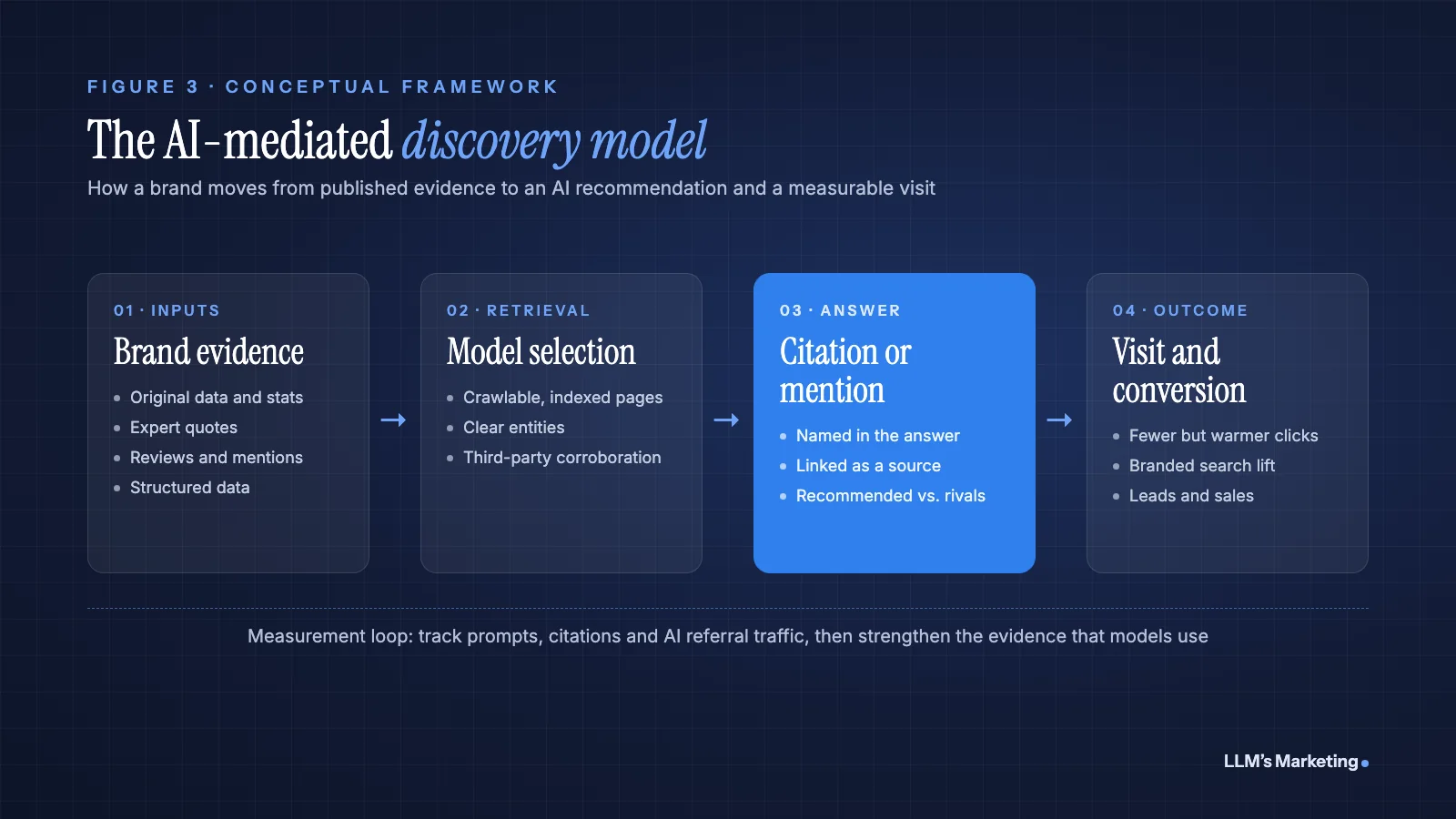
The evidence supports extending existing AI-in-marketing frameworks with a fourth role for AI: the intermediary audience. In Huang and Rust's (2021) terms, firms use mechanical, thinking and feeling AI to serve customers; increasingly, customers use their own thinking AI to evaluate firms. We summarize this as the AI-mediated discovery model (Figure 3). Brand evidence, such as original data, expert quotes, reviews and structured data, feeds model retrieval. Retrieval decides answer inclusion, as a mention, a cited link or a recommendation. Inclusion drives outcomes, which are fewer but warmer visits, branded search lift and conversions. A measurement loop connects outcomes back to evidence.
5.2 Managerial implications for U.S. marketers
Five practical actions follow from the findings:
- Measure share of AI answers, not only rankings. Track a fixed set of buyer prompts across ChatGPT, Google AI Mode, Gemini and Perplexity each month, and record whether your brand is mentioned, cited or recommended.
- Publish evidence that models can quote. Original statistics, named expert commentary and clear definitions are the content traits most associated with inclusion (Aggarwal et al., 2024). This report is itself an example of the format.
- Re-base KPIs on conversions. With click-through falling by a third to two thirds on affected queries, organic sessions will undercount search's contribution. Report leads, pipeline and branded search alongside traffic.
- Separate AI referral traffic in analytics. Create a channel group for chatgpt.com, perplexity.ai, gemini.google.com and similar referrers so its growth and conversion rate are visible.
- Reallocate rather than add budget. Shift spend from easily summarized informational content toward original research, digital PR and comparison content that earns third-party corroboration.
Teams that want a starting baseline can request a review through our AI search visibility service, or see how we run tests in our approach.
6. Future trends: what to watch in 2027
The following are our expectations based on the evidence reviewed, not established findings.
6.1 From answers to agents
AI assistants are moving from answering questions to completing tasks such as booking, comparing and purchasing. When an agent shortlists vendors on a buyer's behalf, inclusion becomes even more binary. Accurate, machine-readable information on pricing, availability and service areas will matter more. We cover the marketing side of this shift in AI agents for marketing.
6.2 Advertising inside AI answers
As AI answers absorb clicks, paid placements inside and around them are becoming a significant part of search advertising. Marketers should expect paid and earned AI visibility to interact, as Seer's paid CTR data already suggests. See our guide to AI advertising.
6.3 Measurement standards
Today, every vendor measures AI visibility differently, which is why the studies in Table 2 disagree on magnitude. We expect pressure from advertisers and publishers for more consistent reporting from platforms on impressions, citations and clicks from AI features.
6.4 Future research agenda
Three questions deserve rigorous study: whether citations cause additional clicks or simply reflect brand strength; how AI visibility differs by industry and local market; and how AI recommendations influence offline and phone conversions, which matter most for local service businesses.
7. Limitations
This review has several limitations. First, it relies on secondary data, and several key datasets (Ahrefs, Seer Interactive, Similarweb, Adobe) are proprietary, so their methods cannot be fully audited. Second, the studies use different measures, time windows and samples, so their effect sizes are not directly comparable. Third, some figures, including SparkToro's 2026 results and the Amsive study, were available to us only through reputable secondary reporting. Fourth, most evidence concerns Google; independent data on click behavior inside ChatGPT, Gemini and Perplexity remains thin. Finally, the field changes quickly, and figures in this report reflect sources available on October 27, 2026. We will update the report as new evidence is published.
8. Conclusion
AI search has passed the point of experimentation. AI answer surfaces reach a majority of U.S. searchers, clicks fall sharply when they appear, and the majority of Google searches now end without a visit. Yet the evidence also shows a clear path forward: brands that AI systems cite keep more of the remaining clicks, and the visitors who do arrive from AI assistants are unusually ready to act. For U.S. marketers, the strategic question for 2027 is no longer whether to optimize for AI answers, but how quickly they can measure their share of those answers and build the evidence that earns it.
Frequently asked questions
How much traffic do AI Overviews take from websites?
Studies report click-through declines of between 15% and 65% on queries where Google shows an AI Overview. Ahrefs' 2026 update found a 58% lower click-through rate for the top-ranking page, and Pew found that searchers clicked a result in 8% of visits with an AI summary versus 15% without one.
What share of Google searches end without a click?
SparkToro's analysis of Similarweb clickstream data found that 68% of U.S. Google searches between January and April 2026 ended without a click, up from roughly 60% in 2024.
Does being cited in an AI Overview help?
Yes, on current evidence. Seer Interactive found that brands cited in AI Overviews earned 35% more organic clicks and 91% more paid clicks than uncited brands, although the relationship is correlational.
How many people use ChatGPT?
OpenAI reported more than 900 million weekly active ChatGPT users in February 2026. Reports of a 1 billion weekly milestone later in 2026 had not been confirmed by an official OpenAI announcement at the time of writing.
Declarations
Disclosure statement
The author is the founder of LLM's Marketing, which provides AI search visibility and SEO services. No organization cited in this report reviewed or sponsored it.
Funding
This research was self-funded by LLM's Marketing.
Data availability statement
All data analyzed in this report come from the publicly available sources listed in the references. No new data were collected.
References
- Adobe. (2026, January 7). Holiday shopping season 2025 [Press release]. https://news.adobe.com/news/downloads/pdfs/2026/01/010726-holiday-shopping-season-2025.pdf
- Aggarwal, P., Murahari, V., Rajpurohit, T., Kalyan, A., Narasimhan, K., & Deshpande, A. (2024). GEO: Generative engine optimization. In Proceedings of the 30th ACM SIGKDD Conference on Knowledge Discovery and Data Mining. https://doi.org/10.1145/3637528.3671900
- Ahrefs. (2025, April). AI Overviews reduce clicks by 34.5%. https://ahrefs.com/blog/ai-overviews-reduce-clicks/
- Ahrefs. (2026, February). Update: AI Overviews reduce clicks by 58%. https://ahrefs.com/blog/ai-overviews-reduce-clicks-update/
- Alphabet Inc. (2025, July 23). 2025 Q2 earnings call. https://abc.xyz/investor/events/event-details/2025/2025-Q2-Earnings-Call/
- Bain & Company. (2025, February). Goodbye clicks, hello AI: Zero-click search redefines marketing. https://www.bain.com/insights/goodbye-clicks-hello-ai-zero-click-search-redefines-marketing/
- Chapekis, A., & Lieb, A. (2025, July 22). Google users are less likely to click on links when an AI summary appears in the results. Pew Research Center. https://www.pewresearch.org/short-reads/2025/07/22/google-users-are-less-likely-to-click-on-links-when-an-ai-summary-appears-in-the-results/
- Davenport, T., Guha, A., Grewal, D., & Bressgott, T. (2020). How artificial intelligence will change the future of marketing. Journal of the Academy of Marketing Science, 48(1), 24–42. https://doi.org/10.1007/s11747-019-00696-0
- Gartner. (2024, February 19). Gartner predicts search engine volume will drop 25% by 2026, due to AI chatbots and other virtual agents [Press release]. https://www.gartner.com/en/newsroom/press-releases/2024-02-19-gartner-predicts-search-engine-volume-will-drop-25-percent-by-2026-due-to-ai-chatbots-and-other-virtual-agents
- Gartner. (2025, May 12). Gartner 2025 CMO Spend Survey reveals marketing budgets have flatlined at 7.7% of overall company revenue [Press release]. Business Wire. https://www.businesswire.com/news/home/20250512782208/en/
- Google Search Central. (2025). AI features and your website. https://developers.google.com/search/docs/appearance/ai-features
- Huang, M.-H., & Rust, R. T. (2021). A strategic framework for artificial intelligence in marketing. Journal of the Academy of Marketing Science, 49(1), 30–50. https://doi.org/10.1007/s11747-020-00749-9
- Labib, E. (2024). Artificial intelligence in marketing: Exploring current and future trends. Cogent Business & Management, 11(1), Article 2348728. https://doi.org/10.1080/23311975.2024.2348728
- McKinsey & Company. (2025). AI at work but not at scale. https://www.mckinsey.com/featured-insights/week-in-charts/ai-at-work-but-not-at-scale
- Search Engine Land. (2025). Google AI Overviews hurt click-through rates: Study. https://searchengineland.com/google-ai-overviews-hurt-click-through-rates-454428
- Search Engine Land. (2026a, February). OpenAI: ChatGPT now has 900 million weekly active users. https://searchengineland.com/chatgpt-900-million-weekly-active-users-470492
- Search Engine Land. (2026b). Google zero-click searches reach 68% in early 2026: Study. https://searchengineland.com/google-zero-click-searches-reach-68-in-early-2026-study-479717
- Seer Interactive. (2025, September). AIO impact on Google CTR: September 2025 update. https://www.seerinteractive.com/insights/aio-impact-on-google-ctr-september-2025-update
- Similarweb. (2026, July 29). AI search stats 2026: Market share, referral, and citation data. https://aisearch.similarweb.com/blog/gen-ai-stats/
Cite this report
You are welcome to quote and cite this report with a link to this page.
Kazmi, M. A. (2026). The state of AI search and LLM marketing 2026: Trends, evidence and implications for U.S. marketers (Research Report No. 01). LLM's Marketing. https://llmsmarketing.com/report/state-of-ai-search-llm-marketing-2026/
Kazmi, Mohd Adil. The State of AI Search and LLM Marketing 2026: Trends, Evidence and Implications for U.S. Marketers. LLM's Marketing, 27 Oct. 2026, llmsmarketing.com/report/state-of-ai-search-llm-marketing-2026/.
@techreport{kazmi2026aisearch,
  author      = {Kazmi, Mohd Adil},
  title       = {The State of AI Search and LLM Marketing 2026: Trends, Evidence and Implications for U.S. Marketers},
  institution = {LLM's Marketing},
  number      = {01},
  year        = {2026},
  month       = oct,
  url         = {https://llmsmarketing.com/report/state-of-ai-search-llm-marketing-2026/}
}
How visible is your brand in AI answers?
Send me your website and I'll reply personally with where your brand appears in ChatGPT, Google AI Mode and Perplexity today, and the first fixes I would make.