

A small dental practice competes against groups with marketing departments, dental support organizations (DSOs) with national ad budgets and the practice down the street that seems to be everywhere. The owner-dentist usually has a few hours a month and a modest budget for marketing. The good news is that most new patients still choose a dentist close to home, from what they see on Google, in reviews and from people they trust. Those are channels a small practice can win.
Marketing a small dental practice means attracting and keeping patients with a limited budget by focusing on the channels closest to the booking decision: a complete Google Business Profile, a website that answers treatment, insurance and cost questions and makes booking easy, a steady flow of genuine reviews, recall and referrals from existing patients, and local community presence. Paid ads and social media come after those foundations, and every channel should be measured by booked appointments.
This guide gives you a budget-tiered plan, current US search data, the review and privacy rules that apply to dental practices, and a 90-day schedule you can follow with a small team.
Why Small Dental Practices Can Still Win
The market is consolidating. According to ADA News, reporting on the ADA Health Policy Institute's 2025 workforce update, younger dentists are delaying practice ownership and the shift from solo practice to group practices and DSOs is a decade-long trend expected to continue (ADA News, September 2025).
That pressure is real, but it also defines the opportunity. Larger groups win on ad budgets and brand awareness. A small practice wins on things patients care about at least as much: seeing the same dentist every visit, a front desk that knows their name, flexible scheduling and a practice embedded in the neighborhood. Good marketing for a small practice makes those advantages visible online, where patients now compare options before they call.
Know Your Numbers Before You Spend
Before choosing tactics, answer three questions with real data from your practice management software:
- How many new patients do you need each month? Work back from your capacity and your goals, and remember that hygiene openings and dentist chair time are different constraints.
- Where do current new patients come from? Ask every new patient "How did you hear about us?" and record it in a consistent field. Without this, every marketing decision is a guess.
- What is a new patient worth? Average first-year production, plus how long patients typically stay. This tells you how much you can sensibly spend to acquire one.
Then look at demand. Patients search by need, and difficulty varies widely. National averages from the Semrush US keyword database (October 2026):
| Search | US monthly searches | Average cost per click | Keyword difficulty (0 to 100) |
|---|---|---|---|
| dentist near me | 1,000,000 | $8.30 | 76 |
| dental implants near me | 135,000 | $17.88 | 14 |
| emergency dentist | 135,000 | $6.86 | 30 |
| pediatric dentist near me | 110,000 | $6.52 | 54 |
| teeth whitening near me | 90,500 | $4.27 | 8 |
| dental cleaning near me | 74,000 | $7.33 | 20 |
| cosmetic dentist near me | 60,500 | $6.26 | 6 |
"Dentist near me" is decided mostly in the map pack by distance, relevance and prominence, so a small practice rarely wins it everywhere. Treatment searches such as "cosmetic dentist near me" (difficulty 6) and "teeth whitening near me" (8) are much more open to a practice with a strong page for each service. We break down the cost side of this in Google Ads vs SEO for dentists.
A Budget-Tiered Dental Marketing Plan
Small practices get the best return by working from the bottom of this list up. Each tier depends on the one below it: ads sent to a weak website waste money, and a strong website with no reviews still loses to the practice with 300 of them. The same order applies outside dentistry, as our guide to small business marketing strategies shows with click costs across ten industries.
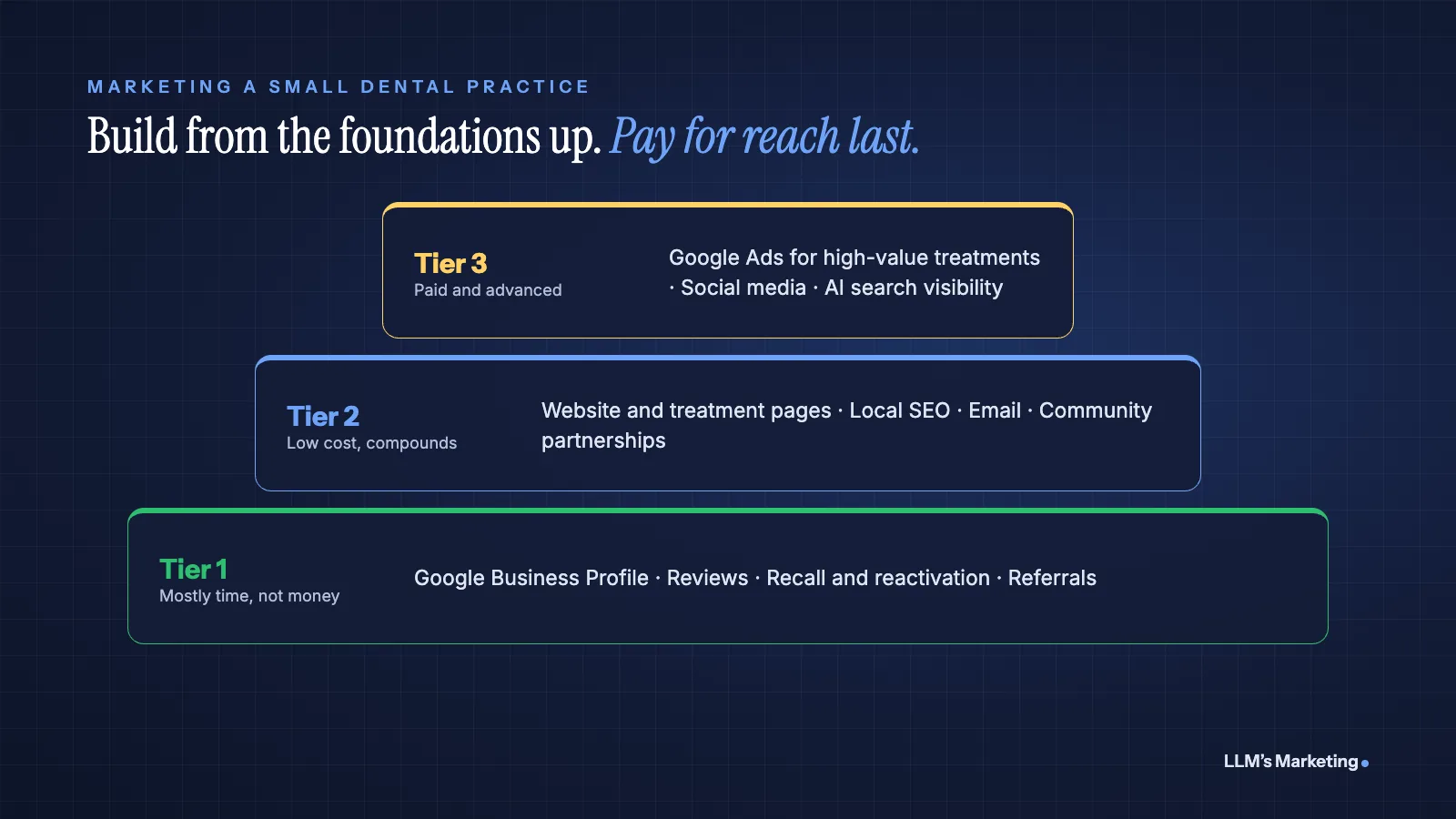
Tier 1: Foundations That Cost Time, Not Money
Google Business Profile
Your Google Business Profile is often the first thing a patient sees, and it is free. Complete every field: primary category ("Dentist," or your specialty), services, hours including holiday hours, insurance information where your profile supports it, accessibility details, appointment links and real photos of your team, office and equipment. Google says local results are based mainly on relevance, distance and prominence, and a complete profile helps with relevance.
Dentists also fall under Google's practitioner rules. A public-facing dentist who can be contacted at the verified location during stated hours can have an individual practitioner profile; a practice with a single public-facing dentist should use one profile named "Practice: Doctor Name." Specialist practices have extra considerations: see our SEO for orthodontists page for how this works with multiple doctors and offices.
Reviews
Reviews are the most powerful trust signal a small practice controls. Google recommends asking patients to leave a review using a link or QR code and replying to reviews, positive and negative (Google Business Profile Help). Build the request into your checkout routine or a follow-up message, so every patient is asked the same way.
Three rules keep the program safe:
- Ask everyone. Google's policies prohibit selectively soliciting positive reviews, discouraging negative ones and offering incentives such as discounts or free services in exchange for reviews (Google). The FTC's 2024 rule on reviews also bans fake reviews and paying for positive ones (FTC).
- Reply without confirming anyone is a patient. A California dental practice paid $23,000 to settle with HHS after its replies to Yelp reviews disclosed patient information. Thank people generically and invite them to call the office.
- Get written authorization for testimonials and photos. Using patient information for marketing generally requires the patient's signed authorization under the HIPAA Privacy Rule.
Recall and reactivation
The cheapest new appointment is an existing patient who is overdue. Run a monthly report of patients with no future appointment, and contact them by phone, email and text (with their consent). Many small practices find more revenue in a clean recall system than in any new marketing channel, and it costs almost nothing.
Referrals
Happy patients tell friends, but only if you make it easy. Mention at the end of a visit that you are welcoming new patients, give a simple card or link, and thank referring patients personally. Before offering any reward for referrals, check your state dental board's rules and the ADA Code, since some states restrict paying for patient referrals.
Tier 2: Low-Cost Channels That Compound
A website that books appointments
Your website does not need to be expensive, but it needs to answer the questions patients ask before calling: which insurance you accept, whether you take new patients, what common treatments cost or how payment works, where you are and how to book. Put online booking or a short request form on every page, make the phone number tappable on mobile and keep pages fast.
Treatment pages and local SEO
Give each service you want more of its own page: implants, emergency care, whitening, Invisalign or clear aligners if you offer them, pediatric dentistry, sedation. Each page should explain what the treatment is, who it suits, what to expect, typical cost factors and how to book, reviewed by your dentist. This is how a small practice ranks for the low-difficulty treatment searches in the table above. Our guide to generative engine optimization for dentists shows how the same pages help you appear in AI answers.
Keep your name, address and phone number identical everywhere they appear: your website, Google, Apple Maps, Bing, Yelp, Healthgrades and insurance directories. Inconsistent listings confuse patients and search engines alike. For the wider SEO basics behind all of this, see how to SEO a website.
Email and text
A short monthly email with an oral health tip, a team update and a booking link keeps your practice in mind between visits. Follow the FTC's CAN-SPAM rules for marketing email: include your physical postal address, use honest subject lines, give an easy way to opt out and honor opt-outs within 10 business days (FTC). For marketing texts, get written consent first and confirm the rules with your vendor or counsel.
Community partnerships
Local presence is where a small practice outshines a chain. Sponsor a school sports team, offer oral health talks at schools and senior centers, partner with local employers on benefits fairs and join the chamber of commerce. These activities build word of mouth and often earn local links and mentions that support your search visibility.
Tier 3: Paid and Advanced Channels
Google Ads for high-value treatments
Paid search makes sense for treatments where a new patient is worth far more than the clicks it takes to win them, such as implants, and for filling gaps while your organic pages grow. Google says ad spend has no impact on organic search results, so ads and SEO do different jobs. Send each campaign to a dedicated treatment page, not your homepage.
Social media
Social media works best for a small practice as proof of personality: introduce the team, show the office, answer common questions in short videos and celebrate community events. Post consistently on one or two platforms rather than everywhere. If you use AI to save time, our guide on how to use AI for social media covers a weekly workflow and the disclosure rules. The American Dental Association's code also applies to social media and influencer content, as covered in our dentist GEO guide.
AI search visibility
Patients increasingly ask ChatGPT, Google AI Mode and Perplexity for dentist recommendations or treatment explanations. Google says there are no special requirements to appear in AI Overviews or AI Mode beyond strong SEO fundamentals. The profile, treatment pages, consistent listings and reviews from tiers 1 and 2 are what AI systems draw on. Our guide on how to get your brand recommended by ChatGPT explains the rest.
Marketing Specialist Practices
Specialists follow the same tiers with different emphasis. Orthodontists depend on cost and treatment pages, parent-focused early treatment content and consultation booking; our orthodontic SEO services page covers that plan in detail. Practices with medical and cosmetic sides, like dermatology, face similar splits, which we cover in SEO for dermatologists.
A 90-Day Plan for a Small Dental Practice
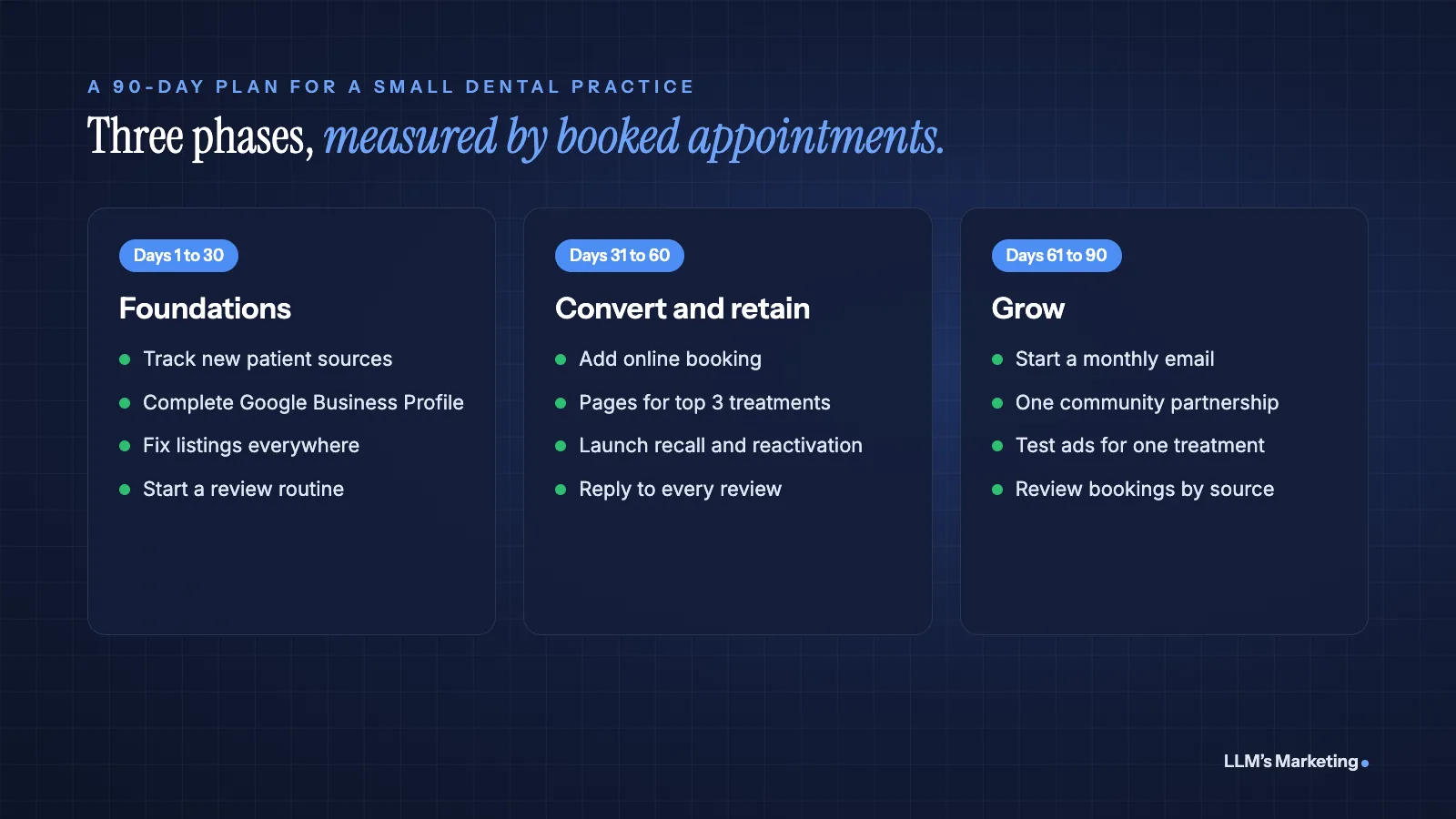
| Phase | Actions | Measure |
|---|---|---|
| Days 1 to 30 | Track new patient sources, complete the Google Business Profile, fix listings, start the review routine | Profile views and calls, reviews per month |
| Days 31 to 60 | Add online booking, publish pages for your top three treatments, launch recall and reactivation | Booking requests, reactivated patients |
| Days 61 to 90 | Start a monthly email, add one community partnership, test ads for one high-value treatment | New patients by source, cost per new patient |
Common Mistakes Small Practices Make
- Buying ads before fixing the basics. Paid clicks landing on a slow site with no booking option and a thin profile cost more and convert less.
- Not tracking sources. If you cannot say where last month's new patients came from, you cannot tell which spend to cut.
- Review gating. Sending only happy patients to Google breaks Google's policies and can cost you reviews or worse.
- Replying to reviews with clinical details. Even a friendly reply that mentions treatment can disclose protected health information.
- One page for every service. A single "Services" page rarely ranks for anything specific.
- Ignoring existing patients. Recall and referrals are usually the highest-return channels a small practice has.
Frequently Asked Questions
How do I market a small dental practice?
Start with the channels closest to the booking decision: a complete Google Business Profile, a website that answers insurance, cost and booking questions, a routine for genuine reviews, recall and referrals from existing patients, and local community presence. Add treatment pages, email and paid ads once those foundations work, and measure every channel by booked appointments.
How much should a small dental practice spend on marketing?
There is no single right figure. Base the budget on how many new patients you need, what a new patient is worth to your practice and how much capacity you have. Start with low-cost foundations, then add paid channels and measure cost per new patient, cutting anything that does not produce bookings.
What is the best marketing for a new dental practice?
A new practice should prioritize its Google Business Profile, a fast website with online booking, early reviews from every patient, listings on insurance directories and community introductions. Paid search can bring patients sooner while the profile and pages build visibility over the first months.
Can a dental practice offer rewards for reviews?
No. Google's policies prohibit offering discounts, free services or payment in exchange for reviews, and the FTC's 2024 rule bans paying for positive reviews. Ask every patient the same way and let them choose whether to leave a review.
Does social media help a small dental practice?
It helps most as proof of the team and the patient experience, and as a way to stay in touch with existing patients. For attracting new patients, the Google Business Profile, reviews and treatment pages usually matter more, so treat social media as a supporting channel.
Where to Start
Start by tracking where new patients come from, then complete your Google Business Profile and put a review routine in place this month. Next, add online booking and pages for your top treatments, and switch on recall. Add paid channels only once you can measure what each new patient costs. Our dental SEO page shows how we approach this for practices in Cypress, Texas, and our SEO for orthodontists page covers specialist practices.
If you would like a second opinion, book a free call, reach us through the contact page or send your details below. Our founder, Mohd Adil Kazmi, will review your profile, website, reviews and AI visibility and reply with the first fixes worth making. You can also explore our AI SEO and content service, our email marketing service or the industries we work with.
Where are new patients finding your practice, or missing it?
Send your website and I'll review your Google Business Profile, service pages and AI visibility, then reply personally with the first fixes I would make.