
Most small businesses do not have a marketing problem. They have a focus problem. There are dozens of channels to try, every vendor says theirs is essential and the budget covers maybe three of them. This guide lays out 13 small business marketing strategies that work, ranks them by cost and speed, and shows which ones to start with so your first dollars go to assets that keep paying back.
The most effective small business marketing strategies start with knowing your customers and competitors, then build assets you own: a fast mobile website, helpful content, an email list, a complete Google Business Profile and a steady flow of genuine reviews. Paid channels such as search ads, social ads and retargeting work best once those foundations are in place, because they send people to pages and profiles that already convert.
You are in good company. The SBA Office of Advocacy counts 36,207,130 small businesses in the United States, 99.9% of all businesses, employing 62.3 million people (SBA Office of Advocacy, February 2026). Most of them compete for the same local searches you do. Everything below is built on official guidance from Google, the FTC and the SBA, plus current consumer research and our own Semrush data, and it is current as of November 2026.
13 Small Business Marketing Strategies at a Glance
Use this table to pick a starting point. Cost and speed are our practical estimates for a typical local or regional business, not fixed rules.
| Strategy | Cost | Time to results | Best for |
|---|---|---|---|
| 1. Study your competitors | Free to low | Days | Everyone, before spending |
| 2. Define your target customer | Free | Days | Everyone, before spending |
| 3. Build a fast, mobile-first website | Medium | Weeks | Every business |
| 4. Publish helpful content | Low to medium | 3 to 6 months | Services with research-heavy buyers |
| 5. Grow an email list | Low | Weeks | Repeat purchases, long sales cycles |
| 6. Optimize your Google Business Profile | Free | Weeks | Local and service-area businesses |
| 7. Earn reviews and testimonials | Free | Ongoing | Every business |
| 8. Get found in AI answers | Low to medium | Months | Businesses customers research first |
| 9. Use social media with a purpose | Low to medium | Months | Visual products, community brands |
| 10. Reward loyalty and referrals | Low | Weeks | Businesses with repeat customers |
| 11. Partner with businesses and creators | Low to medium | Weeks to months | Shared audiences, local markets |
| 12. Become the local expert | Low | Months | Professional services |
| 13. Retarget and run smart promotions | Medium | Days to weeks | Sites with steady traffic |
Start With the Numbers: What Local Clicks Cost
Before choosing channels, look at what it costs to buy attention. We pulled US search volume and average cost per click (CPC) from Semrush for ten common "near me" searches in November 2026.
| Keyword | Monthly US searches | Average CPC |
|---|---|---|
| personal injury lawyer near me | 90,500 | $128.80 |
| roofing company near me | 49,500 | $29.73 |
| hvac repair near me | 135,000 | $28.74 |
| plumber near me | 550,000 | $23.72 |
| electrician near me | 301,000 | $16.25 |
| accountant near me | 18,100 | $8.70 |
| dentist near me | 1,000,000 | $8.30 |
| landscaping near me | 201,000 | $4.62 |
| auto repair near me | 368,000 | $3.20 |
| hair salon near me | 450,000 | $1.01 |
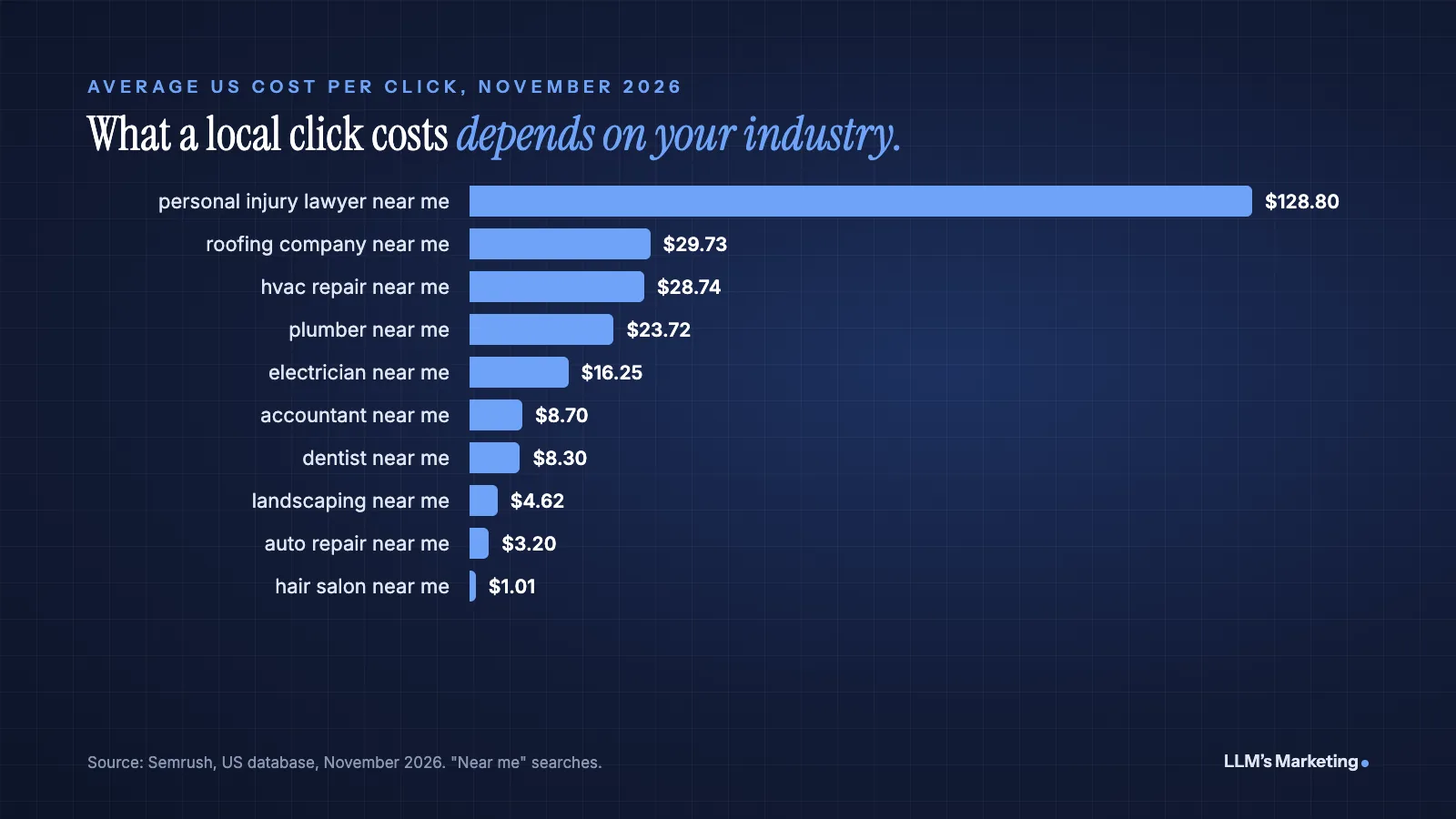
The spread is the point. A $1,000 monthly ad budget buys about 42 clicks for a plumber and fewer than 8 for a personal injury firm, and only some of those clicks become calls. Paid search can still be worth it, but in expensive categories every dollar you put into your Business Profile, reviews and website lowers what you need to spend on ads. That is why the strategies below start with the free and owned channels.
Know Your Market Before You Spend
The first two strategies cost almost nothing and decide whether everything after them works.
1. Study Your Competitors
The SBA's marketing guidance asks owners to "describe what gives your product or service an advantage over the competition" (SBA). You cannot answer that without looking. Search for your main service in your city, then note who shows up in the map results, the organic results and the ads.
What to record for each competitor
- Review count, average rating and how recent the latest reviews are
- The services and areas their website has dedicated pages for
- Their offer: price signals, guarantees, financing, response times
- What customers praise or complain about in their reviews
Complaints in competitors' reviews are free market research. If customers keep mentioning no-shows or surprise fees, a guaranteed arrival window or upfront pricing becomes your positioning.
2. Define Your Target Customer
The SBA advises owners to "describe your audience in detail," including the market's size, demographics and traits (SBA). In practice, write one paragraph per customer type that covers who they are, the problem that makes them search, the words they use and what makes them choose one business over another.
Your best source is your existing customers. Ask your last ten how they found you and why they picked you. Those answers become your headlines, your ad copy and the questions your website should answer.
Build Marketing Assets You Own
Rented attention (ads, social reach) stops when you stop paying. Owned assets keep working. These three are the core.
3. Build a Fast, Mobile-First Website
Google states that it "uses the mobile version of a site's content, crawled with the smartphone agent, for indexing and ranking" (Google Search Central). If your site is slow or awkward on a phone, that is the version Google judges.
Small business website must-haves
- A clear headline that says what you do and where, plus a tap-to-call button above the fold
- One page per core service, and per city or area if you serve several
- Your name, address and phone number matching your Business Profile exactly
- Reviews, photos of real work and a short contact form on every key page
For a full walkthrough, see our guide on how to SEO a website, and if speed is a problem, our Core Web Vitals guide covers the fixes.
4. Publish Helpful Content
Content marketing for a small business is simply answering the questions customers ask before they buy. Think "how much does a water heater replacement cost," "do I need a permit for a deck" or "what to expect at a first orthodontist visit." Each good answer can rank in search, get quoted in AI answers and give your sales team something to send.
Start with the ten questions your staff hears most often. Write each answer as its own page or post, lead with a direct answer, and add specifics only you can give: local prices, photos from real jobs and the mistakes you see customers make. Video works too. Our video SEO guide shows how to make clips findable.
5. Grow and Use an Email List
Email is the one channel where you own the audience outright. Collect addresses at checkout, on booking forms and with a genuinely useful offer such as a seasonal maintenance checklist. Then send fewer, better emails: reminders, seasonal tips and offers for past customers.
The CAN-SPAM rules every sender must follow
The FTC's CAN-SPAM Act guide lists the requirements for commercial email (FTC):
- No false or misleading header information and no deceptive subject lines
- Identify the message as an ad and include your physical location
- Tell recipients how to opt out, and honor opt-outs within 10 business days
- Monitor what any agency or vendor sends on your behalf
Each email that breaks the law can draw penalties of up to $53,088, according to the FTC. If you want help setting up flows that run on their own, see our email marketing and marketing automation services.
Win Local Search and Reviews
For any business that serves customers in a specific area, these two strategies usually deliver the fastest return.
6. Optimize Your Google Business Profile
Google says local results are based on three factors: relevance, distance and prominence. "Prominence means how well-known a business is," and "businesses with complete and accurate info are more likely to show up in local search results" (Google Business Profile Help).
Business Profile checklist
- Verify the profile and choose the most specific primary category
- Fill in hours, service areas, services, products and attributes
- Add real photos and videos regularly
- Respond to reviews, which Google says "shows customers you value their feedback"
You cannot change distance, but relevance and prominence are within your control. If you serve several cities, our SEO by City programs show how we build local relevance without spammy doorway pages.
7. Earn Reviews and Testimonials the Right Way
Reviews are the deciding factor for most local buyers. BrightLocal's 2026 Local Consumer Review Survey of 1,002 US consumers found that 97% read reviews online, 47% will not use a business with fewer than 20 reviews and 74% only care about reviews from the last three months (BrightLocal).
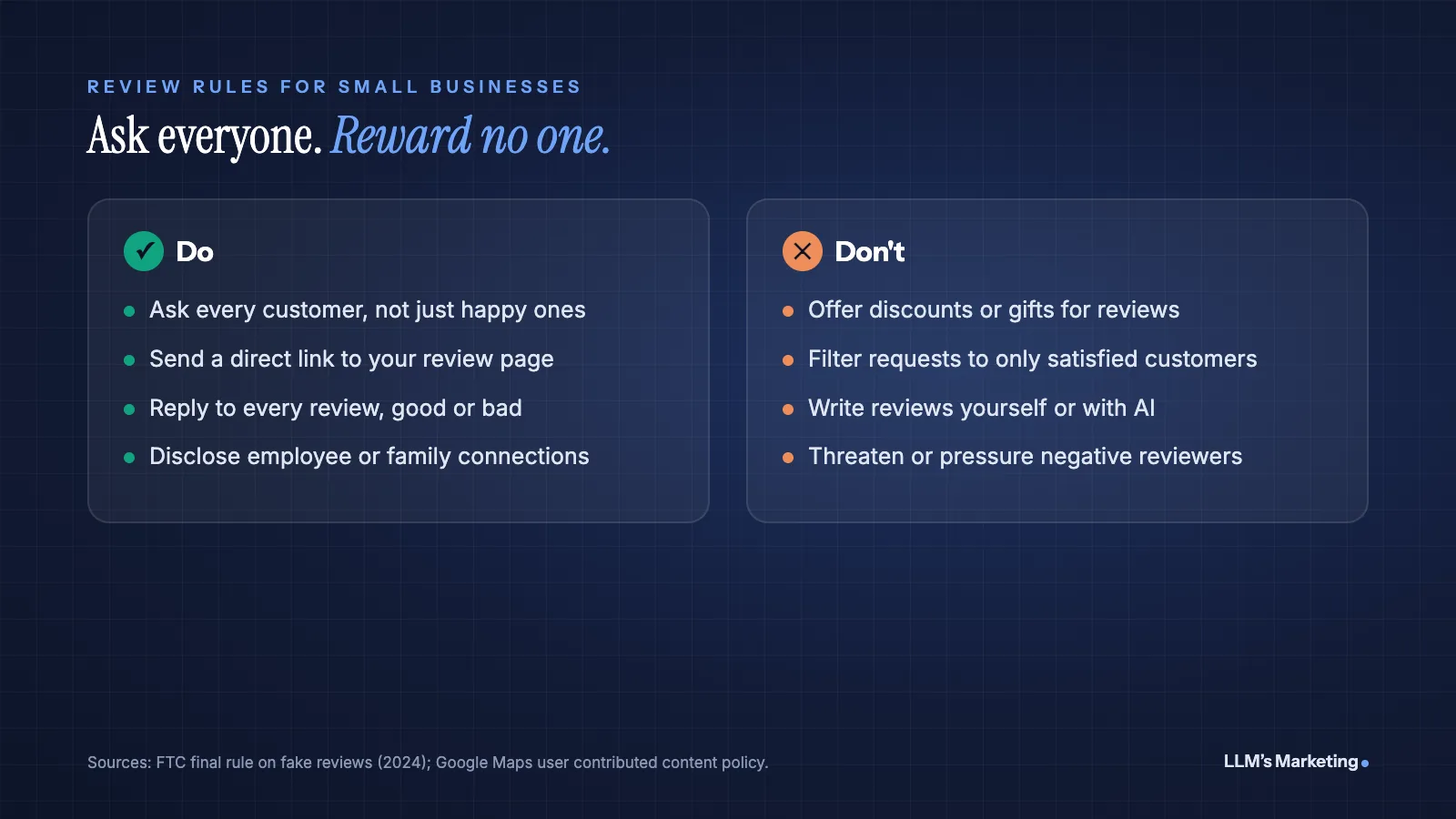
So ask every happy customer, every time, with a direct link. But know the rules, because they changed. The FTC's final rule on fake reviews, announced August 14, 2024, bans fake reviews (including AI-generated ones), paying for reviews of a particular sentiment, undisclosed insider reviews and suppressing negative reviews through threats or intimidation (FTC). Google's own policy goes further. It removes incentivized reviews and forbids businesses to "selectively solicit positive reviews from customers" (Google Maps policy).
Testimonials on your own website follow the same principle: use real customers' words, with permission, and do not edit them in a way that changes the meaning.
Get Found in AI Answers
8. Make Your Business Easy for AI Assistants to Recommend
This is the strategy most small business guides still miss. BrightLocal found that use of ChatGPT and other generative AI tools for local recommendations rose from 6% to 45% in a year, making AI the third most popular source of business recommendations (BrightLocal).
The good news is that the work overlaps with everything above. Google says there are "no additional requirements to appear in AI Overviews or AI Mode, nor other special optimizations necessary." Its advice is to keep crawling open, make content findable through internal links, keep important content in text and keep your Business Profile current (Google Search Central).
Practical steps for AI visibility
- Keep your name, services, service area and hours identical on your website, Business Profile and directory listings
- Write service pages that answer "who is this for, what does it cost, how long does it take" in plain text
- Earn mentions on local news sites, associations and review platforms that AI tools read
- Ask ChatGPT, Gemini and Perplexity who they recommend for your service in your city, and note who they name
Our guides on getting recommended by ChatGPT and AI search visibility go deeper, and our AI search visibility service handles it for you.
Grow Through Social Media and Relationships
9. Use Social Media With a Purpose
Pick platforms by where your customers already are. Pew Research Center's 2025 survey of 5,022 US adults found that 84% use YouTube, 71% use Facebook, 50% use Instagram, 37% use TikTok and 26% use Reddit (Pew Research Center).
For most small businesses, one or two platforms done consistently beat five done badly. Show real work, real staff and real customers (with permission). Answer comments and messages quickly, because a social inbox is a sales channel. Our guide on using AI for social media shows how to plan and draft posts in less time.
10. Reward Loyalty and Referrals
Your past customers are your cheapest new customers. A simple referral program, such as a credit for both the referrer and the new customer, turns them into a sales team. A loyalty program (a punch card, a members' price or priority booking) keeps them coming back.
One caution: a referral reward is a material connection. If customers or affiliates promote you on social media in exchange for a reward, the FTC expects them to disclose it clearly with words such as "ad" or "sponsored" (FTC). And never tie a reward to leaving a positive review.
11. Partner With Complementary Businesses and Creators
Look for businesses that serve your customers right before or after you do. A realtor and a moving company, a gym and a physical therapist, or a wedding venue and a florist can share referrals, co-host events and cross-promote to each other's lists.
Local creators can work too, but choose them for audience fit, not follower count. Under FTC guidance, anyone you pay or give free products to must disclose that relationship in a way that is "hard to miss" (FTC). Put that requirement in writing before any post goes live.
12. Become the Local Expert
Expertise is the most durable form of marketing. Offer to answer reader questions for a local news site, speak at a chamber of commerce event, join a podcast or teach a free workshop. Each appearance builds name recognition, creates mentions that feed your prominence in search and AI answers, and gives you content to reuse on your site.
Use Paid Channels to Accelerate
13. Retarget Visitors and Run Smart Promotions
Most visitors leave without calling. Retargeting (also called remarketing) shows ads to people who already visited your site, which usually costs less per conversion than reaching strangers. It only works if you have steady traffic and a clear offer, which is why it comes last. The same applies to search ads: fix conversion tracking and cut irrelevant searches first, as our Google Ads management process does, before you raise the budget.
Promotions and giveaways can spark that traffic, but use them with a goal: new email subscribers, first-time bookings or reviving lapsed customers. Avoid permanent discounts that train customers to wait for a sale, check your state's rules before running a sweepstakes or contest, and never make a review a condition of entry. If you are weighing newer paid channels, our guide to ChatGPT ads explains how advertising inside AI answers works.
A 90-Day Small Business Marketing Plan
The SBA says marketing plans "should be maintained on an annual basis, at minimum" (SBA). Within that year, a 90-day sprint keeps the work manageable. Here is the order we recommend.
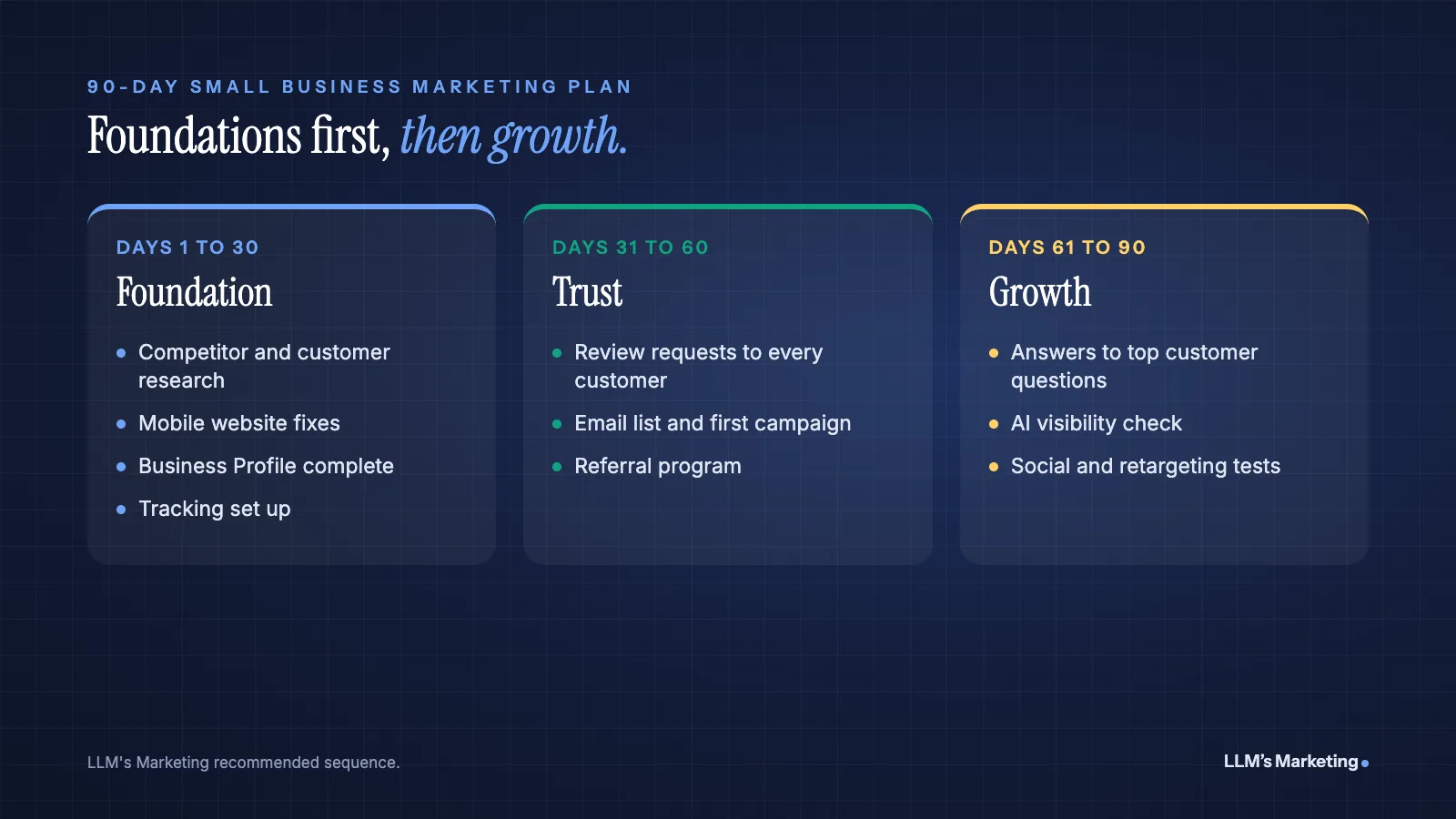
Days 1 to 30: Foundation
- Complete the competitor and customer research (strategies 1 and 2)
- Fix the website basics: mobile speed, service pages, tap-to-call and forms
- Complete and verify your Google Business Profile
- Set up tracking: Google Analytics 4, Search Console and call tracking
Days 31 to 60: Trust
- Start asking every customer for a review, with a direct link
- Launch an email signup and send your first campaign to past customers
- Introduce a referral offer
Days 61 to 90: Growth
- Publish answers to your top five customer questions
- Run your first AI visibility check and fix inconsistent listings
- Test one social platform and, if traffic allows, a small retargeting campaign
How to Measure What Works
Track a handful of numbers monthly rather than every metric available:
- Leads by source: calls, forms and bookings, tagged by channel in Google Analytics 4 and your call tracking
- Cost per lead: spend on a channel divided by the leads it produced
- Business Profile actions: calls, direction requests and website clicks
- Review velocity: new reviews per month and average rating
- Revenue per customer: so you know what a lead is worth
Compare cost per lead against what a customer is worth. A channel with a high cost per lead can still be your best one if the customers it brings stay for years.
Frequently Asked Questions
What is the best marketing strategy for a small business?
For most local and service businesses, the best starting strategy is a complete Google Business Profile plus a steady flow of genuine reviews, backed by a fast mobile website. These are free or low cost, and Google says complete, accurate information and more positive reviews help local ranking.
How much should a small business spend on marketing?
There is no official percentage. The SBA advises including a complete breakdown of marketing costs in your plan and tracking them once it is running. A practical approach is to set a test budget per channel, measure cost per lead for 60 to 90 days and move money toward what produces customers.
How can I market my small business for free?
Free strategies include optimizing your Google Business Profile, asking every customer for a review, answering common questions on your website, posting consistently on one social platform, emailing past customers and building referral partnerships with complementary local businesses.
Do small businesses need to optimize for AI search?
Increasingly, yes. BrightLocal's 2026 survey found 45% of consumers use ChatGPT or other AI tools for local recommendations, up from 6% a year earlier. Google says no special optimization is required for its AI features, so consistent business information, clear service pages and genuine reviews do most of the work.
Can I offer customers a discount for leaving a review?
No, not on Google. Google's Maps policy removes incentivized reviews, and the FTC's 2024 rule bans offering incentives for reviews of a particular sentiment. You can ask every customer for honest feedback, as long as you do not reward it or ask only happy customers.
Where to Start
If you only do three things this month, complete your Google Business Profile, start asking every customer for a review and fix your website on mobile. Then add email, content and AI visibility, and only scale paid channels once you know your cost per lead.
If you would rather have a plan built for your business, our digital strategy and marketing team builds them for small businesses across the US, and you can see the industries we work with or read our case studies. When you are ready, book a free strategy call.
Not sure which marketing channel to start with?
Send your website and I'll review your website, Google Business Profile, reviews and AI visibility, then reply personally with the three marketing moves I would make first.