
Most law firms that regret hiring an SEO company did not pick a bad agency on purpose. They picked the one with the best sales call. The proposal promised page-one rankings, the case studies looked impressive and the monthly report arrived on time. Twelve months later, the firm had a dashboard full of keywords and roughly the same number of signed cases.
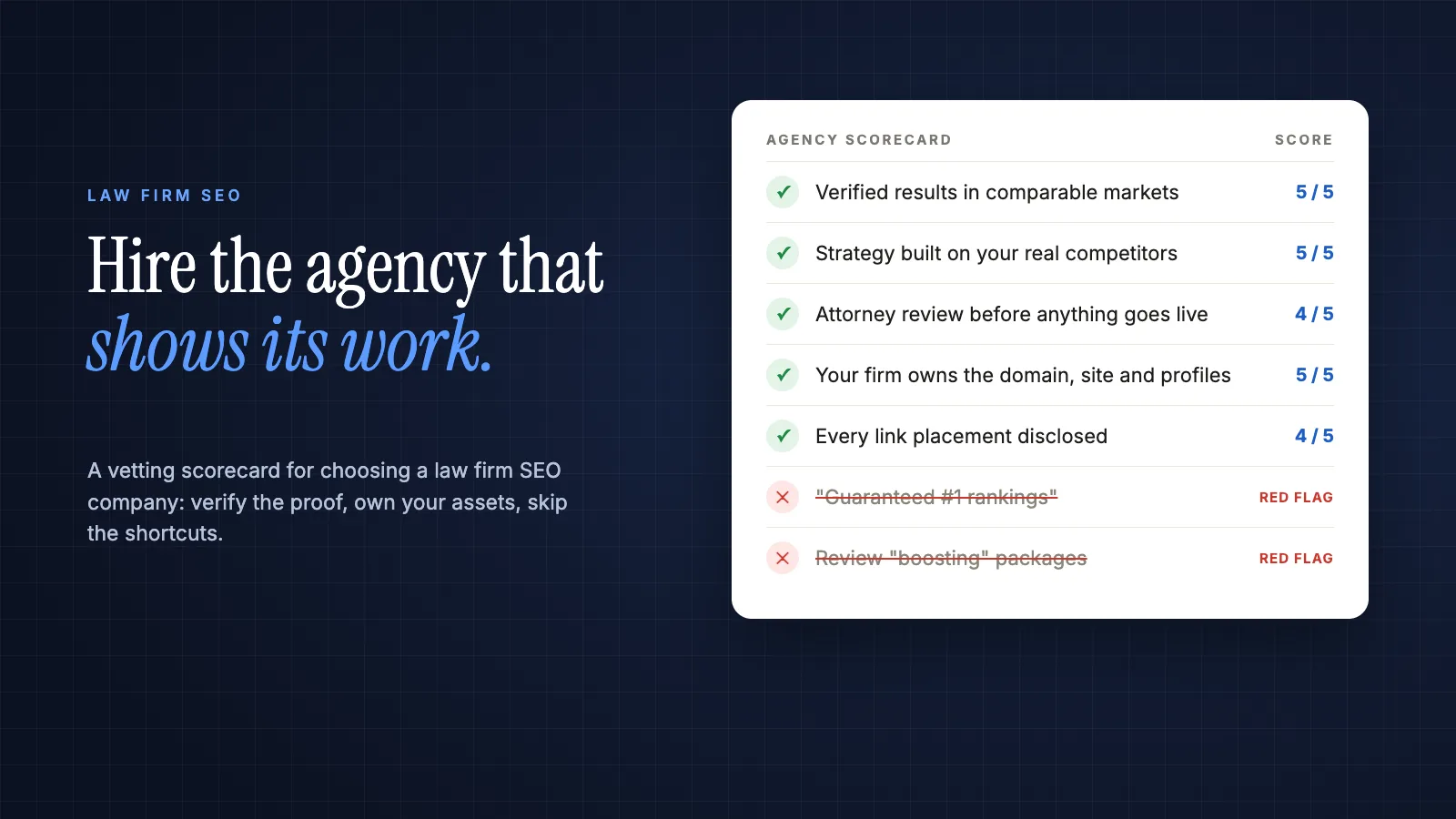
To choose a law firm SEO company, verify its claims before you trust them, then judge it on how it works rather than what it promises. The best choice can show results for firms in markets like yours, explains exactly what it will do and why, uses only methods allowed by Google's spam policies, leaves you owning your domain, website, Google Business Profile and analytics, measures signed cases instead of rankings alone, and builds attorney review into every piece of content.
This guide turns that answer into a process you can run: a 15-minute proof check you can do before the first call, an eight-point scorecard for comparing agencies, the red flags that should end a conversation, the questions to ask and the contract terms to insist on. It draws on Google's own advice for hiring an SEO, Google's spam and Business Profile policies, the ABA Model Rules and the FTC's rule on fake reviews.
What a Law Firm SEO Company Should Actually Do
Before you compare agencies, be clear about the work you are buying. "SEO" on a proposal can mean anything from a monthly blog post to a full rebuild of how your firm appears in Google and AI answers. For most firms, the job has five parts:
| Work stream | What it covers | What good looks like |
|---|---|---|
| Local SEO | Google Business Profile, map pack visibility, reviews, local citations | A compliant profile for each real office, with a steady, honest review process |
| Practice-area content | Pages for each case type and service, plus supporting guides | Pages that answer real client questions and are reviewed by an attorney before publishing |
| Technical SEO | Site speed, crawlability, indexing, structured data, mobile usability | A documented audit with fixes prioritized by impact, not a 200-item export |
| Authority building | Links, legal directories, local press, bar and community involvement | Earned mentions from relevant sources, with every placement disclosed to you |
| AI search visibility | How your firm appears in Google AI Overviews, AI Mode, ChatGPT, Perplexity and Gemini | A baseline of how often your firm is named for key questions, tracked over time |
Local SEO deserves special attention because it works differently from organic results. Google says local rankings depend mainly on relevance, distance and prominence, and that there is no way to request or pay for a better local ranking. An agency that cannot explain how it will influence relevance and prominence for your firm, given that distance is out of everyone's control, is guessing. For a deeper look at how this plays out for injury firms, see our personal injury lawyer SEO approach.
What these services look like in practice
If you want to see how each work stream is usually packaged, our full list of SEO and AI visibility services breaks them down. The two that matter most for a law firm website are practice-area content, covered by our AI SEO and content service, and visibility in AI assistants, covered by our AI search visibility service. Firms in other professional services face similar problems. Our guide to SEO for gyms shows how a review system and location pages win the map pack, and the same principles apply to a law office.
Run a 15-Minute Proof Check Before the First Call
You do not need SEO expertise to test an agency's claims. You need a browser and fifteen minutes. Do this before the sales call so you can ask sharper questions.
- Search their named clients. Take two or three firms from their case studies and search for the firm's main practice area plus its city (for example, "car accident lawyer Tampa"). If the client does not appear in the map pack or first page, ask why the case study is still on the website.
- Check whether the clients are still clients. Look at the footer of each client's website for a "website by" credit, and ask the agency directly. A case study from a firm that left two years ago tells you little about the team you would get today.
- Look up their own Business Profile and reviews. Read the negative reviews, not just the rating. Patterns such as "locked us out of our website" or "hard to cancel" matter more than the star count.
- Verify any badge. A Google Partner badge relates to Google Ads. Google lets agencies check Partner status through a Google Ads manager account, and the program says nothing about organic SEO skill. It is useful if you also want paid search, but it is not proof of SEO ability.
- Ask an AI assistant about them. Ask ChatGPT or Perplexity "who are the best SEO companies for law firms in [your city]?" and "what do clients say about [agency name]?" An agency selling AI search visibility should be able to show some of its own.
This check will not tell you which agency is best. It will quickly remove the ones whose claims fall apart under light pressure.
The Eight-Point Law Firm SEO Company Scorecard
Most guides list qualities to look for. The problem is that every agency claims all of them. A scorecard forces you to compare evidence side by side. Score each agency from 1 (weak or missing) to 5 (strong, with proof), then multiply by the weight. The weights below reflect what tends to decide outcomes for law firms; adjust them to your situation.
| Criterion | Weight | Strong evidence | Weak evidence |
|---|---|---|---|
| Results in comparable markets | 3 | Named firms in similar practice areas and city sizes, with before-and-after data you can check | Anonymous "a law firm grew 300%" claims |
| Market-specific strategy | 3 | Names your top competitors and explains what they do better, before you sign | A generic package with the same deliverables for every firm |
| Content and attorney review | 2 | Named writers, a documented attorney approval step and a policy on AI-assisted drafting | "Our writers handle everything" |
| Compliant methods | 2 | Explains how links are earned and lists every placement | Vague "link packages" or secrecy about sources |
| Reporting tied to cases | 2 | Tracks calls, form leads and signed cases from organic and local search | Rankings and traffic only |
| Ownership and access | 2 | You own the domain, website, Business Profile, Search Console and analytics | The agency "hosts and manages" assets you cannot access |
| AI search measurement | 1 | A baseline of how AI answers mention your firm, re-measured on a schedule | "AI is covered by our SEO" with no measurement |
| Fair contract terms | 1 | Clear deliverables, a reasonable exit clause and market exclusivity | Long lock-in with vague scope |
How to weight the criteria
Weight 3: evidence and strategy
Comparable results and a market-specific plan predict outcomes better than anything else on the list. An agency that has ranked a firm in a market like yours, and can explain why your competitors are ahead, has already done half the diagnostic work.
Weight 2: process and control
Content review, compliant methods, case-based reporting and ownership decide whether results are safe and lasting. Weak scores here rarely hurt in month one, but they are what turns a good year into a penalty, a suspension or a painful exit.
Weight 1: emerging and contractual items
AI search measurement and contract terms matter, but they are easier to fix during negotiation. Weight them higher if AI visibility is a priority or if you have been locked into a bad contract before.
The maximum score is 80. Treat the total as a conversation tool, not a verdict. An agency that scores 1 on ownership should usually be out regardless of its total, because losing control of your website or Business Profile can cost more than any ranking gain.
A worked example
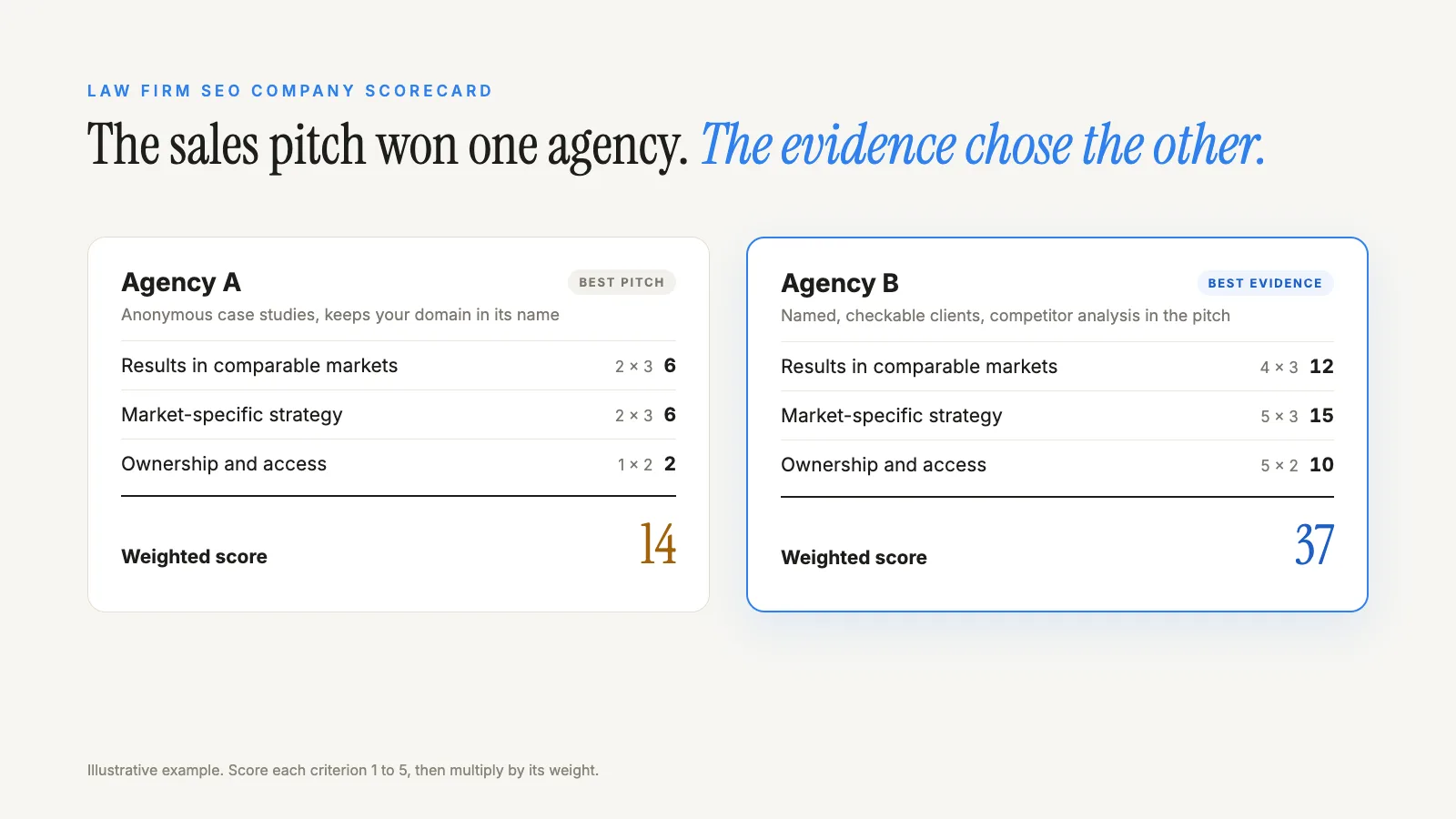
Here is a hypothetical comparison to show how the scorecard changes a decision. For real, checkable numbers from our own client work, see our case studies. Agency A has a polished pitch, a long client list and a low monthly price, but its case studies are anonymous and it keeps hosting and domain registration in its own name. Agency B is smaller, names three firms you can check, and shows you two competitors' strengths during the pitch.
Agency A might score 5 on presentation but 2 on comparable results (×3 = 6), 2 on strategy (×3 = 6) and 1 on ownership (×2 = 2). Agency B might score 4 on results (×3 = 12), 5 on strategy (×3 = 15) and 5 on ownership (×2 = 10). On just those three criteria, B leads 37 to 14, even though A won the sales call. That gap is exactly what a scorecard is designed to surface.
Who Writes Your Content, and Who Is Responsible for It
Legal content falls under what Google calls topics that can significantly affect people's health, financial stability or safety. For those topics, Google says its systems give even more weight to content that aligns with strong E-E-A-T (experience, expertise, authoritativeness and trustworthiness), with trust as the most important part. A page about statutes of limitations written by a generalist content mill is a weak fit for that standard. Dental practices face the same high bar, and our guide to generative engine optimization for dentists shows how a regulated profession can build trustworthy content that AI assistants are willing to cite.
There is also a professional responsibility angle that marketing-focused guides rarely mention. The ABA Model Rules make lawyers responsible for supervising nonlawyers who assist them, including outside vendors. A 2012 comment to Rule 5.3 says a lawyer may hire nonlawyers outside the firm but must make reasonable efforts to ensure the engagement is compatible with legal ethics obligations. And ABA Model Rule 7.1 prohibits false or misleading communications about a lawyer's services. If your agency publishes an inflated verdict claim or a misleading "best lawyer" headline on your site, it is your name on the page.
States adopt their own versions of these rules, and some impose extra advertising requirements, so check your state bar's rules or ask your ethics counsel. In practice, ask every agency three questions:
- Who writes the content, and what legal background do they have?
- Is there a step where an attorney at our firm approves each page before it goes live?
- How do you use AI tools in drafting, and how is the output fact-checked?
Google's helpful content guidance suggests considering a disclosure of AI or automation use when readers would reasonably expect one. A good agency will have a clear answer here rather than a defensive one.
Red Flags That Should End the Conversation
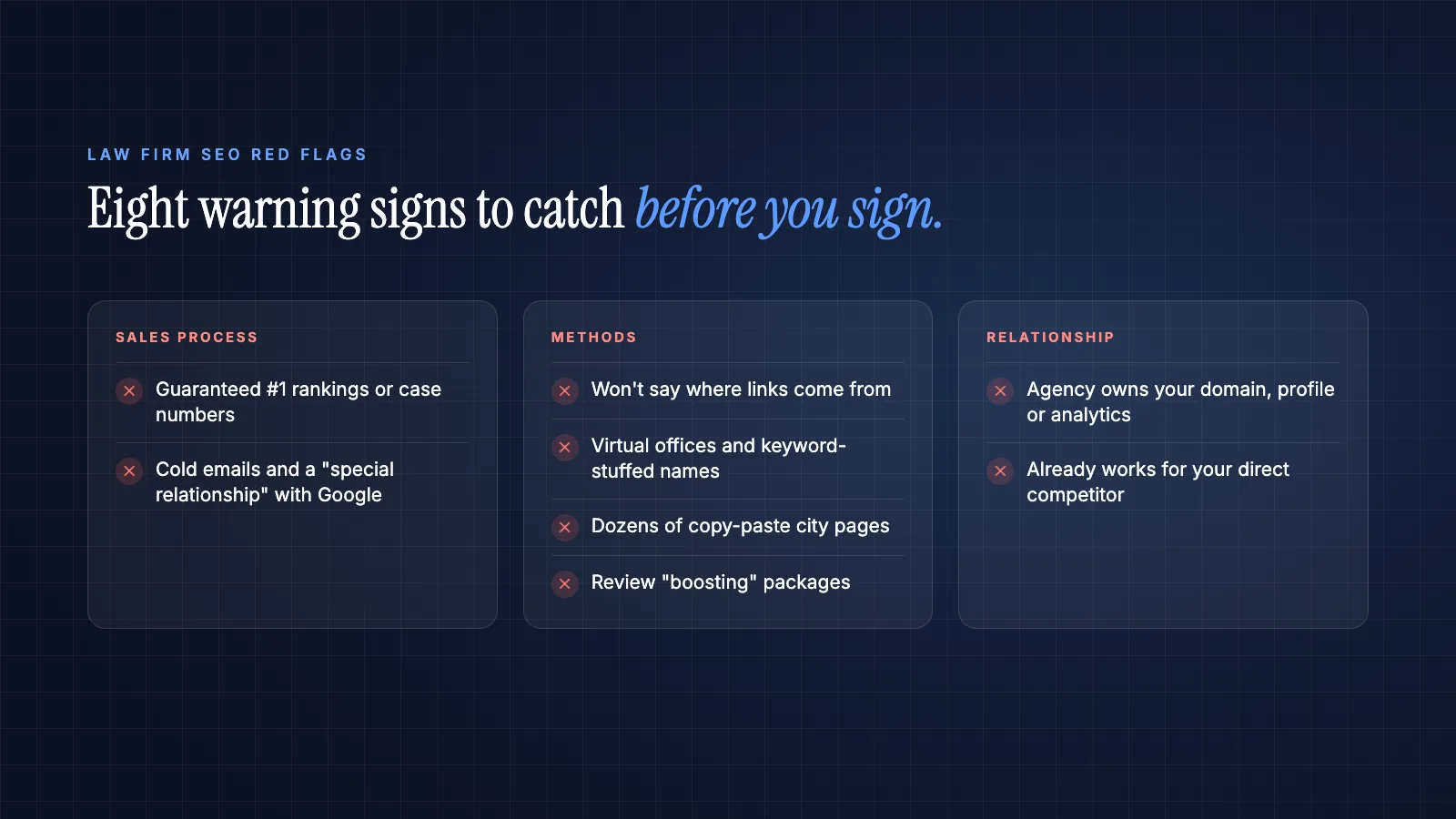
Some warnings come straight from Google. Its guide to hiring an SEO states that "no one can guarantee a #1 ranking on Google" and advises caution with SEOs that email you out of the blue, claim a special relationship with Google or will not explain what they intend to do. Others are specific to law firms.
Red flags in the sales process
Guaranteed rankings or guaranteed case numbers
Nobody controls Google's results. A guarantee usually means vanity keywords nobody searches for, or tactics that put your site at risk.
Cold outreach and a "special relationship" with Google
Google specifically warns about SEO firms that email you out of the blue or claim inside access. No agency has a relationship that changes how Google ranks your firm.
Red flags in the methods
Secrecy about links
Google defines link spam as creating links primarily to manipulate search rankings. If an agency will not tell you where your links come from, assume you would not like the answer.
Fake offices or keyword-stuffed profile names
Google's Business Profile guidelines say a virtual office that you do not operate from is not eligible for a Business Profile, and that business names should reflect your real-world name without extra descriptions. Suspensions caused by these shortcuts can take your firm out of the map pack entirely. Our guide to local SEO without a storefront explains the safe alternatives to fake locations.
Mass-produced city pages
Dozens of near-identical "[Practice] Lawyer in [Town]" pages for places you do not serve can fall under Google's doorway abuse and scaled content abuse policies. A location page should exist because you genuinely serve clients there and have something specific to say about it.
Review schemes
The FTC's rule on consumer reviews, effective October 21, 2024, prohibits buying or selling fake reviews, buying reviews conditioned on their sentiment and certain review suppression practices, and the FTC says AI-generated fake reviews are covered. An agency offering to "boost" your reviews is offering you legal exposure.
Red flags in the relationship
They own your assets
If the agency registers your domain, owns your Business Profile or keeps your analytics in its own account, leaving becomes expensive and messy.
They already serve your direct competitor
For a given search in a given city, only one firm can be first. Ask whether they work with other firms in your practice area and metro, and whether they offer exclusivity.
Questions to Ask a Law Firm SEO Company
Google suggests asking any SEO for examples of previous work, whether they follow Google Search Essentials, what results to expect and in what timeframe, their experience in your industry and city, and whether they will share every change they make to your site. Those are a good base. For law firms, add these, along with what a strong answer sounds like:
| Question | A strong answer sounds like |
|---|---|
| Who are our top three competitors in search, and why do they outrank us? | Specific firms, with concrete reasons such as review volume, practice-area pages or links |
| How will you split effort between the map pack and organic results? | A plan based on your office locations and case types, not a fixed template |
| What will you do in the first 90 days? | A dated list: audit, fixes, profile cleanup, first pages, tracking setup |
| How will you track signed cases from SEO? | Call tracking and form tracking connected to your intake or CRM |
| Where do your links come from? Can we see a list? | Yes, with examples of real placements and how they were earned |
| Do you work with other firms in our practice area and city? | A direct yes or no, plus their exclusivity policy |
| How do you measure our visibility in AI answers? | A repeatable set of prompts tested across assistants, with a baseline |
| If we part ways, what do we keep? | Everything: domain, site, content, profiles, data and account access |
Pay attention to how agencies handle the questions, not just the answers. Defensiveness about links, tracking or ownership is itself an answer.
Why tracking signed cases matters
Rankings and traffic are leading indicators. The number a managing partner cares about is signed cases. That requires call tracking and form tracking connected to your intake software or CRM, which is the kind of plumbing our marketing automation service sets up. Speed matters too: a lead that waits overnight for a reply may already have called another firm, which is why some firms pair SEO with AI lead agents that answer and qualify inquiries around the clock.
Contract Terms to Get in Writing
A good relationship can still end badly if the contract is vague. Before signing, make sure the agreement covers these points:
Ownership and access
Domain and website
The domain should be registered in your firm's name and account. The website files and content should belong to you, with a clause confirming you can take them with you.
Google Search Console
A Search Console property needs at least one verified owner, and owners have full control while users have limited rights. Make sure someone at your firm is a verified owner and the agency is added as a user.
Google Business Profile
Only one person can be the primary owner of a Business Profile. It should be someone at your firm, with the agency added as a manager.
Analytics and call tracking
Google Analytics, call tracking numbers and any CRM integrations should sit in accounts your firm controls, so the history stays with you if the agency changes.
Scope, approvals and exit
- Scope and deliverables. A monthly list of what will be done (pages, fixes, outreach), not just "ongoing optimization."
- Approval rights. No content goes live on your site without attorney sign-off.
- Reporting access. Direct, read access to your own analytics and Search Console at any time, not only monthly PDFs.
- Term and exit. A clear notice period and a handover checklist covering credentials, files and redirects.
- Exclusivity. If it matters to you, a written promise not to take on a direct competitor in your practice area and market.
- Compliance. A commitment to follow Google Search Essentials and your state's advertising rules, and to disclose every third-party placement.
Legal-Only Agency or Generalist?
Nearly every guide on this topic is written by a legal-only agency, so it is no surprise they all recommend hiring a legal-only agency. The honest answer is more nuanced.
A legal specialist brings familiarity with case types, intake and ethics rules, and often has playbooks that work. The tradeoffs are that the playbook can become a template, and a specialist is more likely to already serve a competitor in your city. A generalist with strong local SEO and content skills can do excellent work for a firm, provided it builds in attorney review and learns your practice areas properly.
What matters more than the label is the evidence in the scorecard: comparable results you can verify, a strategy specific to your market and a process that keeps you compliant. Judge the process, not the positioning.
How AI Search Changes the Decision
Some potential clients now ask AI assistants for help before they search: "what should I do after a car accident in Houston?" or "who is a good divorce lawyer near me?" Google says there are no additional requirements or special optimizations needed to appear in AI Overviews or AI Mode, and traffic from those features is reported inside Search Console's Performance report under the Web search type. In other words, strong SEO fundamentals remain the foundation.
What changes is measurement and emphasis. AI answers tend to name firms that are clearly described across the web: consistent firm details, practice areas explained in plain language, reviews and mentions on trusted legal and local sites. An agency worth hiring today should be able to show you a baseline of how often AI assistants mention your firm for your most important questions, and how that changes over time. Our guides on showing up in ChatGPT, Perplexity and Gemini and on the differences between GEO and SEO explain the mechanics in more detail, and how to get your brand recommended by ChatGPT walks through the steps. If the terminology is new, start with what LLM marketing actually covers.
Be cautious with anyone who sells AI visibility as a separate trick. No schema type, format or prompt hack guarantees that an assistant will recommend your firm. If you want to understand where structured data does help, see our guide to schema and entity optimization.
What the First 90 Days Should Look Like
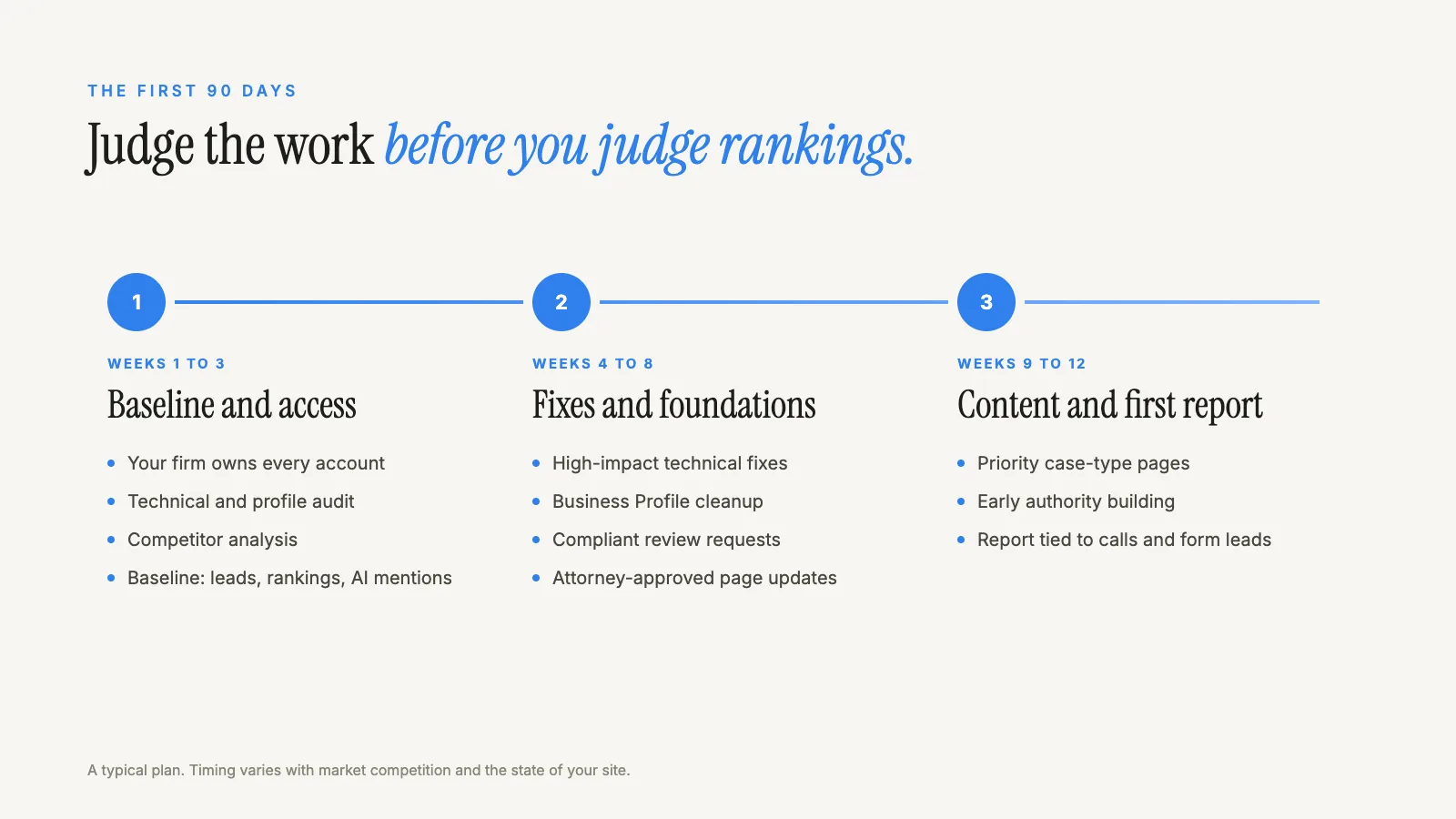
There is no reliable universal timeline for law firm SEO, and Google's own hiring guide frames timing as a question to ask, not a number to expect. Competitive practice areas in large metros usually take longer than niche practices in smaller markets. What you can judge early is whether the work is happening. A credible first 90 days usually includes:
Weeks 1 to 3: baseline and access
Access setup, a technical audit, a Business Profile review, a competitor analysis and a baseline of rankings, leads and AI mentions. By the end of week 3 you should know where you stand and what the agency plans to fix first.
Weeks 4 to 8: fixes and foundations
High-impact technical fixes, profile cleanup, a compliant review request process and the first practice-area page improvements, each approved by an attorney before publishing.
Weeks 9 to 12: content and the first real report
New or rebuilt pages for priority case types, early authority building and the first report that connects activity to calls and form leads.
If you reach day 90 without a clear account of what was done and why, that is a more useful signal than any ranking change.
Frequently Asked Questions
How much does a law firm SEO company cost?
Pricing varies widely by market, practice area and scope, so a single number is not meaningful. Compare proposals by deliverables per month, who does the work and what you own at the end, rather than by price alone. A low fee with vague scope often costs more over a year than a higher fee with clear deliverables.
Should I sign a long-term SEO contract?
SEO takes time, so a minimum commitment of several months can be reasonable. What matters is that the contract includes clear deliverables, reporting access and a fair exit clause, and that you own every asset if you leave.
Can an SEO company work for my competitor?
Many do. For a specific search in a specific city, only one firm can rank first, so serving two competing firms creates a conflict. Ask directly and get any exclusivity promise in writing.
Who is responsible if my SEO agency publishes misleading claims?
Under the ABA Model Rules, lawyers are responsible for communications about their services and for reasonably supervising nonlawyers who assist them, including outside vendors. Rules vary by state, so confirm with your state bar or ethics counsel. Requiring attorney approval before anything is published is the simplest safeguard.
Do I need a separate agency for AI search?
Usually not. Google says AI Overviews and AI Mode have no special requirements beyond normal SEO best practice. What you need is an SEO partner who also measures how AI assistants describe and recommend your firm, and adjusts content and authority building based on what it finds.
Choose the Agency That Shows Its Work
The best law firm SEO company for you is rarely the one with the boldest promise. It is the one that survives your proof check, scores well on evidence rather than presentation, keeps you in control of your assets and treats attorney review as part of the process instead of a delay. Use the scorecard, ask the uncomfortable questions and get the important terms in writing.
If you want a second opinion on a proposal you have received, or a clear picture of how your firm currently appears in Google and AI answers, book a free call, use our contact page or send your details below. You can also browse the industries we work with. Mohd Adil Kazmi, our founder, will review it personally and reply with the fixes worth prioritizing, even if you decide to work with someone else.
Want a second opinion on an SEO proposal?
Send your firm's website (and the proposal, if you have one) and I'll check how your firm appears in Google and AI answers, then reply personally with what I would prioritize.