
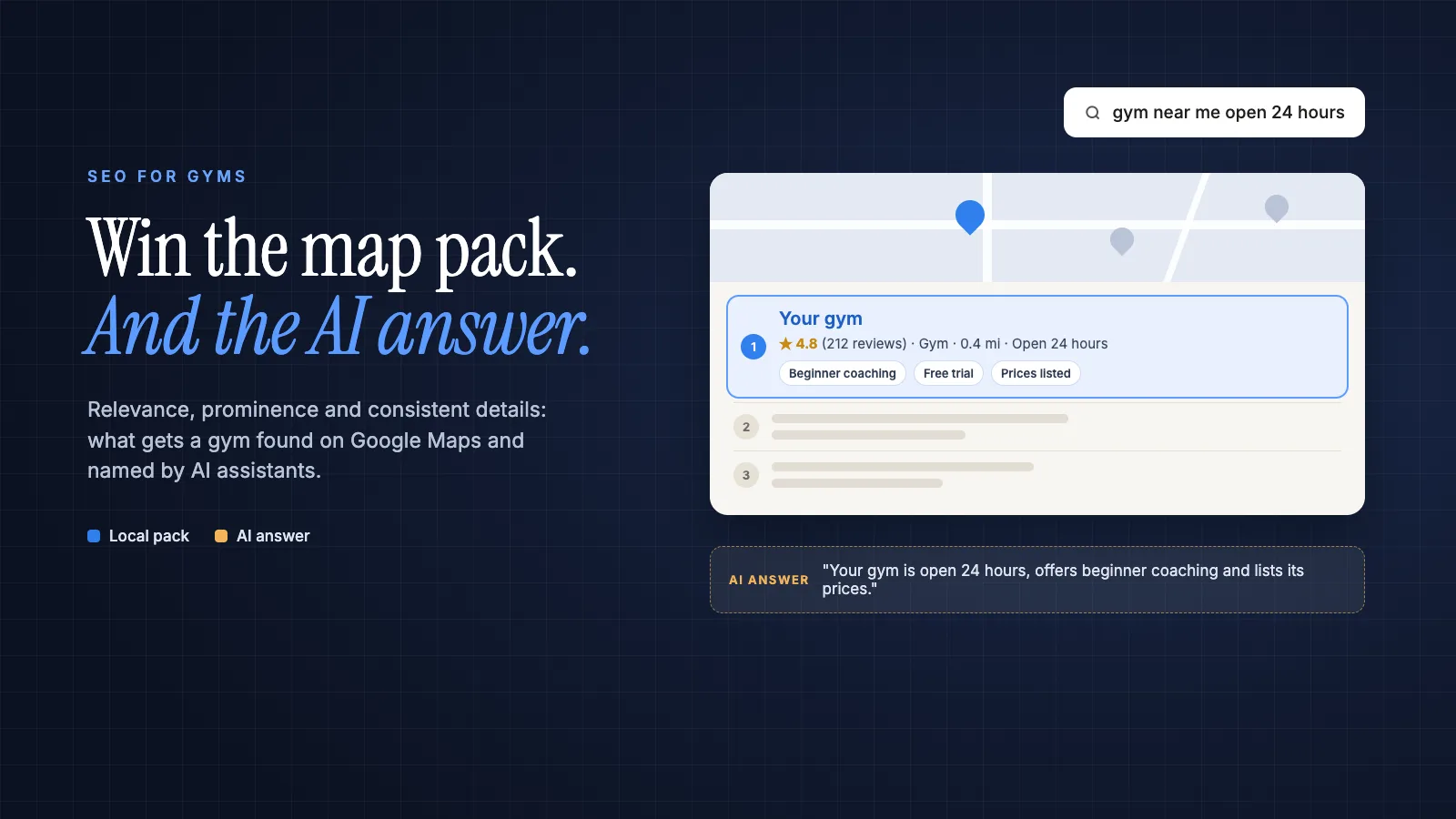
A prospective member does not search for "gym." They search for "gym near me open 24 hours," "reformer Pilates in Austin" or "best CrossFit box for beginners," or they ask ChatGPT which gym near their office has good coaches and fair pricing. SEO for gyms comes down to being the business that shows up, looks credible and is easy to choose at each of those moments.
Most gym SEO advice is a long list of tactics with no order. A gym owner with a front desk to run and classes to fill needs a sequence: what to fix first, what moves rankings, and what simply looks busy. This guide follows the factors Google says it uses to rank local businesses, then adds the newer layer, which is showing up when AI assistants recommend gyms.
What does SEO for gyms need to win now?
Gym SEO is the work of making a fitness business visible and convincing in three places:
- The Google local pack and Google Maps, where most "near me" and city-level gym searches resolve.
- Organic search results, where your website ranks for program, class and comparison searches such as "HIIT classes for beginners in Denver."
- AI answers, including Google AI Overviews, AI Mode, ChatGPT, Perplexity and Gemini, which increasingly summarize options before anyone clicks.
The third channel is growing fast. In BrightLocal's 2026 Local Consumer Review Survey, 45% of US consumers said they use ChatGPT or other generative AI tools for local business recommendations, up from 6% the year before. That does not replace Google Maps, but a gym that ignores AI visibility is missing a channel its prospects already use. The difference between the two is covered in more depth in our guide to GEO vs SEO.
How does Google decide which gym appears in the map pack?
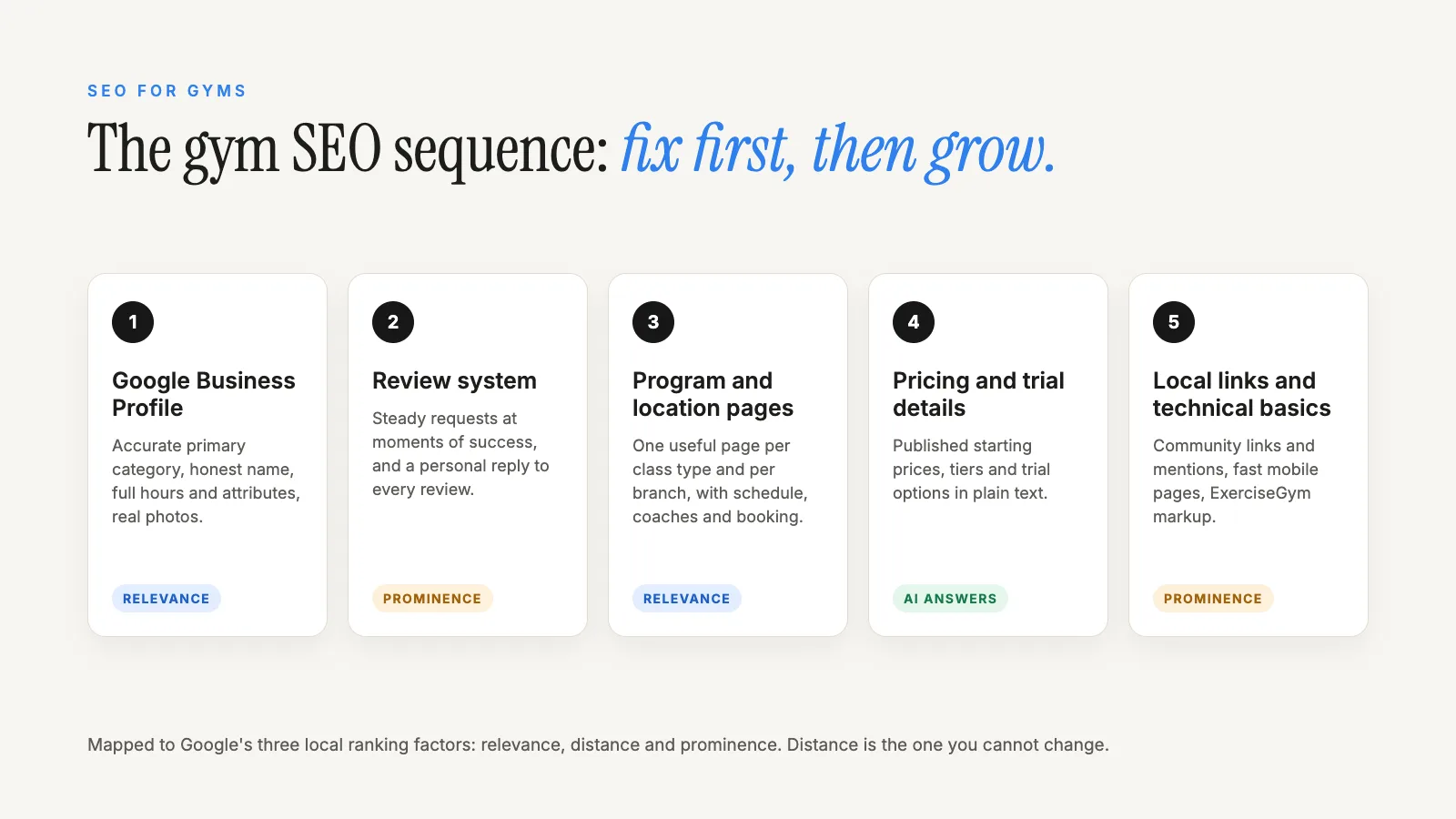
Google's own guidance on improving local ranking names three factors: relevance, distance and prominence. Every local SEO task for a gym should map to one of them.
| Factor | What Google means | What a gym can actually influence |
|---|---|---|
| Relevance | How well your Business Profile matches the search | Primary category, services, attributes, description and website content |
| Distance | How far you are from the searcher | Very little, apart from accurate address and service details |
| Prominence | How well known your business is | Reviews, ratings, links, local mentions and brand searches |
Two points are worth stating plainly. First, Google says there is no way to pay for a better local ranking, so any vendor promising guaranteed map pack placement is overselling. Second, distance is mostly out of your control. A gym two miles from a searcher will struggle to outrank one next door for a generic query, which is why relevance and prominence are where your effort pays off.
How should a gym build its SEO plan?
Treat the plan as a sequence rather than a checklist. Each step makes the next one more effective.
Fix the Google Business Profile first
The Business Profile is the single highest-impact asset for most gyms, because it is what appears in Maps and the local pack.
- Choose the most accurate primary category. "Gym," "Fitness center," "Yoga studio," "Pilates studio" and "Personal trainer" each match different searches. Pick the one that describes your core offer, then add secondary categories only where they are genuinely true.
- Keep the business name honest. Google's guidelines say the listing name should reflect your real-world name and that unnecessary keywords can lead to suspension, as BrightLocal's breakdown of name spam explains. "IronWorks Gym" is fine; "IronWorks Gym Best Fitness Center Brooklyn" is a risk.
- Complete hours, special hours and attributes. Holiday hours, early-morning opening and women-only sessions are exactly the details searchers filter on.
- Upload real photos regularly. Show the floor, equipment, locker rooms and classes in progress. Prospects judge a gym visually before they visit.
Build a review system instead of asking occasionally
Reviews feed prominence directly, and they decide whether a searcher who finds you actually walks in. The 2026 BrightLocal data makes the bar clear: 97% of consumers read online reviews, and 74% look for reviews written in the last three months.
Recency matters as much as volume, so a gym needs a steady flow rather than a one-off campaign. A practical system looks like this:
- Ask at moments of genuine success, such as after a member hits a personal best, finishes a challenge or completes their first month.
- Send the request by text message or email with a direct review link, because friction kills follow-through.
- Reply to every review in a personal voice. BrightLocal found that 80% of consumers are more likely to use a business that responds to all its reviews, while half are put off by generic, templated replies.
Do not offer discounts, free sessions or merchandise in exchange for reviews. Google's Maps content policy prohibits incentivized reviews, including incentives to change or remove negative ones, as Search Engine Land reported. A free smoothie for a five-star review can cost you the listing.
Give every program and location its own useful page
Your website supplies the relevance signals the Business Profile cannot. The most common gap is a single "Classes" page that lists everything in one paragraph.
Build dedicated pages for the programs people search for by name: strength training, HIIT, yoga, Pilates, personal training, kids' fitness or whatever your gym actually runs. Each page should answer the questions a prospect has before booking: who the class suits, what a session looks like, schedule, coach credentials, pricing or trial options, and a clear way to book.
Multi-location gyms need a page per branch, but each one has to be genuinely distinct. Include the branch's own address, hours, photos, coaches, class timetable, parking or transit notes and reviews from that location. Pages that only swap the city name in the same template add little value and rarely rank well.
Publish transparent pricing and trial details
Many gyms hide pricing to force a sales conversation. The problem is that "membership cost," "day pass price" and "free trial" are some of the most common pre-visit searches, and AI assistants cannot recommend you on price if your price is not published anywhere. If exact figures change too often, publish a starting price and what each tier includes.
Earn local links and mentions
Google lists links and broader web presence as prominence signals. For a gym, the best links usually come from the local community rather than fitness bloggers in another country:
- Sponsorships of local runs, school sports days or charity events, with a link from the organizer's page.
- Corporate wellness partnerships with nearby offices.
- Features in local news, neighborhood blogs and city guides.
- Accurate listings on the directories and booking platforms your members actually use.
These mentions also help AI systems, which build their picture of a business from what other sources say about it.
Clean up the technical basics
Most gym sites are built on templates and rarely need deep technical work, but a few issues are common: slow mobile pages heavy with uncompressed photos, class schedules embedded as images or iframes that search engines cannot read, and booking flows that break on phones. Keep the schedule, prices and program descriptions in real text on the page.
Add LocalBusiness structured data using the most specific type that fits, such as ExerciseGym, following Google's local business structured data guidelines. Make sure the markup matches what visitors can see on the page. Our post on schema and entity optimization for LLMs covers which markup is worth the effort and which is not.
How do gyms show up in ChatGPT and Google AI Overviews?
Google is explicit that there is no special trick for its AI features. Its documentation on AI features and your website says there are no additional requirements or special schema to appear in AI Overviews or AI Mode. Pages need to be indexed, crawlable and useful, and Business Profile information needs to be current.
That means the work above is also your AI visibility foundation. Beyond it, a few habits make a gym easier for AI assistants to describe accurately:
- State facts in plain text. "Open 5 am to 11 pm on weekdays," "women-only strength sessions on Tuesday and Thursday evenings" and "monthly membership starts at a published price" are the kinds of specific statements an AI answer can quote.
- Describe who each program is for. Assistants often answer queries like "best gym for beginners near me." A page that clearly explains beginner onboarding gives them something concrete to match.
- Keep details consistent everywhere. If your website, Business Profile and booking platforms list different hours or prices, AI summaries may pick the wrong one.
- Collect detailed reviews. BrightLocal found that 82% of consumers read AI-generated review summaries. Reviews that mention coaches, cleanliness, crowding and class quality give those summaries better material.
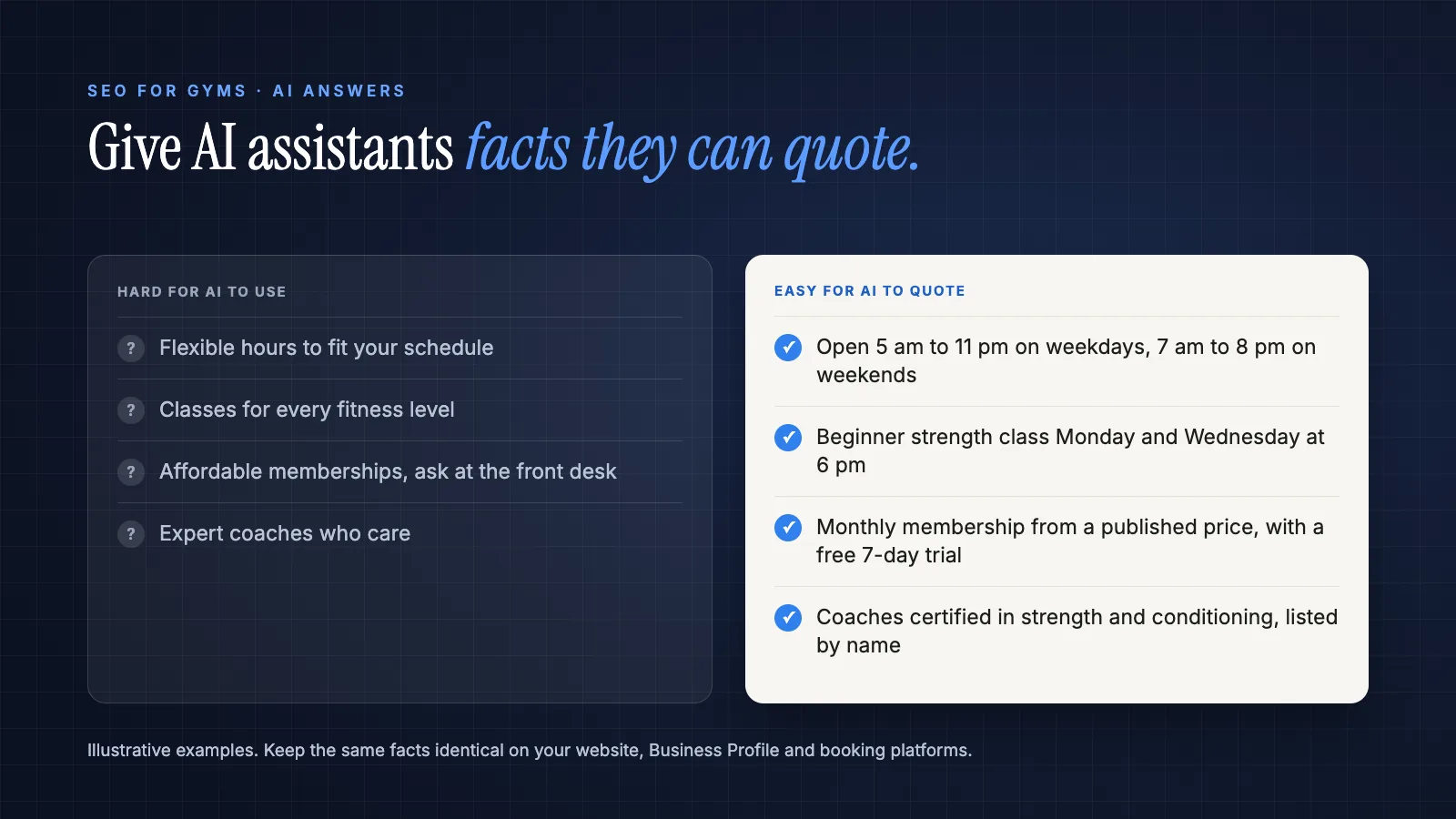
No tactic guarantees that ChatGPT or Gemini will recommend a particular gym. What you can control is whether accurate, specific and well-corroborated information about your business exists for them to find. Our step-by-step guide on getting your brand recommended by ChatGPT goes deeper on this, and AI search visibility across ChatGPT, Perplexity and Gemini explains how each platform sources answers.
What mistakes hold gym SEO back?
The same problems appear across most gym websites and profiles:
- Keyword-stuffed business names, which risk suspension and rarely deliver lasting gains.
- Bursts of reviews followed by silence, which look unnatural and lose value as consumers increasingly ignore older reviews.
- Template location pages that differ only by city name.
- Schedules and prices locked in images or PDFs, invisible to search engines and AI systems.
- Inconsistent hours and contact details across the website, Business Profile and third-party platforms.
- Measuring rankings instead of members, which hides whether SEO is actually filling classes.
How should a gym measure SEO results?
Rankings are a means, not the goal. Track the actions that lead to memberships:
- Business Profile performance: calls, direction requests, website clicks and bookings from the profile.
- Organic conversions in Google Analytics 4: trial sign-ups, booking completions and inquiry form submissions from organic traffic.
- Search Console queries: which program, location and price searches are growing, and which pages earn clicks.
- Front-desk attribution: a simple "How did you hear about us?" field at sign-up, with options for Google Maps, Google search, AI assistant and referral. It is imperfect, but it is often the only way to see walk-ins that started online.
Review these monthly. Local SEO results compound slowly, and the timeline depends heavily on how competitive your area is and where your profile and site start from.
Where should a gym start this week?
If you only do three things, fix your Business Profile category and details, set up a steady review request routine, and build dedicated pages for the programs people search for most. Those three moves address relevance and prominence directly, and they also give AI assistants accurate information to work with.
The same playbook works for other local businesses where parents or members compare options nearby. Our guide to daycare SEO applies it to child care centers, preschools and home daycares, and our guide to SEO for yoga studios adapts it for boutique studios with class styles and intro offers.
If you want help building a search presence that works across Google Maps, organic search and AI assistants, explore our AI SEO and content services or book a free discovery call with the LLM's Marketing team.
Is your brand showing up in ChatGPT, Perplexity and Gemini?
Send me your website and I'll check how your brand appears in AI answers and search, then reply personally with the first fixes I would make.