Will Google let US users book a dentist appointment directly inside AI Mode in Google Search by June 30, 2027?
Why the forecast moved Numbered as on the chart · forecast last updated 24 October 2026
| # | Date | Event and reasoning | Change | Source |
|---|---|---|---|---|
| 1 | 21 Aug 2025 | AI Mode starts agentic restaurant booking for US Ultra subscribers and promises local service appointments nextGoogle commits to booking local appointments inside AI Mode, the capability this question depends on, though healthcare is not named. | +4.0 pts8.0% → 12.0% | Source |
| 2 | 17 Nov 2025 | Agentic booking for local appointments opens to all US Search Labs users, starting with beauty and wellnessAppointment booking now works through scheduling partners such as Booksy, Fresha and Vagaro, so adding a dental scheduling partner is a smaller step. | +5.0 pts12.0% → 17.0% | Source |
| 3 | 19 May 2026 | I/O 2026: agentic booking expands to local services, with Google calling businesses for home repair, beauty and pet careBooking keeps widening across local categories, but the named list still leaves out healthcare, which suggests Google is moving carefully there. | +4.0 pts17.0% → 21.0% | Source |
| 4 | 12 Aug 2026 | Zocdoc becomes the Gemini app's first health appointments partner, with real-time booking for US adultsGoogle now books healthcare appointments inside its own AI, a direct precedent; the open question is whether it reaches Search's AI Mode by mid-2027. | +9.0 pts21.0% → 30.0% | Source |
| 5 | 24 Sep 2026 | Gemini's new calling agent launches with terms that bar sharing health data with doctors' officesGoogle keeps its calling agent away from healthcare providers, so a dental booking in AI Mode will likely need a scheduling partner rather than a phone call. | -4.0 pts30.0% → 26.0% | Source |
Expert commentary Quotes attached to the tracked events · each checked against its source
| Who | What they said | # | Source | |
|---|---|---|---|---|
| Robby SteinVP of Product, Google SearchOfficial | “expanding soon to local service appointments and event tickets” | 1 | blog.google | |
| Julie FaragoVP of Engineering, Search, GoogleOfficial | “This week, we're bringing AI Mode's agentic capabilities to even more people, so you can take the hassle out of booking things, like restaurant reservations, event tickets or beauty and wellness appointments.” | 2 | blog.google | |
| Elizabeth ReidVP, Search, GoogleOfficial | “And for select categories like home repair, beauty or pet care, you can ask Google to call businesses on your behalf.” | 3 | blog.google | |
| Oliver Kharraz, M.D.Founder and CEO, ZocdocIndependent | “Patients are increasingly starting their health journeys with AI” | 4 | techtarget.com | |
| Michael HowellChief Health Officer, GoogleOfficial | “Health isn't only about knowledge, it's about action and access.” | 4 | techtarget.com |
Probability estimate by LLM's Marketing for llmsmarketing.com, not a statement by Google. Resolves YES only if, on or before June 30, 2027, US users can book an appointment with a dentist from within AI Mode in Google Search, either through a booking partner or by having Google book it for them, confirmed by a Google blog post, Help page or official statement. A Search Labs experiment open to all US Labs users counts; invite-only tests, features limited to paid subscription tiers, booking only in the separate Gemini app, and links that send the user elsewhere to book do not count. Starts from a 8% base rate on 1 April 2025 and moves at each dated, sourced event; values before 24 October 2026 are reconstructed from those events, not predictions made at the time. Last updated 24 October 2026.
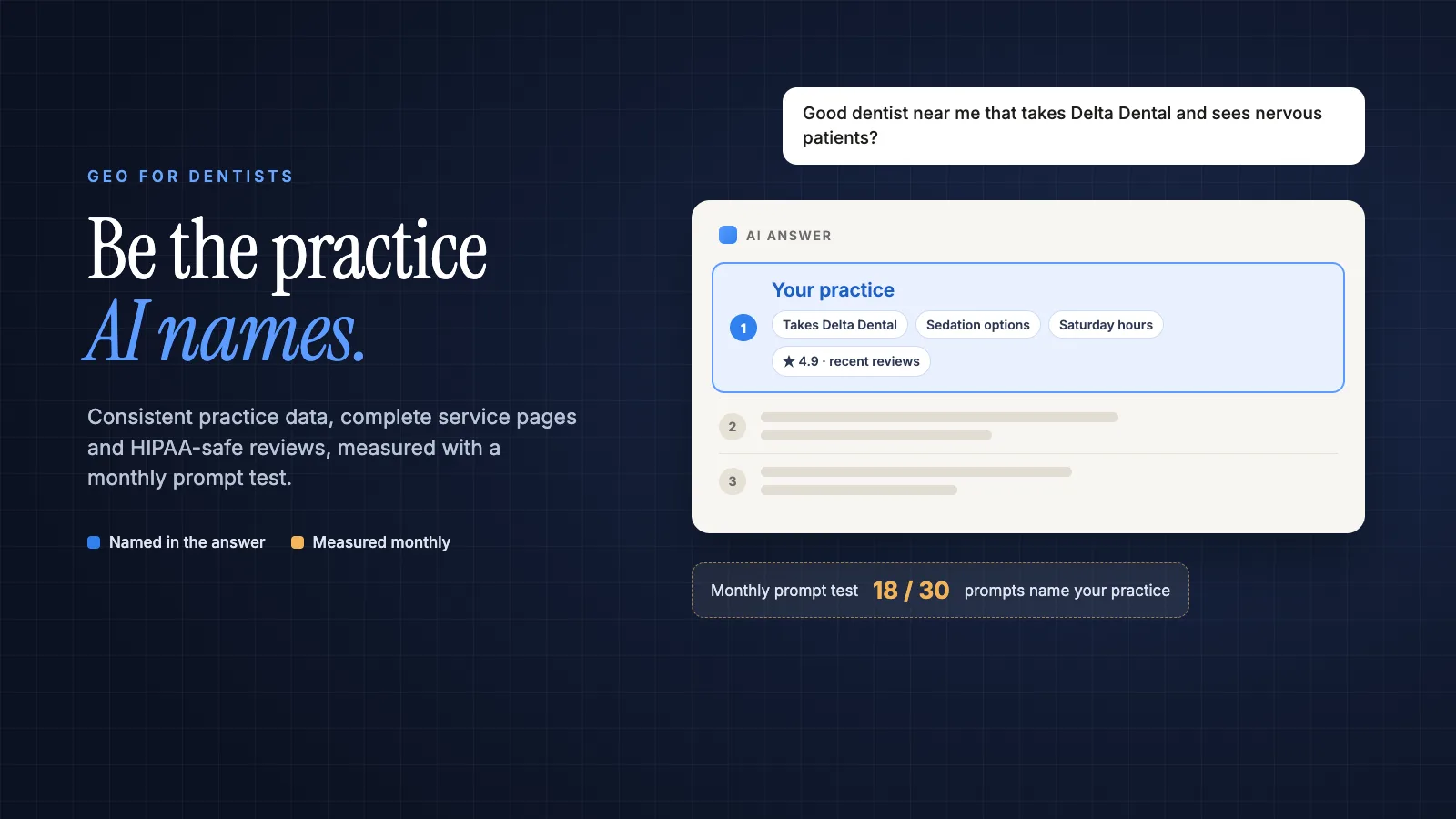
A patient types "who is a good dentist near me that takes Delta Dental and sees nervous patients" into ChatGPT, Google AI Mode or Perplexity. The answer names two or three practices, summarizes what each is known for, and often links to a Google Business Profile or a review site rather than to a practice website. Either your practice is in that answer or it is not, and most dentists have no idea which.
Generative engine optimization (GEO) is the work of making a dental practice easy for AI systems to find, understand and recommend. For a local business like a dental office, it rests on the same foundations as local SEO, with a heavier emphasis on consistent entity data, specific service-level detail, verifiable credentials, review content and answerable patient questions. This guide covers what the evidence actually supports, what dentists can do inside a normal practice schedule, the compliance rules that make dental GEO different from GEO for a software company, and how to measure whether any of it is working.
What does generative engine optimization mean for a dental practice?
Generative engine optimization is the practice of structuring your online presence so that AI-driven answer systems (Google AI Overviews and AI Mode, ChatGPT search, Perplexity, Gemini and similar tools) can retrieve accurate information about your practice and are more likely to cite or recommend it when someone asks a relevant question.
For a dentist, the "entity" that AI systems reason about is not a web page. It is the practice itself: its name, address, hours, dentists, credentials, services, insurance accepted, prices where published, and what patients say about it. Those facts live in many places at once: your website, your Google Business Profile, Healthgrades, Zocdoc, the ADA Find-a-Dentist directory, insurer directories, Yelp and social profiles. AI systems assemble their picture of your practice from all of them. When the facts disagree, or when a key fact is missing everywhere, the system either leaves you out or describes you incorrectly.
That is why dental GEO is less about writing "AI-friendly" prose and more about making sure the same, specific, verifiable facts about your practice exist wherever an AI system might look. If you want the broader background first, our guide to GEO vs SEO explains how the two disciplines overlap and where they diverge.
How do AI search engines find and recommend local businesses?
Much of the advice published for dentists describes how AI "decides" who to recommend as if the mechanism were known. Most of it is inference. Here is what the platforms themselves have documented, and what remains a reasonable but unproven working assumption.
What Google says about AI Overviews and AI Mode
Google's own documentation is unusually direct. Its AI features and your website page states that there are no additional requirements to appear in AI Overviews or AI Mode and no special optimizations are necessary; the fundamentals of SEO still apply. The same page explains that both features may use a "query fan-out" technique, issuing multiple related searches across subtopics and data sources to build a response, and asks site owners to make sure structured data matches the visible text and that Business Profile information is up to date.
Two practical consequences follow for dentists. First, the question "do you take Delta Dental, offer sedation and have Saturday hours in Plano" is broken into sub-questions, and your practice is only assembled into the answer if each sub-question can be answered from your pages, your profile or third-party listings. Second, your Google Business Profile is explicitly named by Google as an input, which is why it does more work in dental GEO than any single blog post.
What OpenAI and Perplexity say about their crawlers
OpenAI's crawler documentation describes three user agents. OAI-SearchBot indexes sites for ChatGPT search results, ChatGPT-User fetches pages when a user's question requires it, and GPTBot collects training data. Each can be allowed or blocked independently in robots.txt. A practice that blanket-blocked AI crawlers in 2023 to protect its content may have blocked itself out of ChatGPT search without realizing it.
Perplexity's crawler documentation makes the same distinction: PerplexityBot surfaces and links websites in search results and is not used for model training, while Perplexity-User visits pages to answer a specific question and include a link.
What remains a working assumption
Nobody outside these companies knows the weighting of reviews, credentials, directory consistency or content freshness in a recommendation. What is observable is that AI answers for "best dentist in [city]" questions tend to pull from the same sources local search has always rewarded: Business Profiles, major directories, review platforms and practice websites that state facts plainly. Treat any guide that gives you a precise ranking formula for AI recommendations as marketing, not documentation.
Why should dental practices care now?
The case for acting is not that AI will replace Google for finding a dentist. It is that the behavior of search itself has changed in ways that reduce clicks and raise the value of being named inside the answer.
Pew Research Center's analysis of real browsing data, published in July 2025, found that users clicked a traditional search result in 8% of visits when an AI summary appeared, compared with 15% when it did not, and clicked a link inside the AI summary itself in only 1% of such visits. Semrush's AI Mode study, based on almost 69 million US desktop sessions between May and July 2025, found that only 6 to 8% of AI Mode sessions led to a visit to an external site, and that the average AI Mode query was 7.22 words, nearly twice the length of a traditional search.
Longer, more conversational queries are exactly how patients describe dental needs: "dentist who can do a same-day crown and is gentle with kids." A practice page optimized for the two-word keyword "Plano dentist" does not answer that question. A page, a profile and a review base that each state the specifics do.
The practical implication for a practice is that the goal shifts from "rank first and get the click" to "be named accurately in the answer, and make the next step (call, book, directions) available wherever the answer sends the patient."
The dental GEO foundation: get the entity right first
Before writing any new content, fix the data that every AI system reads. This is unglamorous and it is where most of the result comes from.
Google Business Profile
Google's guidelines for representing your business treat dentists as individual practitioners. Each public-facing dentist who can be contacted at the location during stated hours may have a profile in their own name, and the practice has a separate location profile. Support staff should not have profiles, and a dentist should not have separate profiles for each specialty. The business name must match real-world signage, with no taglines, service keywords or location descriptors added.
Within those rules, do the following:
- Choose the most specific primary category (for example "Dentist", "Pediatric dentist", "Endodontist", "Cosmetic dentist") and only add secondary categories that describe what the business is, not services it offers.
- Complete the services list in full rather than listing a few popular items. Google's guidelines ask for a complete list, and the fan-out behavior described above means a missing service is a missed sub-question.
- Write the description as plain facts: specialties, sedation options, languages spoken, accessibility, insurance participation and emergency availability. Promotions, prices and links are not allowed in the description.
- Keep hours accurate, including holiday hours. "Open now" is a common filter in AI answers.
- Add real photographs of the office, team and equipment with descriptive filenames.
Directory and citation consistency
Audit your name, address, phone number, hours and dentist names across Healthgrades, Zocdoc, Yelp, the ADA Find-a-Dentist directory, every insurer directory you participate in, Apple Maps, Bing Places and your state dental association listing. Correct discrepancies in the source systems rather than only on your website. A dentist who has changed practices and still appears at an old address on an insurer directory will be described incorrectly by any AI system that trusts that directory.
Your own website as the source of truth
Every fact above should also appear on your website in crawlable HTML text, not only in images or PDFs. The practice page should state the address, hours, phone and a complete service list. Each dentist should have a profile page with full name, degree, license state, education, board certifications and professional memberships, written as text. These pages are what Google's documentation means by making sure your structured data "matches the visible text."
Structured data for a dental practice
Schema.org defines Dentist as a type under both LocalBusiness and MedicalBusiness. It supports properties including address, openingHoursSpecification, medicalSpecialty, priceRange, hasCredential and isAcceptingNewPatients. Mark up the practice with Dentist, each clinician with a Person entity connected to the practice, and keep the values identical to the visible page content. Structured data helps systems interpret your pages; Google has not stated that it is a ranking or recommendation factor for AI features, so treat it as clarity work, not a lever. Our guide to schema and entity optimization for LLMs covers the implementation detail.
Crawler access
Check robots.txt for rules that block OAI-SearchBot, PerplexityBot or Google's crawlers. Blocking GPTBot (training) while allowing OAI-SearchBot (search) is a legitimate choice. Blocking everything is a decision to be absent from AI search.
How do you write content that answers the questions patients actually ask?
Once the entity is clean, content earns its place. The goal is not volume. It is a complete, accurate answer to each question a patient might ask an AI system about your practice or about a procedure you offer.
Start with front-desk questions, not keyword tools
Your reception team already knows the questions: Do you take my insurance? How much is a crown without insurance? Do you see children? Can I be sedated for an extraction? How long will I be numb? Is it an emergency? Write them down for two weeks. Each is a sub-question an AI system will try to answer when a patient asks a compound question about you.
Build complete service pages, not thin ones
For each core service (cleanings and exams, fillings, crowns, root canals, extractions, implants, Invisalign or braces, whitening, emergency care, pediatric dentistry, sedation), write one page that answers, in plain language: what the procedure is, who it is for, what to expect at the appointment, recovery and aftercare, typical price range or how pricing is determined, insurance considerations, and which dentist at your practice performs it. State the facts in self-contained sentences that still make sense when quoted on their own.
Compare the two sentences below. The first is how most practice pages read. The second is how an AI system can use it.
| Typical practice copy | Answerable, self-contained copy |
|---|---|
| We offer comprehensive crown solutions using the latest technology. | Riverside Family Dental in Plano, Texas, places same-day CEREC ceramic crowns in a single two-hour appointment; a traditional lab-made crown takes two visits about two weeks apart. |
The second version names the practice, the location, the procedure, the method and a concrete timeframe. It can be quoted without context. It is also a factual claim about your practice, which brings us to the part most GEO guides for dentists skip.
Keep clinical answers general and clinician-reviewed
Articles that recommend adding "micro-answers" such as "a crown lasts 10 to 15 years" rarely mention that every such sentence is a clinical claim on a healthcare website. Have a dentist review every clinical statement, attribute ranges to a source where one exists, and use language that acknowledges variation ("most patients", "typically", "depending on"). This is both better medicine and better GEO, because AI systems are increasingly cautious about health content and favor sources that qualify claims appropriately.
Comparison and decision content
Patients ask AI systems comparison questions constantly: Invisalign versus braces, implant versus bridge, in-office versus take-home whitening. These are the pages that get quoted. Write them as balanced comparisons with a clear structure, and end with how your practice helps a patient decide rather than a sales close. For the rest of the marketing plan around these pages, see marketing a small dental practice. Orthodontic practices face the same comparison questions at a larger scale; our SEO for orthodontists page covers how we handle them.
Freshness without churn
Several competitor guides recommend rewriting pages every three to four months. There is no public evidence that AI systems reward arbitrary date changes, and Google's documentation does not mention freshness as a requirement for AI features. Update a page when a fact changes: a new dentist, a new service, a price change, a new insurance plan, revised clinical guidance. Show a visible "last reviewed" date with the reviewing clinician's name. That is a credible freshness signal because it is true.
Reviews: the input you control least and need most
Reviews are the one source that appears in nearly every AI recommendation of a local business, because they are how the system learns what a practice is like rather than what it offers. Two things matter: the volume and recency of reviews, and whether the text of those reviews contains the specifics patients ask about (procedure, insurance, anxiety, children, wait times, pain management).
You cannot script what patients write, and you should not try to, but you can ask at the right moment. A request sent the same day as a completed treatment, mentioning the procedure by name in a neutral way ("Thank you for visiting us for your crown today"), tends to produce reviews that mention the procedure.
The HIPAA line in review responses
This is where dental GEO differs sharply from GEO for any other industry. In a settlement concluded in December 2022, the HHS Office for Civil Rights found that a dental practice had disclosed patient names, treatment and insurance information in its responses to Yelp reviews, including details the reviewers had not posted themselves, and imposed a corrective action plan along with a monetary resolution, as summarized by DLA Piper. The lesson for any review strategy: a patient may say anything about their own care in a review, but your response must not confirm that they are a patient, name a procedure, or reference their visit. Respond generally, thank them, and invite them to contact the office directly.
Advertising claims and the ADA Code
The American Dental Association's Principles of Ethics and Code of Professional Conduct prohibits communications that are false or misleading in a material respect, and its 2025 updates extended that standard to social media and influencer content, as reported by ADA News. Several dental GEO guides recommend "quantified expertise" such as "Dr. Chen has completed 3,000 Invisalign cases." Use such figures only if you can substantiate them, and check your state dental board's advertising rules, which often go further than the ADA Code on superlatives ("best", "painless", "top-rated") and on specialty claims by general dentists. An AI system that quotes an unsubstantiated claim does not make it compliant; it makes it more visible.
A 90-day dental GEO plan a practice can actually run
The plan below assumes one practice manager with a few hours a week, a dentist available for clinical review, and a web developer or agency for the technical items. Everything in weeks one to four costs nothing but time.
| Period | Work | Owner |
|---|---|---|
| Weeks 1 to 2 | Baseline test (see measurement below). Audit Google Business Profile against Google's guidelines; complete services, categories, description, hours. Check robots.txt for AI crawler blocks. | Practice manager, developer |
| Weeks 3 to 4 | Citation audit across the eight to ten directories that matter for your area; fix discrepancies at source. Add full dentist profile pages to the website. Start the two-week front-desk question log. | Practice manager |
| Month 2 | Rewrite the five highest-volume service pages to the complete, self-contained standard above, with clinician review. Add Dentist and Person structured data that mirrors the visible text. Set up the review request routine. | Manager, dentist, developer |
| Month 3 | Publish two or three comparison pages drawn from the question log. Add a "last reviewed by" line to every clinical page. Re-run the baseline test and compare. | Manager, dentist |
Keep the pace after month three: one new or substantially improved page a month, reviews requested consistently, and the measurement routine below run monthly.
How do you measure whether dental GEO is working?
Most guides tell dentists to "track AI citations" without saying how. Here is a measurement routine that a practice can run without enterprise tooling, in roughly an hour a month.
Build a fixed prompt set and test it the same way every month
Write 20 to 30 prompts a real patient might use, in natural language, including your city or neighborhood, specific services, insurance names and situational modifiers (anxious patient, child, emergency, Saturday). Run each prompt in ChatGPT with search enabled, Google AI Mode, Perplexity and Gemini, from a logged-out or fresh session, on the same day each month. Record for each prompt whether your practice is named, where it appears in the answer, which competitors are named, and which sources are linked. Over three to six months this gives you a presence rate per platform that you can act on. Our guide to AI search visibility walks through the method in more detail.
Separate AI referral traffic in analytics
In Google Analytics 4, create a channel or a custom segment for sessions whose referrer contains chatgpt.com, perplexity.ai, gemini.google.com or copilot.microsoft.com. Volumes will be small. What matters is the trend and the conversion rate of those sessions, which in our experience across industries tends to be higher than organic search because the visitor arrives having already been recommended.
Ask patients and record it
Add "AI assistant (ChatGPT, Google AI, etc.)" as an option to the "how did you hear about us" question on your intake form and train the front desk to ask it on phone bookings. This is the only measurement that connects AI visibility to actual patients.
Watch for inaccuracies, not just absence
Run a handful of branded prompts monthly ("tell me about [practice name]", "does [practice] take [insurance]", "who are the dentists at [practice]"). When an answer is wrong, trace the wrong fact back to its source, which is nearly always an outdated directory listing or an old page on your own site, and fix it there.
What mistakes cost dental practices AI visibility?
- Blocking AI crawlers wholesale in robots.txt and then wondering why ChatGPT never mentions the practice.
- Keyword-stuffed Business Profile names ("Smile Dental Plano Best Implants"), which violate Google's guidelines and risk suspension.
- Thin service pages that say the practice "offers" a service without stating who performs it, what it costs or how it works.
- Clinical micro-answers written by a marketing agency with no dentist review.
- Review responses that confirm a reviewer is a patient or mention their treatment.
- Case-count and success-rate claims that cannot be substantiated.
- Rewriting pages every quarter to look fresh while the underlying facts have not changed.
- Measuring success by the number of blog posts published rather than by presence in a fixed set of patient prompts.
What else do people ask about GEO for dentists?
Does a dental practice need a separate GEO strategy from its SEO strategy?
No. Google states that no special optimization is needed for AI Overviews or AI Mode, and the inputs AI systems use for local recommendations (Business Profile, directories, reviews, clear service pages) are the same inputs local SEO has always relied on. GEO for a dentist is best understood as local SEO done to a higher standard of completeness and accuracy, plus a measurement routine that includes AI platforms.
Can a small practice compete with a DSO or a large group in AI answers?
In principle, yes, because AI systems reason about facts and reviews rather than domain size, but there is no public evidence quantifying this. A small practice with complete, consistent data and specific recent reviews is well placed. A small practice with a thin website and inconsistent listings is not, regardless of how good the dentistry is.
Should dentists block AI crawlers to protect their content?
Decide crawler by crawler. Blocking GPTBot (used for training) while allowing OAI-SearchBot and PerplexityBot (used for search results) lets a practice appear in AI search without contributing content to model training. Blocking all of them removes the practice from AI search entirely.
How long before a practice sees results?
Expect three to six months of consistent work before the monthly prompt test shows a clear change, and longer in dense urban markets. Anyone promising results in 30 days is describing something they cannot measure.
Where should a practice start?
If you take one action from this guide, run the baseline prompt test this week. Thirty prompts, four platforms, one spreadsheet. It will show you whether AI systems can find your practice at all, what they say about it, and which competitors they prefer. Everything else in this guide follows from what that test reveals.
If you are also deciding how much to spend on paid search versus organic visibility, our breakdown of Google Ads vs SEO for dentists compares real click costs by treatment and shows how to work out your cost per new patient. For another specialty that balances medical and cosmetic patients, see our guide to SEO for dermatologists.
If you would rather have the audit, the entity clean-up and the monthly measurement run for you, LLM's Marketing offers AI search visibility services built on exactly this process. You can book a discovery call to see what the baseline looks like for your practice. Practices in Cypress, Texas can also see our dental SEO program for Cypress.
Is your brand showing up in ChatGPT, Perplexity and Gemini?
Send me your website and I'll check how your brand appears in AI answers and search, then reply personally with the first fixes I would make.