
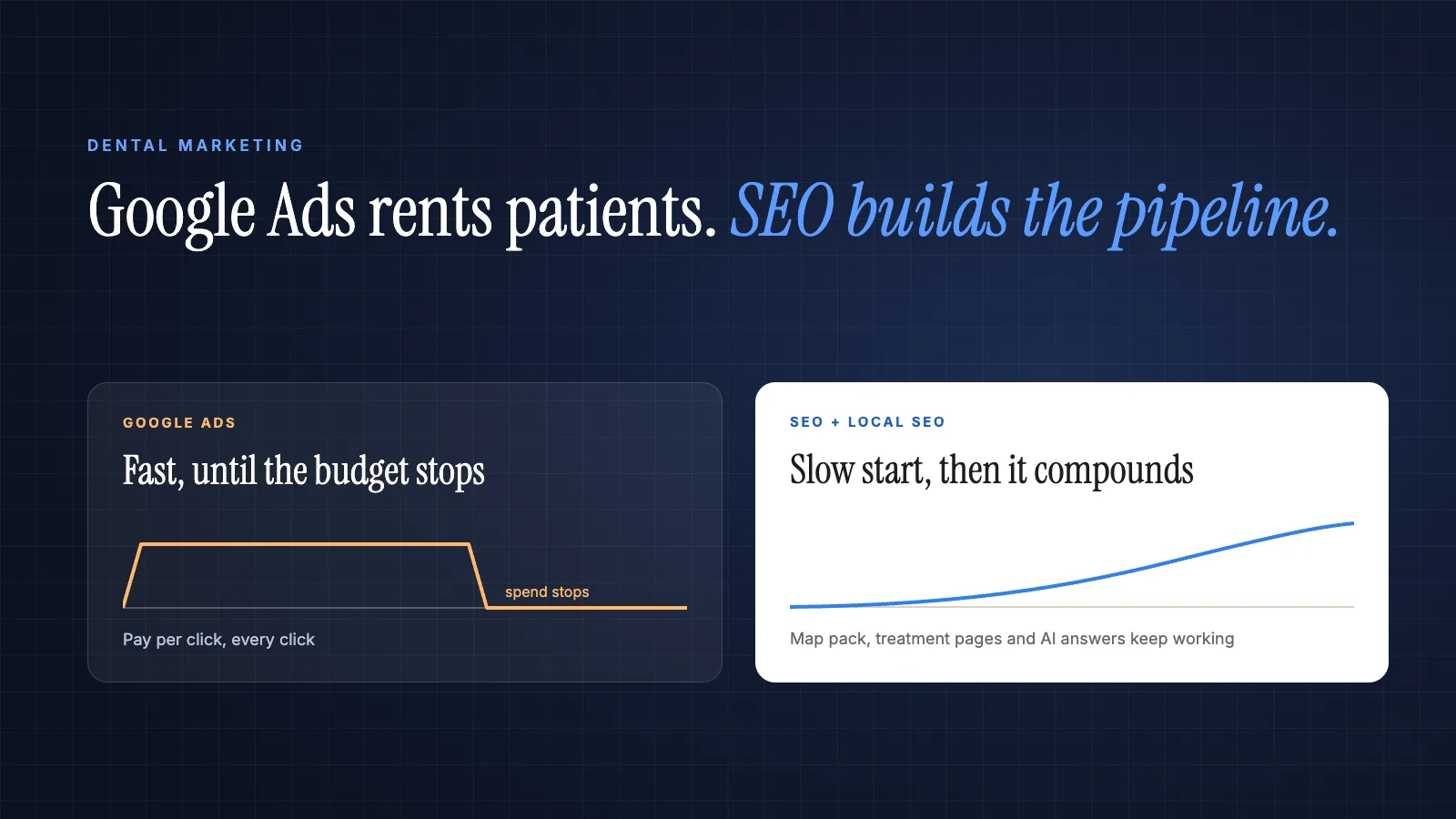
Every dental practice owner eventually gets two pitches in the same month. One agency says Google Ads will fill the chair by next week. Another says SEO is the only investment that compounds. Both are partly right, which is exactly why the decision feels hard.
Google Ads is better for dentists who need new patients quickly, want to promote a specific high-value treatment, or are launching a new location, because ads can appear as soon as a campaign is approved. SEO is better for long-term, lower-cost patient acquisition, because organic and map pack visibility keeps producing calls without a per-click fee. Most established practices do best with both: SEO and the Google Business Profile as the foundation, and ads used selectively for high-value treatments and gaps in the schedule.
"Do both" is not a plan, though. This guide gives you the numbers and the decision rules: real cost-per-click data for common dental searches, a simple formula for what a new patient costs through ads, the compliance limits that make dental advertising different from other industries, and a budget split for five common practice situations.
How Google Ads and SEO Differ for a Dental Practice
Google Ads and SEO compete for the same search results page but work in completely different ways. With Google Ads, you pay each time someone clicks your ad, and your ads stop the moment the budget stops. With SEO, you invest in your website, content and Google Business Profile so that your practice earns unpaid visibility in the organic results and the local map pack.
One point causes a lot of confusion: buying ads does not improve your organic rankings. Google states plainly that what you pay for ads will have no impact on the organic search results. The two channels can support each other indirectly, but you cannot buy your way into the map pack. Google also says there is no way to request or pay for a better local ranking, which depends on relevance, distance and prominence.
| Factor | Google Ads | SEO and local SEO |
|---|---|---|
| Speed | Visible as soon as campaigns are approved and live | Usually months to build, faster for low-competition treatments |
| Cost model | Pay per click, every click | Pay for the work; clicks are free |
| When you stop paying | Visibility stops immediately | Visibility fades slowly, if at all |
| Control | Choose treatments, areas, hours and budget precisely | Influence, but no control, over rankings |
| Best for | Urgent demand, high-value treatments, launches, testing | Steady new-patient flow, reviews, reputation, AI answers |
| Main risk | Spending more per patient than a patient is worth | Investing for months without measuring results |
What Dental Clicks Actually Cost
Competing articles often quote a vague "$10 to $50 per click" range with no source. Real numbers vary by treatment, and the variation matters more than the average. The table below shows national US averages from the Semrush US keyword database, pulled in October 2026. Cost per click (CPC) is the average advertisers paid for a click in Google Ads.
| Search | US monthly searches | Average CPC | Organic difficulty (0 to 100) |
|---|---|---|---|
| dental implants near me | 135,000 | $17.88 | 14 |
| invisalign near me | 135,000 | $10.78 | 35 |
| all on 4 dental implants | 90,500 | $10.72 | 15 |
| dentist near me | 1,000,000 | $8.30 | 76 |
| dental cleaning near me | 74,000 | $7.33 | 20 |
| emergency dentist | 135,000 | $6.86 | 30 |
| pediatric dentist near me | 110,000 | $6.52 | 54 |
| cosmetic dentist near me | 60,500 | $6.26 | 6 |
| teeth whitening near me | 90,500 | $4.27 | 8 |
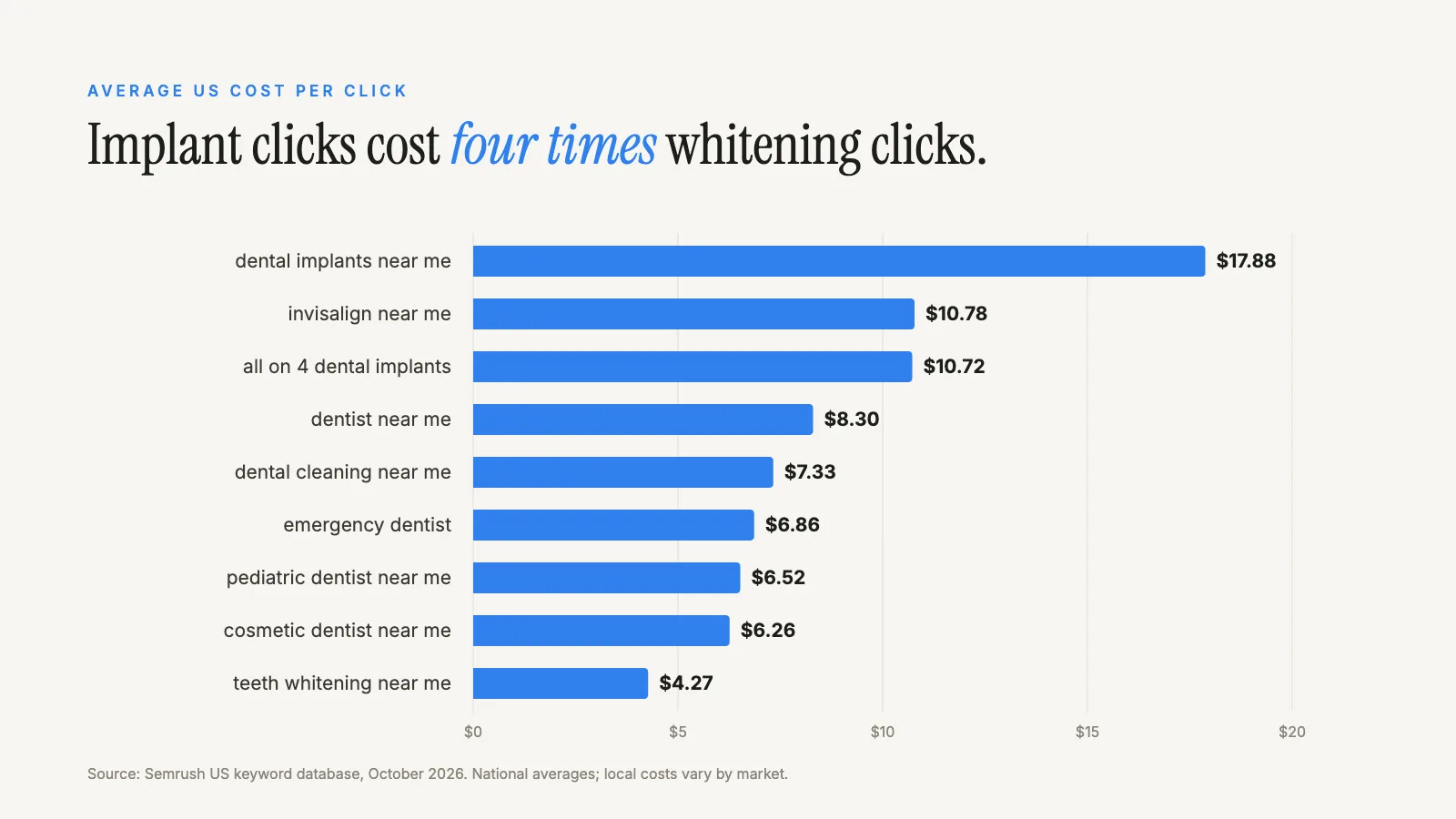
How to read these numbers
National averages hide local spikes
These figures are national averages. In dense metros with many competing practices, you can expect to pay more, and in smaller towns less. Use Google Ads Keyword Planner with your own service area for real bids before you set a budget.
Difficulty and CPC tell different stories
"Dentist near me" has a high organic difficulty score (76) because the results are dominated by the map pack, directories and large practices. "Dental implants near me" and "cosmetic dentist near me" have low difficulty scores but meaningful click costs. That combination is a signal: those are searches where a strong treatment page can realistically win organic visibility and save you the click cost over time.
The Math: What a New Patient Costs Through Ads
A click is not a patient. To judge Google Ads, convert click cost into cost per new patient with three numbers you can measure in your own practice:
Cost per new patient = CPC ÷ click-to-inquiry rate ÷ inquiry-to-booked rate
Here is a worked example using the national CPCs above and conversion rates chosen only for illustration. Your rates will be different, which is the point of measuring them.
| Campaign | CPC | Click to inquiry | Inquiry to booked | Cost per new patient |
|---|---|---|---|---|
| Implant consultations | $17.88 | 8% | 30% | About $745 |
| Emergency appointments | $6.86 | 15% | 60% | About $76 |
| New patient cleanings | $7.33 | 10% | 50% | About $147 |
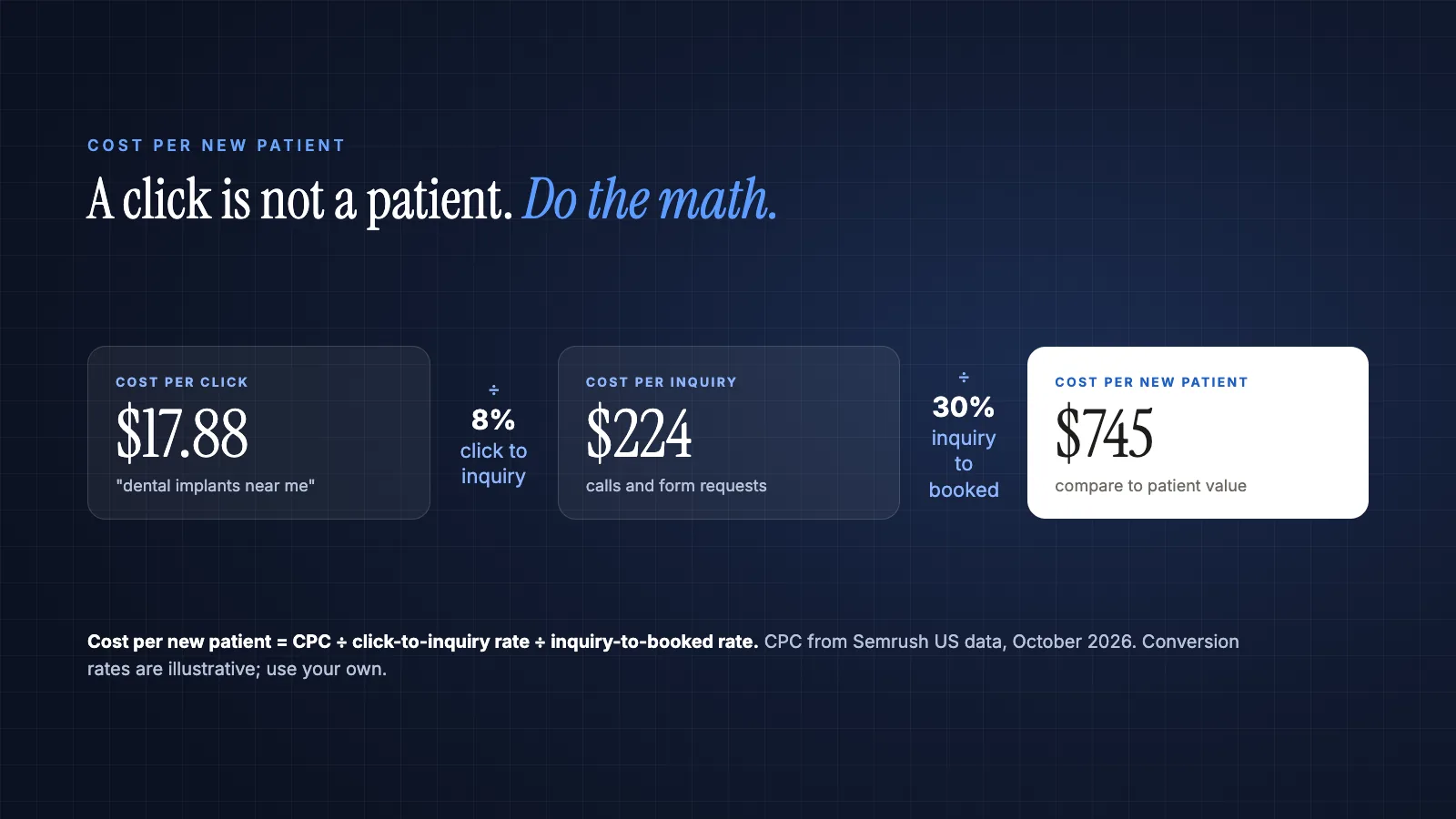
Whether $745 is expensive depends entirely on what an implant patient is worth to your practice over time. Whether $147 is cheap depends on whether that cleaning patient stays for years of recall visits. Ads make sense when the cost per new patient sits comfortably below the value of that patient, after accounting for your intake team's ability to answer and book quickly.
That last part is often the real bottleneck. Calls that go to voicemail and web inquiries answered the next morning make every click more expensive. Practices that run ads should fix response speed first, whether through front desk processes or tools like AI lead agents that answer and qualify inquiries around the clock.
Dental Ads Have Rules Most Guides Skip
Healthcare advertising carries restrictions that generic comparisons ignore, and they change how much value you can get from ads.
Google limits audience targeting for health
Google's personalized advertising policy treats health as a sensitive interest category. When you promote in a sensitive category, advertiser-curated audiences, including remarketing lists and Customer Match, cannot be used. In practice, the classic "show ads to everyone who visited the implants page" retargeting tactic that competing articles recommend is restricted for dental treatments. Plan your ads around search intent, not follow-up audiences.
Tracking and HIPAA
To measure ads properly you need conversion tracking, and in healthcare that raises privacy questions. In 2022 and 2024, the HHS Office for Civil Rights issued guidance on online tracking technologies for HIPAA-covered entities. In June 2024 a federal court in Texas held that part of that guidance exceeded HHS's authority, and HHS later dropped its appeal. The ruling narrowed the guidance but did not make every tracking setup safe, especially on patient portals and booking flows that collect health information.
The practical rule: never send patient details such as names, treatments or appointment information to an ad platform, keep tracking to non-identifying conversion events, and have your setup reviewed by someone who understands HIPAA. Our marketing automation service handles call and form tracking with that separation in mind.
Local Services Ads are a third option
Google's Local Services Ads list dentists among the eligible health care categories in some areas, and Google says advertisers pay only for leads rather than clicks. Availability varies by location, and eligibility requires verification. If your area qualifies, they are worth testing alongside search ads because they charge per inquiry instead of per click.
What SEO Gives a Dental Practice That Ads Cannot
The map pack and your reviews
Most local dental searches show a map pack with three practices, their star ratings and their review counts. That space cannot be bought through standard search ads. It is earned through a complete, accurate Google Business Profile, consistent practice details across the web, and a steady flow of genuine reviews. Our guide to SEO for gyms walks through the same map pack playbook for another local business, and our dental SEO work in Cypress, Texas shows how it applies to a practice.
Treatment pages that keep working
A well-built page for implants, Invisalign or emergency care can rank for hundreds of related searches and keep bringing in patients for years. At the CPCs in the table above, every organic click on "dental implants near me" is a click you are not paying around $18 for. Building those pages is the core of our AI SEO and content service.
Visibility in AI answers
Some patients now ask ChatGPT, Gemini or Google's AI Mode questions like "how much do dental implants cost?" before they search for a dentist. Google says there are no special requirements to appear in AI Overviews or AI Mode beyond normal SEO best practice, which means the same treatment pages and reputation that help organic rankings also feed AI answers. Our explainer on GEO vs SEO covers what changes and what stays the same. Our guide to generative engine optimization for dentists covers this in depth, and our AI search visibility service measures how often assistants recommend your practice.
Ads are moving into AI answers too, with Google testing and expanding ad placements in and around AI results. Eligibility rules for healthcare advertisers are still changing, so treat any promise of guaranteed ad placements inside AI answers with caution. Our guide to AI advertising explains how ads inside AI answers work.
How to Split Your Budget by Practice Situation
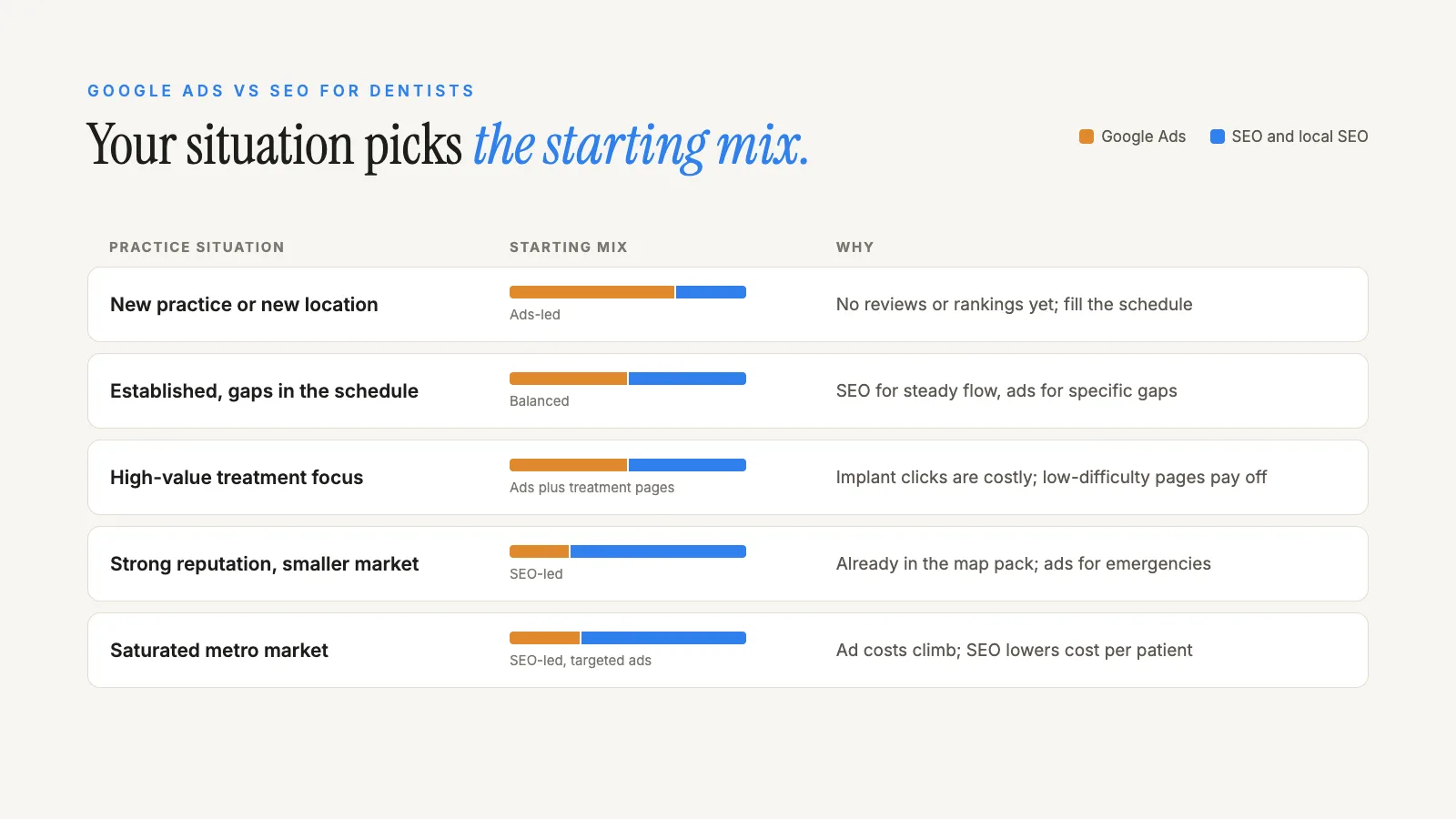
There is no universal split, but your situation narrows it quickly. Use these as starting points and adjust with your own cost per new patient.
New practice or new location
Lean on ads first, because you have no reviews, no rankings and a schedule to fill. At the same time, set up your Google Business Profile and core treatment pages on day one so organic visibility starts building. Plan to shift budget toward SEO as reviews and rankings arrive.
Established practice with gaps in the schedule
Run a balanced mix. Use SEO to grow steady new-patient flow and ads for specific gaps, such as open hygiene slots or a new associate's calendar. Re-engage existing patients through recall reminders before paying for new ones; our email marketing service builds those sequences.
Focus on a high-value treatment
Implants, All-on-4 and clear aligners justify higher click costs. Run focused ad campaigns with dedicated landing pages, and build in-depth treatment pages in parallel. The low organic difficulty for many implant searches makes this one of the best places for SEO to pay off. For the full channel mix beyond ads and SEO, see our guide to marketing a small dental practice. Specialist orthodontic practices can see our SEO for orthodontists page for the aligner and braces version of this plan.
Strong reputation in a smaller market
If you already have strong reviews and rank in the map pack, SEO should lead. Use a small ad budget for emergency searches and treatments where you do not yet rank.
Saturated metro market
In dense cities, ad costs climb and the map pack is crowded. SEO matters more here, not less, because it is the only way to lower your average cost per patient over time. Keep ads tight: specific treatments, specific neighborhoods and hours when your team can answer.
Mistakes That Waste Dental Marketing Budgets
Google Ads mistakes
Sending ad traffic to the homepage
An implant ad should land on an implant page with pricing guidance, financing options and a clear way to book. A general homepage loses many of those clicks.
Chasing Quality Score as a cost lever
Many dental marketing articles claim that SEO "raises your Quality Score and lowers your ad costs." Google describes Quality Score as a diagnostic based on expected clickthrough rate, ad relevance and landing page experience, and states that Quality Score is not an input in the ad auction. Better landing pages still help your ads perform, but treat Quality Score as a health check, not a lever.
Measuring clicks instead of booked patients
Track calls and form submissions as conversions, and match them against booked appointments in your practice management system. A campaign that looks cheap per click can be expensive per patient.
SEO mistakes
One thin page for every service
A single "Services" page listing twenty treatments rarely ranks for any of them. Each major treatment deserves its own page that answers what patients actually ask.
Ignoring the Google Business Profile
Wrong hours, a missing primary category or no recent reviews will hold back your map pack visibility no matter how good your website is.
Paying for SEO without reporting
You should be able to see rankings, calls and booked appointments from organic search. If your agency cannot show that, our guide on how to vet an SEO company was written for law firms, but the scorecard works just as well for dental practices.
Frequently Asked Questions
Is Google Ads or SEO better for dentists?
Neither is better in every situation. Google Ads is better for speed and for promoting specific high-value treatments. SEO is better for long-term, lower-cost patient acquisition and visibility in the map pack and AI answers. Most established practices benefit from SEO as the foundation, with ads used selectively.
How much should a dentist spend on Google Ads?
Start from cost per new patient rather than a fixed budget. Work out how much a new patient is worth to your practice, measure your click-to-inquiry and inquiry-to-booked rates, and spend only as much as keeps your cost per new patient well below that value. National CPCs for common dental searches range from about $4 to $18 per click, according to Semrush data from October 2026, and vary by market.
How long does dental SEO take to work?
It depends on your market, your current site and the competition for each treatment. Google Business Profile fixes and low-competition treatment pages can show results sooner than competitive searches like "dentist near me" in a large city. Judge early progress by the work completed and leading indicators such as impressions and calls, not rankings alone.
Do Google Ads help SEO rankings?
No. Google states that paying for ads has no impact on organic search results. Ads can support SEO indirectly, for example by revealing which search terms bring booked patients so you can build pages around them.
Can dentists use remarketing in Google Ads?
Google treats health as a sensitive interest category, and advertiser-curated audiences such as remarketing lists and Customer Match cannot be used when promoting in a sensitive category. Check Google's personalized advertising policy for your specific campaigns before planning around remarketing.
Build the Foundation, Then Buy the Gaps
The question is not really Google Ads versus SEO. It is which problem you are solving this quarter. If you need patients now, ads can deliver them as long as your intake team converts the calls. If you want patient acquisition to get cheaper every year, SEO and your Google Business Profile are where that happens. The practices that grow most steadily use SEO as the foundation and ads to buy the gaps. If you run ads, our Google Ads management service starts with an audit of where your current budget goes.
If you want help working out the right mix for your practice, book a free call, reach us through the contact page or send your details below. Our founder, Mohd Adil Kazmi, will review your website, map pack visibility and current ad spend, and reply with the first changes worth making. You can also explore all our services, see results from our client work or browse the industries we work with.
Not sure whether to spend on ads or SEO?
Send your practice website and I'll review your map pack visibility, treatment pages and ad spend, then reply personally with the mix I would start with.