
Will US e-commerce reach 18% of total retail sales in a Census quarterly report by December 31, 2027?
Why the forecast moved Numbered as on the chart · forecast last updated 24 October 2026
| # | Date | Event and reasoning | Change | Source |
|---|---|---|---|---|
| 1 | 19 May 2025 | Census Q1 2025: e-commerce virtually unchanged from Q4 2024, 16.2% of retailOnline sales stalled at $300.2 billion while total retail grew, so the share needs faster gains later to reach 18%. | -3.0 pts24.0% → 21.0% | Source |
| 2 | 30 Jul 2025 | White House suspends duty-free de minimis entry for all countries from August 29Low-value cross-border parcels start paying duties, which raises prices for some of the cheapest online orders. | -1.0 pts21.0% → 20.0% | Source |
| 3 | 19 Aug 2025 | Census Q2 2025: e-commerce at 16.3% of retail, up 5.3% year over yearGrowth stays near its long-run pace of about 0.1 points of share per quarter, too slow to reach 18% by 2027. | -1.0 pts20.0% → 19.0% | Source |
| 4 | 29 Sep 2025 | OpenAI launches Instant Checkout in ChatGPT for US users with Etsy sellersBuying inside an AI assistant removes steps between product discovery and an online order, a new source of demand. | +1.5 pts19.0% → 20.5% | Source |
| 5 | 18 Dec 2025 | Census Q3 2025: e-commerce at 16.4% of retail, up 5.1% year over yearAnother quarter of slow share gains keeps the required pace out of reach on the 2025 trend. | -0.5 pts20.5% → 20.0% | Source |
| 6 | 7 Jan 2026 | Adobe: record $257.8 billion spent online in the 2025 holiday season, up 6.8%Holiday online spending beat the prior year and generative AI traffic to retail sites surged, a sign of strong Q4 demand. | +1.5 pts20.0% → 21.5% | Source |
| 7 | 10 Mar 2026 | Census Q4 2025: e-commerce at 16.6% of retail, up 5.3% while total retail grew 2.7%The gap between online and total retail growth widens, and share rises 0.2 points in a quarter. | +2.5 pts21.5% → 24.0% | Source |
| 8 | 18 May 2026 | Census Q1 2026: e-commerce at 16.9% of retail, up 9.8% year over yearOnline growth nearly doubles its 2025 pace, putting 18% within reach if gains of 0.2 to 0.3 points a quarter continue. | +9.0 pts24.0% → 33.0% | Source |
| 9 | 18 Aug 2026 | Census Q2 2026: e-commerce at 17.1% of retail, up 12.2% year over yearShare crosses 17% with the fastest growth in years; about 0.9 points remain over the next five quarterly reports. | +10.0 pts33.0% → 43.0% | Source |
| 10 | 23 Aug 2026 | Analysts flag that Prime Day moved into June, pulling online spending from Q3 into Q2Part of the Q2 jump may be timing rather than trend, and the figures are not adjusted for inflation. | -3.0 pts43.0% → 40.0% | Source |
Expert commentary Quotes attached to the tracked events · each checked against its source
| Who | What they said | # | Source | |
|---|---|---|---|---|
| Li ChenProfessor of Manufacturing Management, Cornell SC Johnson College of BusinessIndependent | “It is still a good bargain, just not as deeply discounted as before.” | 2 | news.cornell.edu | |
| OpenAIInstant Checkout announcementOfficial | “ChatGPT already helps millions of people find what to buy. Now it can help them buy it too.” | 4 | nairametrics.com | |
| Vivek PandyaLead Analyst, Adobe Digital InsightsIndependent | “This 2025 holiday season, consumers embraced generative AI more than ever as a shopping assistant in their purchasing decisions.” | 6 | news.adobe.com | |
| Armando RoggioSenior Contributor, Practical EcommerceIndependent | “an ecommerce market gaining momentum rather than benefiting from higher retail spending generally” | 9 | practicalecommerce.com | |
| Armando RoggioSenior Contributor, Practical EcommerceIndependent | “potentially shifting billions of dollars in ecommerce spending from the third quarter into the second” | 10 | practicalecommerce.com |
Probability estimate by LLM's Marketing for llmsmarketing.com, not a statement by the U.S. Census Bureau. Resolves YES only if a Quarterly Retail E-Commerce Sales report released by the U.S. Census Bureau on or before December 31, 2027 shows seasonally adjusted e-commerce sales at 18.0 percent or more of total retail sales for any quarter. Not-seasonally-adjusted shares, other data providers and private estimates do not count. Starts from a 24% base rate on 1 April 2025 and moves at each dated, sourced event; values before 24 October 2026 are reconstructed from those events, not predictions made at the time. Last updated 24 October 2026.
Most guides to local SEO for ecommerce open with the same advice: create a Google Business Profile, set a service area, and start collecting reviews. For a store that only sells online, that advice is the riskiest place to start. Google's own rules usually exclude you, and a suspended profile does more damage than no profile at all.
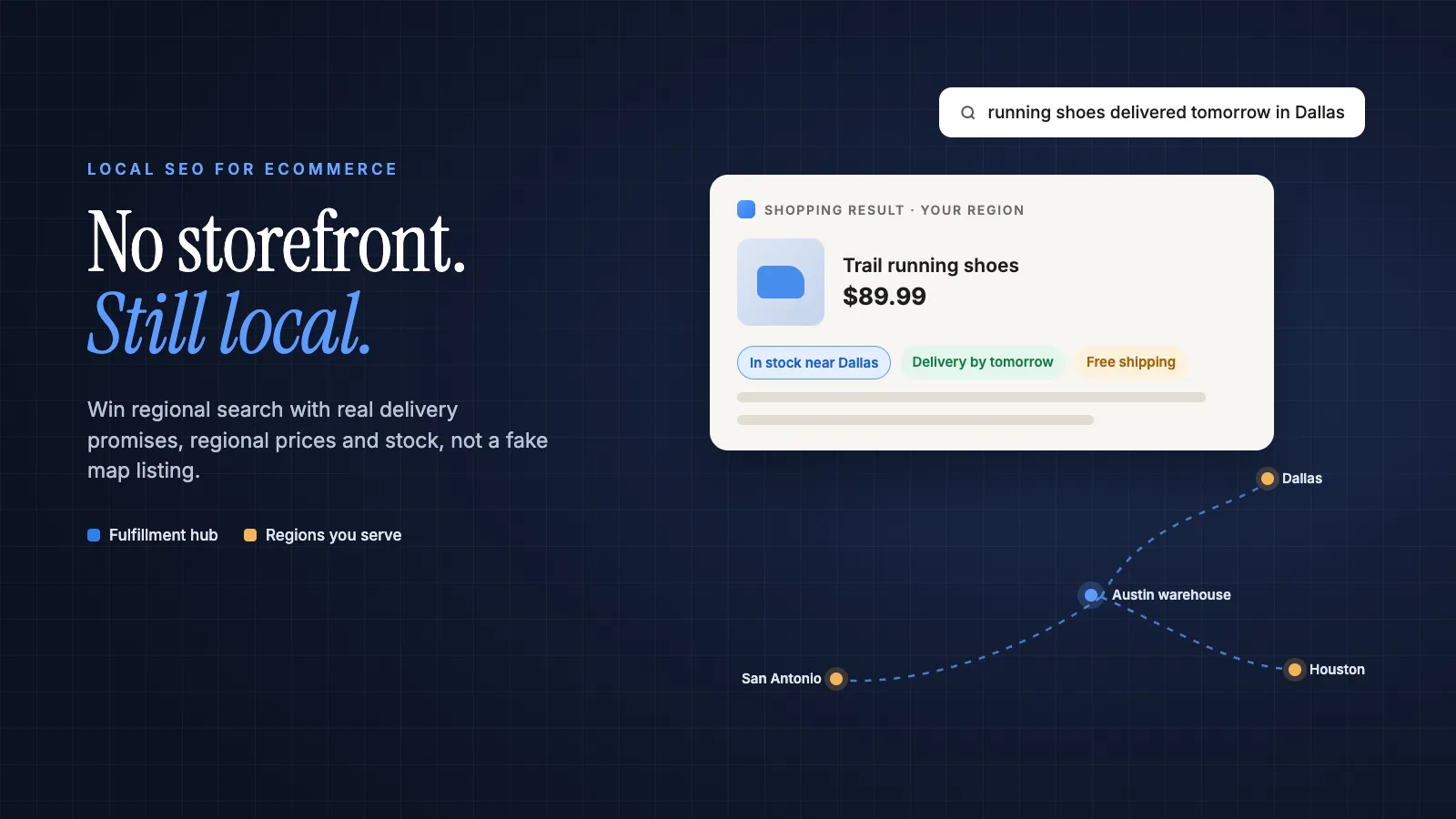
The good news is that online-only stores have better local levers than a map listing. Google lets you show regional prices, regional stock and delivery times directly in Search and Shopping results. Well-built regional content can rank for "near me" and city-level queries. AI assistants increasingly answer shopping questions that carry an implied location, such as "which store delivers organic coffee beans to Austin by tomorrow?"
This guide covers what local SEO actually means for an online-only business, which tactics are safe, and how to build local relevance without a storefront.
What does local SEO mean for an online-only store?
For a business with a shop or office, local SEO mostly means ranking in Google Maps and the Local Pack (the map block of three businesses that appears for queries like "florist near me"). Those results rely on a verified Google Business Profile tied to a real address or service area.
An online-only store usually can't compete for that map block, and it doesn't need to. Local SEO for ecommerce means matching location-specific shopping intent with accurate, location-specific information:
- Prices and availability that reflect where the shopper is.
- Delivery speed and shipping cost for their region.
- Content that answers regional questions, such as climate-specific product advice, regional regulations or local sizing conventions.
- Signals that show search engines and AI assistants that you actually serve that market.
When a shopper searches "same-day delivery running shoes Chicago", Google's job is to find the store that can actually deliver. Your job is to make that fact easy to find and verify.
Can an online-only business use Google Business Profile?
In most cases, no. Google's guidelines for representing your business on Google say a business is eligible if it has a physical location that customers can visit, or if it travels to customers where they are. A store that ships parcels from a warehouse and never meets customers in person fits neither description.
Several popular guides suggest working around this by setting up a "virtual" service-area profile. That approach runs into three problems:
- Google restricts virtual offices. The same guidelines say a virtual office can't be listed unless it is staffed during business hours.
- Service areas are now tighter. Google's guidelines say a service area shouldn't extend beyond roughly two hours' driving time from your base. In June 2025, Google also stopped allowing countries and states as service areas. A national online store can't describe its reach that way anymore.
- Suspensions are common and slow to fix. BrightLocal's guide to Google Business Profile suspensions identifies virtual office addresses as a frequent cause of hard suspensions.
When a profile is legitimate
Some ecommerce businesses do qualify, and they should claim their profile:
- Hybrid stores with a showroom, outlet or staffed pickup counter customers can visit.
- Stores that deliver with their own team in a defined region, such as a grocery or furniture business running its own vans. These can operate as service-area businesses, within the distance limits above.
- Businesses offering in-person services alongside online sales, such as installation, fitting or repairs.
If one of these describes you, treat the profile like any local business would: accurate categories, real hours, photos and steady review collection. If none of them does, skip the profile and put that effort into the tactics below.
How do you show regional prices and availability in Google?
This is the most underused local lever for online stores. Google Merchant Center offers regional availability and pricing (RAAP), an add-on that lets you set different prices, stock levels or both for different regions. Shoppers then see the version that matches their location in Shopping ads and free product listings.
According to Google's setup guide, regions are defined by postal codes or by states and provinces. Each region must cover at least 3 square kilometers and roughly 1,000 people. You then upload a regional inventory file with prices and availability per region, which needs updating at least every 14 days.
The step most teams miss is the landing page. Your product pages need to accept a region_id parameter and display the matching regional price and stock. If a shopper clicks a listing showing "in stock" at one price and lands on a page saying "out of stock" at another, you lose the sale and risk disapprovals.
Where RAAP pays off:
| Situation | What regional data lets you do |
|---|---|
| Fulfillment centers in several cities | Show "in stock" only where you can actually ship quickly |
| Shipping costs vary sharply by region | Show realistic prices instead of one national average |
| Regional promotions or launches | Run them without confusing shoppers elsewhere |
| Products restricted in some regions | Hide availability where you can't legally sell |
How does shipping markup help local visibility?
For an online-only store, delivery speed is local relevance. A shopper in a particular city wants to know how fast and how cheaply you can reach them.
Google supports merchant shipping policy structured data (ShippingService). You can describe shipping costs and delivery times by destination, weight or size, and Google may show that information with your products in Search. A standard policy goes on your Organization markup through the hasShippingService property, ideally on your shipping policy page. Product-specific exceptions use OfferShippingDetails inside the product's Offer.
One detail matters for implementation. Google's documentation sets an order of precedence: shipping settings in Merchant Center or Search Console override what your on-page markup says. If you manage shipping in Merchant Center, keep the two consistent, or treat Merchant Center as the source of truth.
If structured data is new territory for your team, our guide to schema and entity optimization for LLMs explains how markup helps both search engines and AI systems understand who you are and what you sell.
Should you build city or regional landing pages?
Yes, but only when each page has a genuine reason to exist. Google's spam policies list "doorway abuse" as a violation and give a specific example: multiple pages targeted at particular regions or cities that funnel users to one page. A set of near-identical "Buy Sneakers in Dallas", "Buy Sneakers in Houston" pages fits that description exactly.
A regional page earns its place when it carries information a shopper in that region can't get from your main category page. Use this test before publishing one:
- Different delivery promise. "Next-day delivery across Phoenix from our Tempe warehouse" is useful. "We deliver to Phoenix" is not.
- Different product relevance. Waterproof footwear for Seattle, or heaters and thermal wear for Minnesota winters, reflects a real regional need.
- Different price or stock. If RAAP shows regional pricing, the regional page can explain it.
- Regional proof. Reviews from customers in that city, local press coverage, or partnerships with local creators.
- Regional rules. State sales tax, state-specific shipping restrictions, or local regulations that affect the purchase.
If you can't fill a page with at least two of these, don't create it. A few strong regional pages will outperform dozens of thin ones, and they won't put the rest of your site at risk.
How do you target local keywords without keyword stuffing?
Local keyword research for ecommerce starts with your own data rather than a keyword tool:
- Check Google Search Console. Filter queries by country, then look for city names, "near me" and "delivery" modifiers already sending impressions. These show demand Google already associates with your site.
- Check your order data. Your top regions by revenue and repeat purchase rate tell you where local content will pay back first.
- Map queries to the right page type. "Buy [product] online [city]" usually belongs on a regional page. "Best [product] for [climate or region]" suits a guide. Generic product queries stay on product pages.
Then write location terms where they describe something true. A product description can say "ships same day to Dallas from our Fort Worth warehouse" because that is useful information. Adding "best soy candles Dallas" to every product title is not, and it reads that way to shoppers too.
How do you build local authority without a physical address?
Map listings aren't the only way to show you belong in a market. Online stores can earn regional trust signals in ways that also produce links and brand mentions:
- Regional press and features. Local business publications cover expansions, new fulfillment centers, regional hiring and local supplier partnerships.
- Local creators and communities. City-focused food, fashion or parenting creators often produce reviews that mention your delivery experience in their region.
- Supplier and maker stories. If you source from a particular region, telling that story earns coverage there.
- Marketplace and review-platform presence. Consistent brand information across the platforms shoppers use helps search engines and AI assistants connect the mentions to one entity.
Be honest about location in every mention. A press release that implies a local shop you don't have will create the same trust problems as a fake profile.
How do AI search engines handle local shopping questions?
Shoppers increasingly ask assistants such as ChatGPT, Perplexity and Gemini questions with built-in location context: where to buy something, which store delivers fastest to a city, or what suits a particular climate. These systems assemble answers from sources they can retrieve and trust. There is no documented formula that guarantees a store will be named.
What you can control is how clearly your site states the facts an assistant would need: which regions you ship to, typical delivery times, where your warehouses are, your return policy, and what makes your products suited to a region. Self-contained statements are easier to quote accurately than vague ones. "We deliver to every Atlanta ZIP code within 24 hours of dispatch" is more useful to an AI system than "fast delivery nationwide".
For a deeper look at how assistants choose which brands to mention, see our guides to AI search visibility in ChatGPT, Perplexity and Gemini and getting your brand recommended by ChatGPT. If you're working out how these channels differ from traditional rankings, GEO vs SEO breaks it down.
How do you measure local SEO for ecommerce?
Map rankings are the wrong metric for an online-only store. Track the outcomes that show regional demand is reaching you:
| Metric | Where to find it | What it tells you |
|---|---|---|
| Impressions and clicks for location-modified queries | Google Search Console, filtered by query and country | Whether regional content is being found |
| Regional page performance | Search Console page report | Which regional pages earn traffic and which are thin |
| Revenue and conversion rate by region | Your analytics and ecommerce platform | Whether regional traffic turns into orders |
| Free listing and Shopping performance by region | Google Merchant Center | Whether regional pricing and availability improve clicks |
| Brand mentions in AI answers for regional prompts | Manual prompt tests or an AI visibility tool | Whether assistants associate you with key markets |
Review these quarterly. Regional pages that earn impressions but no orders usually have a delivery or pricing problem, not an SEO problem.
A practical local SEO checklist for online-only stores
- Confirm whether you're genuinely eligible for a Google Business Profile. If not, don't create one.
- Publish a clear shipping policy page that lists regions, costs and delivery times.
- Add
ShippingServicemarkup, and keep it consistent with Merchant Center. - Set up regional availability and pricing in Merchant Center if prices or stock differ by region.
- Make sure product pages display the matching regional price and stock.
- Identify your top regions from Search Console and order data.
- Build regional pages only where delivery, products, pricing or proof genuinely differ.
- Write location details as plain, verifiable statements that both shoppers and AI assistants can quote.
- Earn regional press, creator coverage and partnerships with honest location claims.
- Measure regional queries, revenue and AI mentions instead of map rankings.
What else do people ask about local SEO for ecommerce?
Can I use a virtual office address for Google Business Profile?
Only if the office is staffed during your stated business hours, according to Google's guidelines. An unstaffed virtual or mailbox address is a common reason for suspension.
Do online-only stores need LocalBusiness schema?
Usually not. LocalBusiness markup describes a place customers can visit or a business that serves them in person. Online-only stores generally get more value from Organization, Product and shipping policy markup.
How many regional landing pages should an ecommerce site have?
There's no fixed number. Create a regional page only when it carries information the main category page can't, such as a different delivery promise, regional pricing or regionally relevant products.
Bring local relevance into your search and AI strategy
Local SEO for an online-only store isn't about pretending to have a storefront. It's about making your real regional strengths visible: where you deliver, how fast, at what price, and why your products fit that market. Get those facts into your feeds, markup and content, and you compete for local intent on ground Google actually supports.
If you want help connecting regional search, structured data and AI visibility into one plan, explore our AI SEO services or book a call with the LLM's Marketing team.
Is your brand showing up in ChatGPT, Perplexity and Gemini?
Send me your website and I'll check how your brand appears in AI answers and search, then reply personally with the first fixes I would make.