
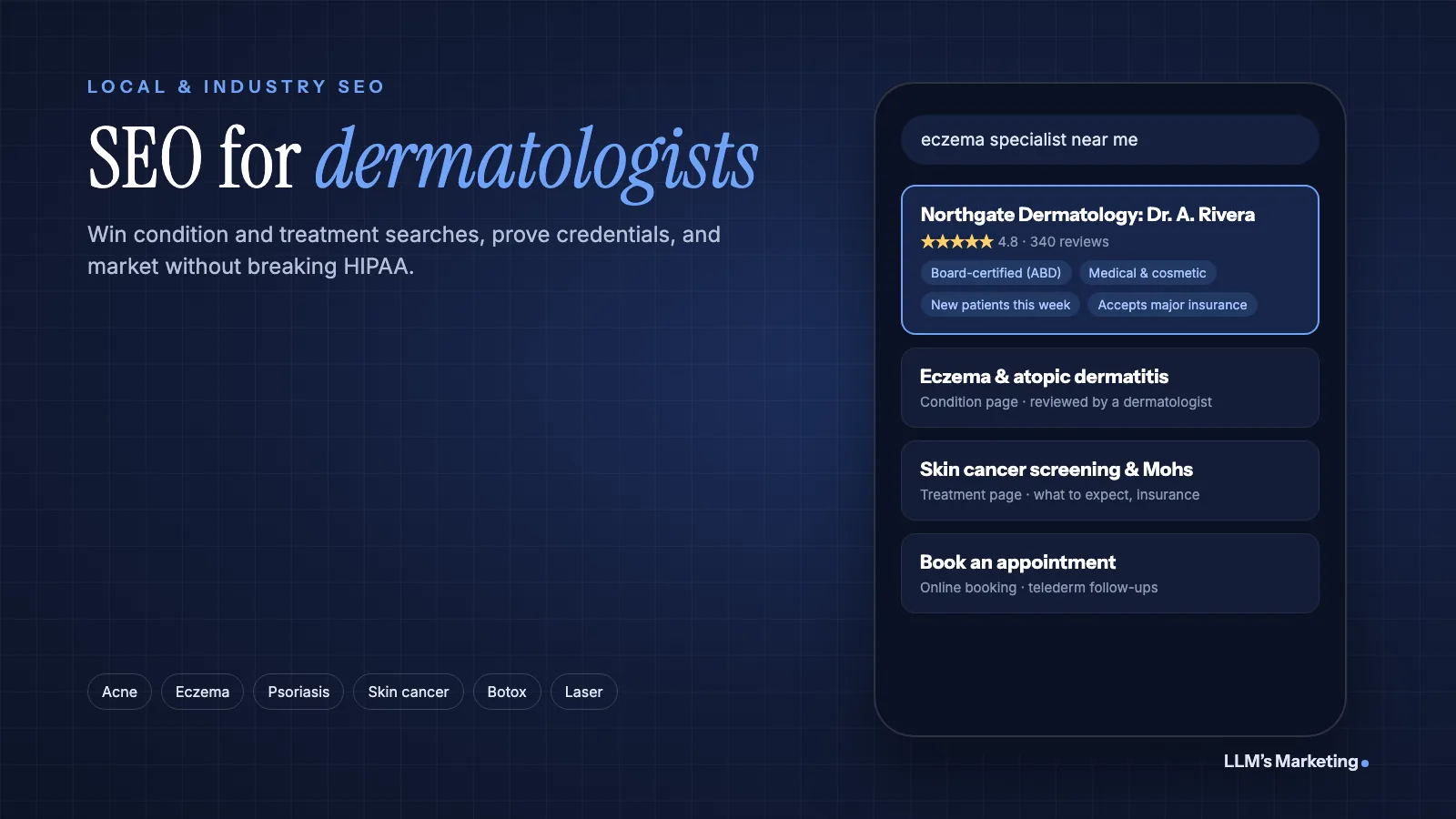
Dermatology practices face an unusual search problem. The biggest search in the field, "dermatologist near me," is enormous and fiercely contested, while the searches that bring the right patients ("eczema specialist near me," "mole removal near me," "acne treatment near me") are smaller, far easier to rank for and often ignored. On top of that, a dermatology practice is two businesses in one: a medical specialty that patients reach through insurance and referrals, and a cosmetic service that competes with med spas on price and results. And because it is healthcare, every review reply, before-and-after photo and tracking pixel has privacy rules attached.
SEO for dermatologists is the work of making a dermatology practice appear when nearby patients search for skin conditions, treatments and dermatologists on Google, Google Maps and AI assistants, and making the practice easy to trust and book. The foundations are a correctly structured Google Business Profile for the practice and each dermatologist, separate pages for each condition and treatment, visible board certification and insurance information, a steady flow of genuine reviews handled within HIPAA, and online booking.
This guide uses current US search data to show where the opportunity is, then covers the profile, pages, credentials, privacy rules and measurement that turn search visibility into booked appointments. Nothing here is legal advice; confirm privacy decisions with your compliance officer or healthcare attorney.
How Patients Search for a Dermatologist
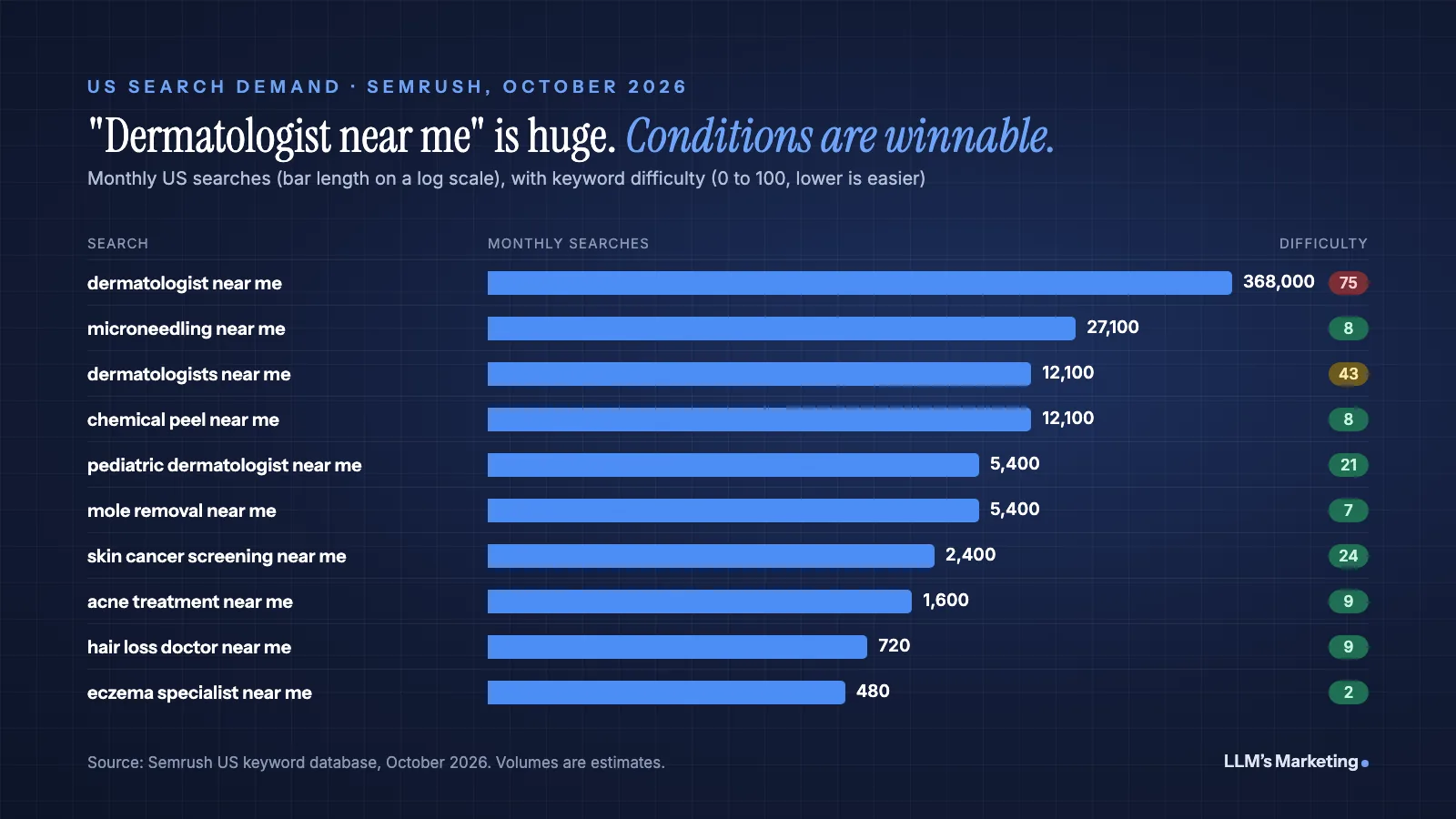
Patients search by doctor type, by condition and by treatment. The difficulty of ranking varies enormously across those groups. Here is US monthly demand from the Semrush keyword database, October 2026:
| Search | US monthly searches | Keyword difficulty (0 to 100) |
|---|---|---|
| dermatologist near me | 368,000 | 75 |
| botox near me | 90,500 | 19 |
| laser hair removal near me | 60,500 | 16 |
| microneedling near me | 27,100 | 8 |
| dermatologists near me | 12,100 | 43 |
| chemical peel near me | 12,100 | 8 |
| best dermatologist near me | 9,900 | 67 |
| pediatric dermatologist near me | 5,400 | 21 |
| mole removal near me | 5,400 | 7 |
| cosmetic dermatologist near me | 2,900 | 36 |
| skin cancer screening near me | 2,400 | 24 |
| acne treatment near me | 1,600 | 9 |
| dermatologist that accepts medicaid near me | 1,300 | 44 |
| hair loss doctor near me | 720 | 9 |
| eczema specialist near me | 480 | 2 |
| psoriasis doctor near me | 390 | 8 |
What the data tells you
- The broad terms are a map pack game. "Dermatologist near me" (difficulty 75) and "best dermatologist near me" (67) are decided mostly by proximity, your Business Profile and reviews. Organic rankings for them come slowly.
- Condition searches are open. "Eczema specialist near me" scores 2, "mole removal near me" 7, "psoriasis doctor near me" 8 and "acne treatment near me" 9. A specific, well-written condition page can compete for these within months.
- Cosmetic searches are big and contested by non-dermatologists. "Botox near me" and "laser hair removal near me" have large volumes and moderate difficulty, but the results are full of med spas and chains. Your edge there is who performs the treatment, not price.
- Insurance is part of the search. 1,300 people a month search for a dermatologist that accepts Medicaid. Insurance questions belong on your pages, not only on the phone.
Medical and Cosmetic Are Two Journeys
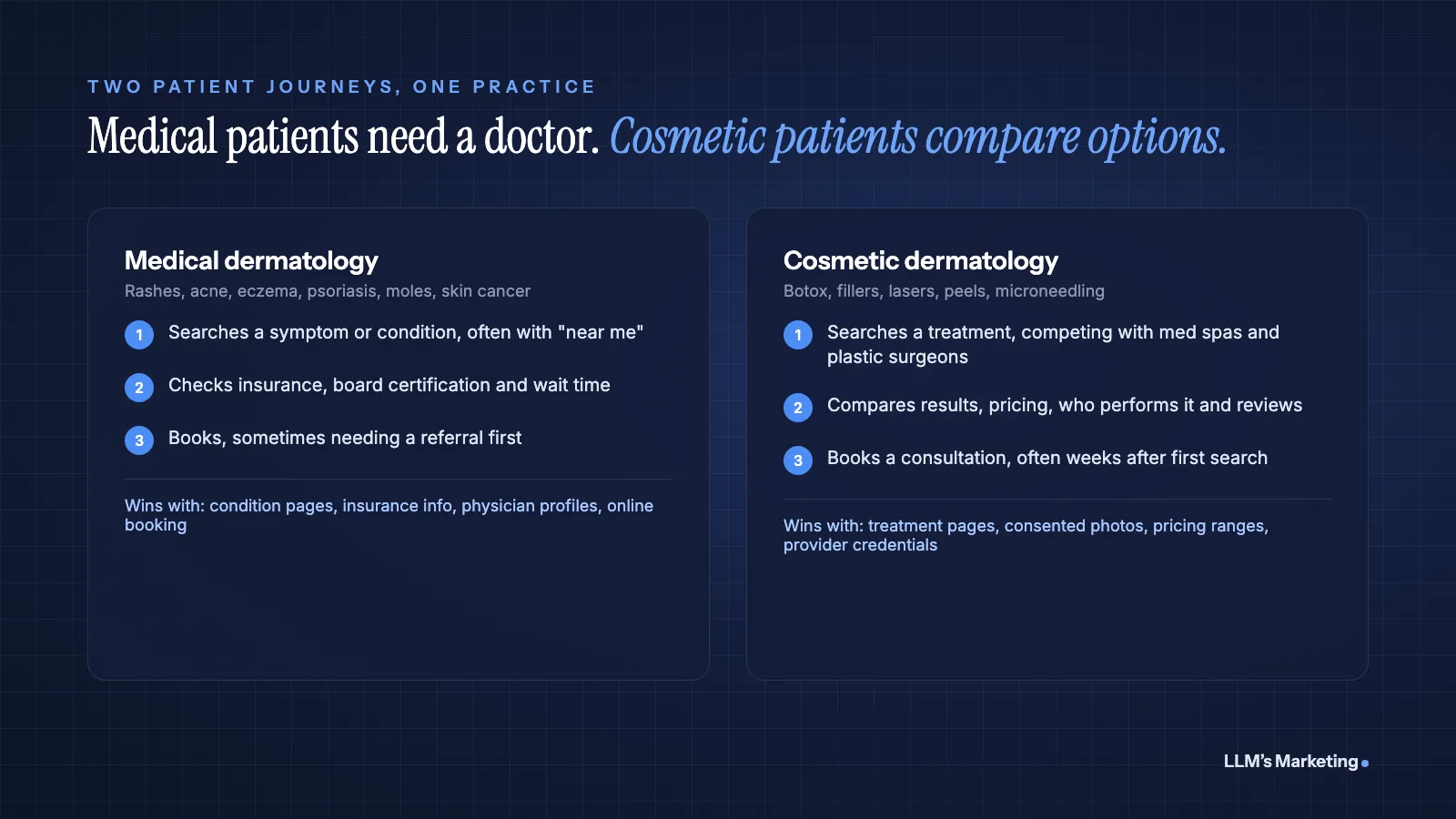
A patient with a suspicious mole and a patient comparing microneedling prices both search for "dermatology," but they decide differently. A website that blends both journeys into one services page serves neither well.
Medical patients
They want to know three things: whether you treat their condition, whether you take their insurance and how soon they can be seen. Condition pages, a clear insurance page, physician profiles and online booking answer all three.
Cosmetic patients
They compare results, price, the person doing the treatment and reviews, often over several weeks. Treatment pages with realistic expectations, price ranges or starting prices where you can publish them, consented before-and-after photos and the credentials of the person performing each procedure are what set a dermatology practice apart from a med spa down the street.
Set Up Google Business Profiles for the Practice and Each Doctor
Google says local results depend mainly on relevance, distance and prominence. Medical practices have extra profile rules because Google treats doctors as individual practitioners.
Practice and practitioner profiles
Google's guidelines say an individual practitioner who is public-facing and can be contacted at the verified location during stated hours can have their own profile. When several dermatologists work at one location, the practice creates its own profile for the location and each dermatologist's profile uses only their own name. A dermatologist who is the only practitioner at a branded practice should share one profile, named in the format "Practice: Doctor Name." Google also says a practitioner should not have multiple profiles to cover different specializations, so do not create separate profiles for "Dr. Rivera, Mohs" and "Dr. Rivera, Cosmetic."
Categories, services and details
Use "Dermatologist" as the primary category for the practice and each dermatologist. List the conditions and treatments you offer as services, keep hours accurate (including telehealth availability, if you offer it) and link each profile to the most relevant page: the practice profile to your homepage or location page, and each doctor's profile to their bio page. Keep the practice name exactly as it appears on your signage, without added keywords such as "Best Skin Doctor."
Photos
Show your exterior and entrance (so patients can find you), the waiting area, treatment rooms and your team. Do not post patient photos to your profile without written authorization, which is covered below.
Build Condition and Treatment Pages
The data makes the case for specific pages. One "Services" page cannot rank for "eczema specialist," "mole removal" and "chemical peel" at once, and it cannot answer each patient's questions. Build a page for each condition you treat and each procedure you perform.
| Page group | Examples | What each page should answer |
|---|---|---|
| Medical conditions | Acne, eczema, psoriasis, rosacea, hair loss, hyperhidrosis, warts | Symptoms, when to see a dermatologist, treatment options you offer, insurance coverage, how to book |
| Skin cancer | Skin cancer screening, mole checks, Mohs surgery, biopsies | What a screening involves, who performs it, timing of results, referral requirements |
| Pediatric | Pediatric dermatology, birthmarks, childhood eczema | Ages seen, what to expect at the visit, which doctor sees children |
| Cosmetic | Botox, fillers, laser treatments, chemical peels, microneedling | Who performs it, realistic results, downtime, starting price or price factors, consented photos |
Write to a medical standard
Skin conditions are health topics, and Google says its systems give even more weight to content with strong E-E-A-T (experience, expertise, authoritativeness and trustworthiness) for topics that can significantly affect health. In practice, that means each condition page should be written or reviewed by a dermatologist, show the reviewer's name and the date it was last reviewed, avoid promising outcomes, and cite reputable medical sources where you make clinical claims.
Location pages
Multi-location groups need one page per office, each with its own address, hours, doctors, parking and insurance details. Pages that repeat the same text with a different city name are what Google's spam policies call doorway abuse, and they do not help patients choose an office.
Show Board Certification and Credentials
Patients often cannot tell a board-certified dermatologist from other skin care providers, and cosmetic searches put you side by side with clinics where treatments may be performed by non-physicians. Make the difference visible.
- Physician bio pages: education, residency, board certification, fellowships (such as Mohs surgery), clinical interests and the conditions each doctor sees most. The American Board of Dermatology offers a public board certification lookup that patients can use to confirm certification, so link to it from each bio.
- Who performs each procedure: on cosmetic pages, name the dermatologist, physician assistant or nurse who performs the treatment and their credentials.
- Reviewer bylines: on condition pages and articles, show which dermatologist wrote or reviewed the content.
- Insurance and access: a page listing the plans you accept, whether referrals are required and how soon new patients can be seen.
Reviews, Photos and HIPAA
Healthcare marketing has rules that most local SEO advice ignores. These are the areas where dermatology practices most often create risk.
Replying to reviews
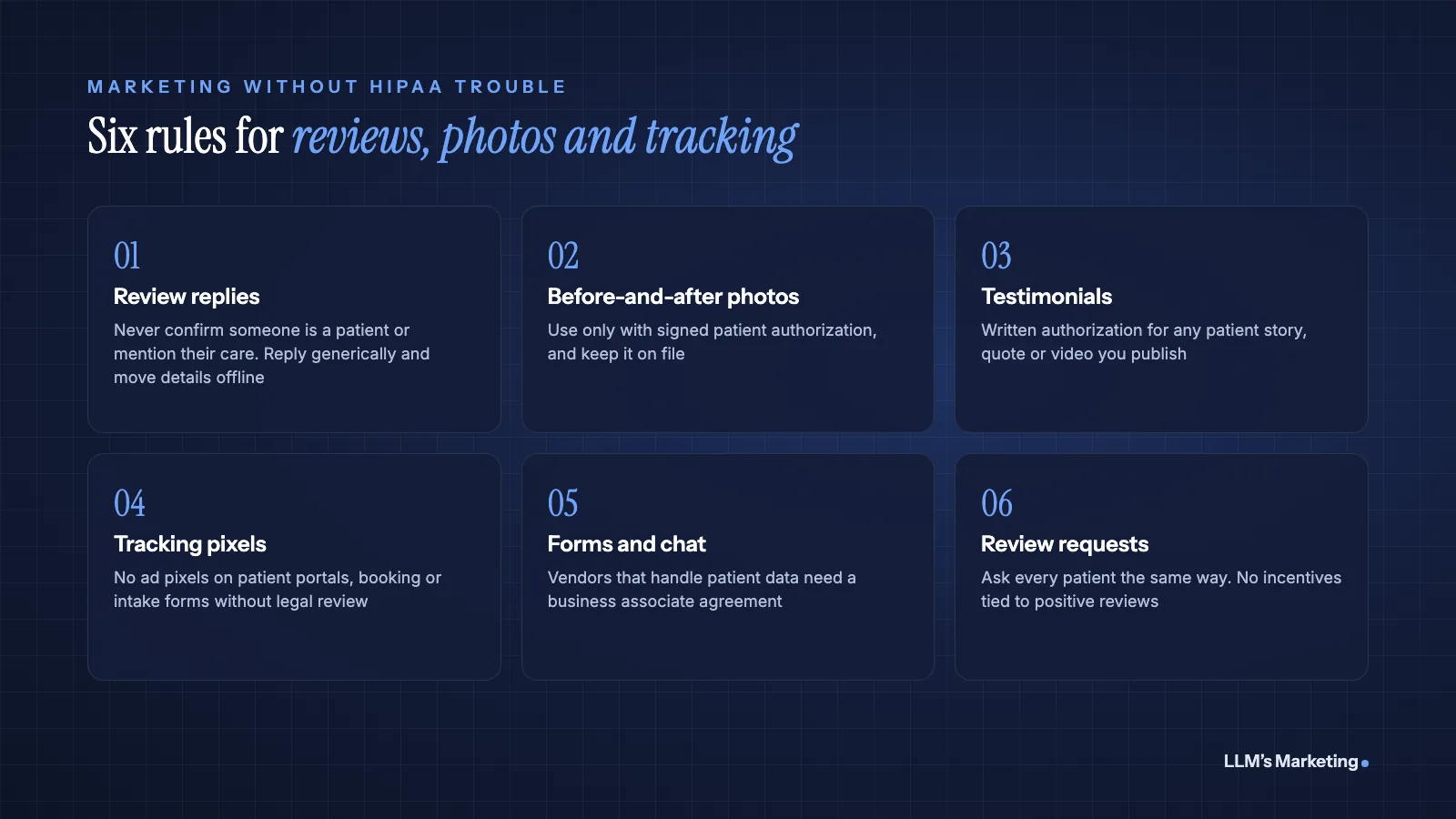
Reviews feed local prominence, and replying shows you care. But a reply must not confirm that the reviewer is a patient or mention their care. In one enforcement case, a California dental practice paid the HHS Office for Civil Rights $23,000 to settle allegations that its replies to Yelp reviews disclosed patients' names, treatment and insurance details. Use a generic reply ("We take every concern seriously. Please call our office manager so we can help.") and move the conversation offline.
Asking for reviews
Ask every patient the same way, for example by text after the visit, with a direct link to your review form. Do not offer incentives conditioned on a positive review or write reviews for patients. The FTC's rule on consumer reviews and testimonials, effective October 21, 2024, prohibits fake reviews and incentives tied to positive sentiment.
Before-and-after photos and testimonials
Patient photos, stories and quotes are protected health information when they come from your records. The HIPAA Privacy Rule says a covered entity must obtain an authorization for any use or disclosure of protected health information for marketing, with narrow exceptions. Get signed, specific authorization before publishing any patient photo or testimonial, store it with the image and remove the image if the authorization is revoked.
Tracking pixels and forms
Advertising pixels and analytics tools can collect health information from booking forms, intake forms and patient portals. In 2024 a federal court vacated part of HHS's guidance on online tracking technologies, specifically the part covering unauthenticated public pages, and HHS withdrew its appeal, as Epstein Becker Green summarizes. The rest of the picture remains complex and state privacy laws also apply, so keep ad pixels off booking, intake and portal pages unless your compliance team approves the setup, and use vendors that will sign a business associate agreement for any tool that handles patient data.
Structured Data and AI Search
Patients increasingly ask AI assistants questions like "is this mole worth getting checked?" or "which dermatologists near me treat psoriasis?" Google says there are no additional requirements to appear in AI Overviews or AI Mode beyond being indexed and eligible for a snippet, so the work above applies directly. What helps most is consistency and specificity: the same practice name, doctors, locations and services across your website, Business Profiles and directory listings, and condition pages that state clearly which conditions each doctor treats.
Structured data supports that clarity. Schema.org includes Dermatology as a medical specialty, which you can set on MedicalClinic and Physician markup along with your name, address, phone, hours and doctors. Our guide to schema and entity optimization explains how this helps search engines and AI tools understand your practice, and our generative engine optimization guide for dentists shows the same approach in another healthcare specialty, including how to measure it. For data on how AI answers are changing click behavior, see our State of AI Search 2026 report.
Booking and Measurement
Make booking easy
Put online booking or a request-an-appointment button on every condition and treatment page, and show your phone number as a tap-to-call link on mobile. Separate "new medical patient" and "cosmetic consultation" paths so each request reaches the right person. AI lead agents can answer common scheduling and insurance questions after hours, provided the tool is set up for healthcare privacy, and marketing automation can send review requests and annual skin check reminders.
Measure appointments, not rankings
Track calls and booking requests by landing page, and tag them as medical or cosmetic so you can see which pages produce which patients. Use aggregate reports rather than sending patient-level data to ad platforms. Google says ad spend has no impact on organic search results, so compare cost per booked appointment from paid and organic channels to decide where the next dollar goes. Our comparison of Google Ads vs SEO for dentists walks through the same budget decision for another healthcare practice.
A 90-Day Dermatology SEO Plan
Days 1 to 30: profiles and credentials
Fix the practice and doctor profiles to match Google's practitioner rules, add real photos, and publish physician bio pages with board certification and the certification lookup link. Add an insurance page and online booking.
Days 31 to 60: condition and treatment pages
Build pages for your five most common conditions, starting with low-difficulty searches you treat often, such as eczema, acne, psoriasis and mole removal, each reviewed by a dermatologist. Start a consistent review request routine and write a HIPAA-safe review reply template.
Days 61 to 90: cosmetic pages, privacy and tracking
Add cosmetic treatment pages with named providers and authorized photos, audit tracking pixels on booking and intake pages with your compliance lead, add MedicalClinic and Physician structured data, and set up call and booking tracking split by medical and cosmetic.
Dermatology SEO Mistakes to Avoid
Chasing "dermatologist near me" organically first
The broad term is mostly a map pack decision. Condition pages win sooner and bring patients who need what you treat.
Duplicate profiles for one doctor
Google's guidelines do not allow multiple profiles for one practitioner's specializations, and duplicates can split reviews or get suspended.
Replying to reviews with patient details
Even confirming that someone is a patient can be a disclosure. Keep replies generic.
Publishing photos without authorization
A signed, specific authorization should exist for every patient image and testimonial you publish.
Unreviewed medical content
Condition pages written without a dermatologist's review undercut the trust that health searches demand.
Frequently Asked Questions
What is SEO for dermatologists?
SEO for dermatologists is the process of helping a dermatology practice appear when nearby patients search for skin conditions, treatments and dermatologists on Google, Google Maps and AI assistants. It covers Google Business Profiles for the practice and each doctor, condition and treatment pages, board certification and insurance information, HIPAA-safe reviews, structured data and booking.
Should each dermatologist have their own Google Business Profile?
In a practice with several dermatologists, Google's guidelines allow each public-facing doctor to have a profile using only their own name, alongside a separate profile for the practice location. A solo dermatologist at a branded practice should share one profile named "Practice: Doctor Name." One doctor should not have multiple profiles for different specializations.
Can dermatologists respond to online reviews?
Yes, but replies must not confirm that the reviewer is a patient or mention any details of their care. HHS has settled cases with healthcare practices whose review replies disclosed patient information. A short, generic reply that invites the person to contact the office is the safe approach.
Can a dermatology practice post before-and-after photos?
Yes, with the patient's signed authorization. Under the HIPAA Privacy Rule, using protected health information for marketing generally requires written authorization. Keep the signed form on file with each image and remove the image if the patient revokes permission.
How long does dermatology SEO take?
Profile fixes can affect map visibility within weeks. New condition and treatment pages usually take a few months to rank, and competitive metros take longer. Measure booked appointments split by medical and cosmetic, not only rankings.
Where to Start
Start with the profiles and credentials: practice and doctor profiles that follow Google's practitioner rules, physician bios with board certification, an insurance page and online booking. Then build condition pages for the low-difficulty searches you treat every week, and put HIPAA-safe habits in place for reviews, photos and tracking before you scale cosmetic marketing. Our dental SEO page and SEO for orthodontists page show how we approach other healthcare specialties.
If you would like a second opinion, book a free call, reach us through the contact page or send your details below. Our founder, Mohd Adil Kazmi, will review your profiles, condition pages and AI visibility and reply with the first fixes worth making. You can also explore our AI SEO and content service, our AI search visibility service, all services or the industries we work with.
Are new patients finding your practice, or the med spa next door?
Send your website and I'll review your Google Business Profile, service pages and AI visibility, then reply personally with the first fixes I would make.