
Most lists of "companies that outsource" repeat the same claims with no source behind them. Google outsources to the Philippines. WhatsApp was built in Russia. Sixty-eight percent of US firms outsource something. Try tracing any of these back to a filing, a company statement or a named study and the trail usually goes cold.
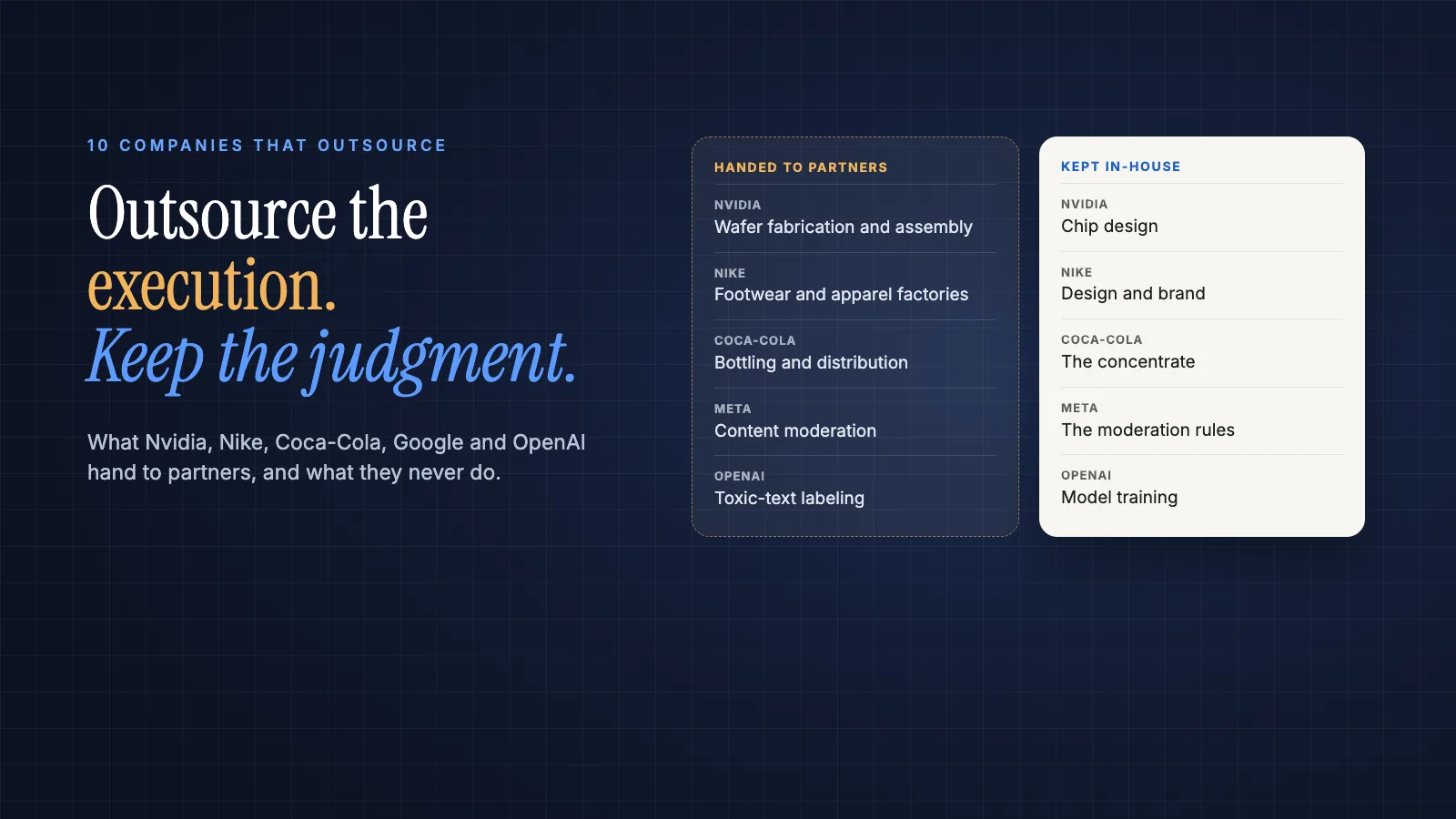
This list takes the opposite approach. Every example below is backed by a company's own disclosure (an SEC filing, a supplier list, an official statement) or by a major investigative report. The short answer: Nvidia does not manufacture its own chips, Nike does not own the factories that make its shoes, Coca-Cola does not own most of its bottlers, and the AI assistants you use every day, including ChatGPT and Gemini, were refined with help from outsourced human raters.
For each company you will see what it outsourced, who did the work and, more usefully, what it kept in-house. That last part is the real lesson, and it applies just as much to a 20-person SaaS team hiring an agency as it does to Apple. If marketing is the work you plan to hand off, our comparison of the top digital marketing companies in the US groups established agencies by specialty.
What Counts as Outsourcing in This List
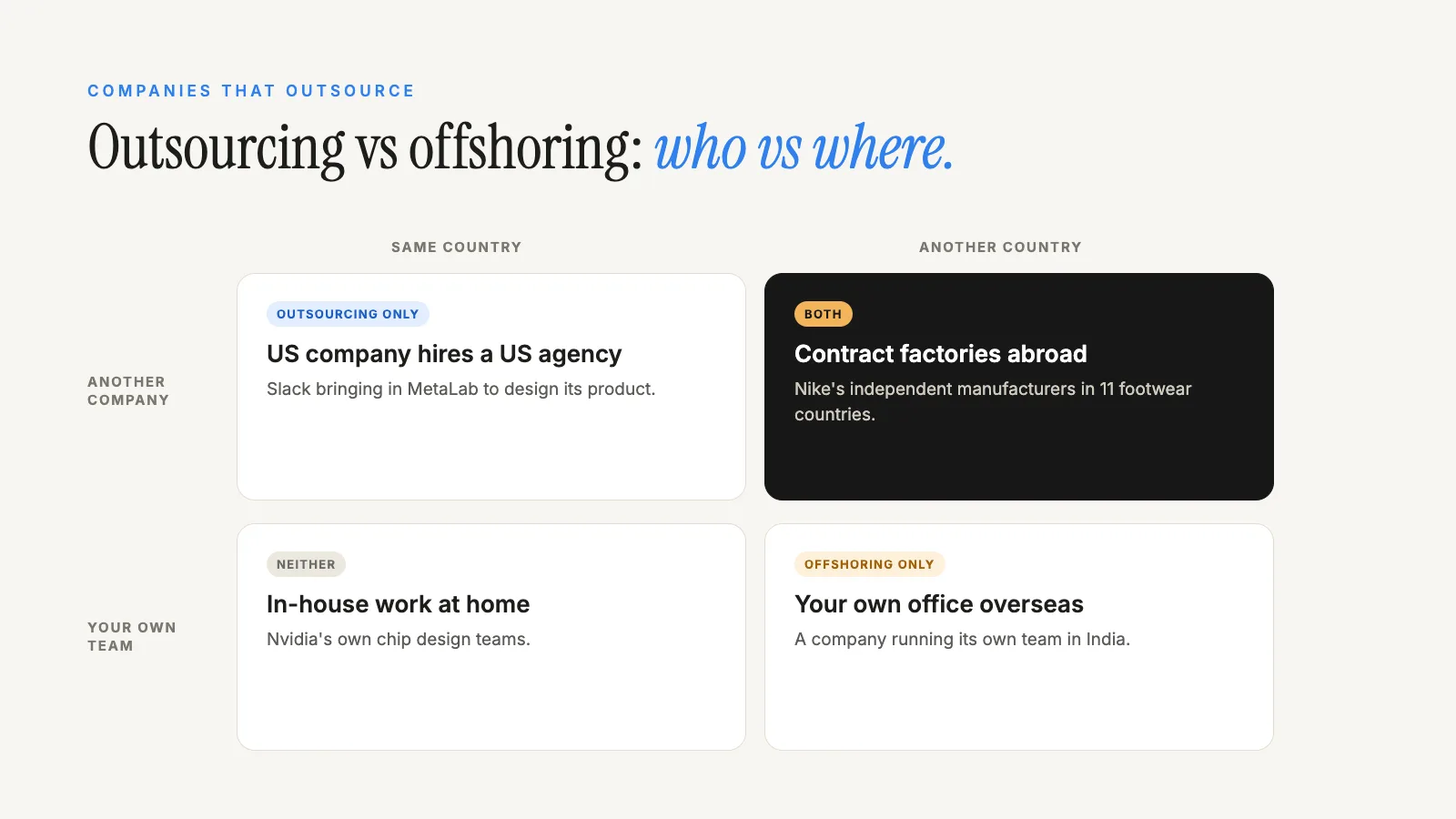
Outsourcing means paying an outside company to do work you could, in principle, do yourself. It is broader than offshoring, which only describes where the work happens. A US company hiring a US design agency is outsourcing without offshoring. A company running its own office in India is offshoring without outsourcing.
The examples below cover four common forms: contract manufacturing, IT and business process outsourcing, specialist agency work, and contracted human labor for data and content tasks.
The 10 Companies at a Glance
| Company | What it outsources | Named partners | What it keeps in-house |
|---|---|---|---|
| Eastman Kodak | Data centers and IT infrastructure (1989) | IBM, Digital Equipment Corporation, Businessland | Business strategy and IT direction |
| Nvidia | Wafer fabrication, assembly, testing and packaging | TSMC, Samsung, Hon Hai (Foxconn), Wistron, Fabrinet | Chip design, quality assurance, marketing, customer support |
| Apple | Manufacturing and final assembly | Hon Hai (Foxconn) and other listed suppliers | Product design, software, supplier standards |
| Nike | Nearly all footwear and apparel production | 15 footwear and 64 apparel contract manufacturers | Design, brand, marketing, some cushioning components |
| The Coca-Cola Company | Bottling, packaging and local distribution | Independent bottling partners such as Coca-Cola Europacific Partners | Concentrate, brand and system leadership |
| Specialized services, temporary roles and AI rating work | Vendors, staffing partners and GlobalLogic | Work Google defines as core to its business | |
| OpenAI | Labeling toxic text for ChatGPT's safety filter | Sama | Model training and the safety system itself |
| Meta (Facebook) | Content moderation | Accenture, Cognizant, TaskUs | Community standards and moderation policy |
| Slack | Early product design and branding | MetaLab | Product vision and engineering |
| Moderna | Large-scale vaccine manufacturing and fill-finish | Lonza, Catalent, ROVI | mRNA science and its own manufacturing facility |
1. Kodak Started the Modern IT Outsourcing Industry
In 1989, Eastman Kodak handed its information systems function to IBM, Digital Equipment Corporation and Businessland, a move that academic researchers later described as unprecedented for a company that treated IT as a strategic asset. The Rochester Business Journal put the deal at 10 years and $250 million.
The logic came from Kodak's then CIO, Katherine Hudson. A colleague later summarized her argument to CIO magazine: running data centers was no more central to Kodak's business than running a power plant. Hudson herself favored "selective outsourcing", meaning you hand over infrastructure and keep the decisions.
The deal mattered far beyond Kodak. It is widely treated as the moment large companies began handing core IT operations to outside providers, and it became a reference point for the IT outsourcing contracts that followed.
2. Nvidia Contracts Out Every Phase of Chip Manufacturing
The most valuable chip company in the world does not run a chip factory. In its fiscal 2026 annual report, Nvidia describes a fabless and contract manufacturing strategy covering wafer fabrication, assembly, testing and packaging. TSMC and Samsung produce its wafers, while Hon Hai (Foxconn), Wistron and Fabrinet handle assembly, testing and packaging.
Nvidia is explicit about why. Because suppliers procure most raw materials and run production, Nvidia can put its resources into product design, quality assurance, marketing and customer support. In other words, it keeps the work that makes its GPUs worth buying and rents everything else.
3. Apple Relies on Foxconn and Other Assemblers
Apple designs its products in California, but the iPhone in your pocket was almost certainly assembled by a contract manufacturer. Apple's own supplier list covers 98 percent of its direct spend on materials, manufacturing and assembly, and it lists Hon Hai Precision Industry (Foxconn) with manufacturing sites across multiple provinces in mainland China.
Apple did not always publish this information. According to CNBC, criticism of working conditions at Foxconn pushed Apple to disclose its final assembly facilities. That is a recurring theme in this list: you can outsource production, but you cannot outsource accountability for how it is done.
4. Nike Owns the Brand, Not the Factories
Nike is one of the clearest examples of a company built around outsourcing. Its fiscal 2026 annual report states that nearly all of its footwear and apparel is made outside the United States by independent contract manufacturers. As of May 31, 2026, those partners operated 95 footwear factories in 11 countries and 321 apparel factories in 34 countries.
The concentration is notable. Fifteen contract manufacturers produced Nike Brand footwear that year, and the four largest accounted for roughly 60 percent of it. Nike keeps design, brand building and marketing, and the same filing lists a facility in St. Charles, Missouri among its suppliers of Air-Sole cushioning components.
5. Coca-Cola Sells Concentrate and Lets Independent Bottlers Do the Rest
Most people assume the Coca-Cola Company makes the bottle of Coke in their hand. Usually it does not. On its Coca-Cola system page, the company explains that local bottling partners mix, bottle and package the finished drinks and work with local businesses to get them to consumers. It states plainly that it does not own, manage or control most local bottling companies.
According to the company's 2024 annual report, the five largest independent bottlers alone represented 44 percent of Coca-Cola's total worldwide unit case volume in 2024. The same filing flags the trade-off: as independent companies, bottlers make their own business decisions, which may not always align with Coca-Cola's interests.
6. Google Runs on an Extended Workforce
Google calls the people who work for it through other companies its extended workforce. It is made up of vendors (employees of supplier companies), temporary staff from staffing partners and independent contractors. Google states that these people are not, and have never been, Google employees.
The scale is larger than most people assume. In 2019, an internal document reported by The New York Times put Google's temps, vendors and contractors at roughly 121,000 positions, compared with about 102,000 full-time employees, as summarized by AfroTech. A Google spokesperson, quoted by HR magazine HCAMag, described the rule: employees do jobs core to the business, while outside workers fill gaps in expertise, infrastructure or short-term capacity.
Outsourcing now reaches Google's AI products too. A 2025 Guardian investigation reported that thousands of raters contracted through Hitachi-owned GlobalLogic evaluate and moderate output from Gemini and AI Overviews. Google told the Guardian that its quality raters are employed by suppliers.
7. OpenAI Used an Outsourcing Firm to Label Toxic Content for ChatGPT
Before ChatGPT launched, OpenAI needed a filter that could recognize violent, hateful and abusive text. To build it, OpenAI sent tens of thousands of text snippets to Sama, an outsourcing firm with workers in Kenya, starting in November 2021, according to a TIME investigation. OpenAI confirmed to TIME that Sama employees contributed to the toxic content detection tool that was later built into ChatGPT.
The report also documented pay of roughly $1.32 to $2 per hour and the psychological toll of the work. Sama ended the arrangement in February 2022, eight months early. For anyone building with AI, this is a useful reminder that "AI-powered" products often depend on outsourced human judgment behind the scenes.
8. Meta Pays Accenture to Moderate Facebook Content
Content moderation at Facebook is one of the largest outsourcing arrangements in tech. A 2021 New York Times investigation found that Facebook had signed contracts with Accenture for content moderation and other services worth at least $500 million a year. Accenture employed more than a third of the 15,000 people Facebook said it had hired to review posts, and Facebook also spread the work across firms such as Cognizant and TaskUs.
Meta still writes the rules. Its community standards and moderation policies stay in-house, while the volume work of applying them is contracted out. The Times reporting also showed the cost of that model: Accenture's own leadership reviewed whether to keep the contract because of the mental health risks to moderators and the reputational risk to the firm.
9. Slack Hired an Agency to Design Its Product Before Launch
Slack's playful, colorful interface helped it stand out from dull enterprise software, and it came from an outside studio. According to MetaLab's case study, Stewart Butterfield's team brought the agency in when Slack was still a rough, unstyled prototype. MetaLab founder Andrew Wilkinson has written that the studio delivered the logo, marketing site, and web and mobile app design in about six weeks.
Slack kept the product vision and engineering. It brought in specialists for the one capability it lacked at a decisive moment, then built on that foundation itself. For early-stage companies, this is the most transferable example on the list.
10. Moderna Partnered with Lonza and Catalent to Scale Its Vaccine
When Moderna needed to scale its COVID-19 vaccine from clinical batches to global supply, it did not try to build all the capacity itself. In May 2020, Moderna and Lonza announced a 10-year collaboration to set up manufacturing suites for mRNA-1273 at Lonza sites in the United States and Switzerland, with Moderna's CEO saying the deal would increase its manufacturing capacity tenfold.
Moderna's quarterly filing from that period adds that Catalent would handle large-scale fill-finish in Indiana and ROVI would do the same in Spain for markets outside the US. Moderna kept its mRNA platform and continued manufacturing at its own facility. It outsourced capacity and speed, not science.
The Pattern: Outsource Execution, Keep the Judgment
Put these ten companies side by side and a consistent rule appears. Each one outsourced work that is capital-heavy, labor-heavy or specialized, and kept the work that defines why customers choose it.
- They keep what differentiates them. Nvidia keeps chip design, Nike keeps design and brand, Coca-Cola keeps the concentrate, and Meta keeps the rules for what stays on its platform.
- They outsource capacity and specialist skill. Factories, bottling plants, data centers, moderation teams and labeling teams are expensive to build and slow to scale. Partners already have them.
- They keep the standards and stay accountable. Apple publishes its supplier list, Nike discloses its factory base, and Google requires its suppliers to follow its code of conduct. When things go wrong, the brand takes the hit, as the Foxconn, Accenture and Sama stories show.
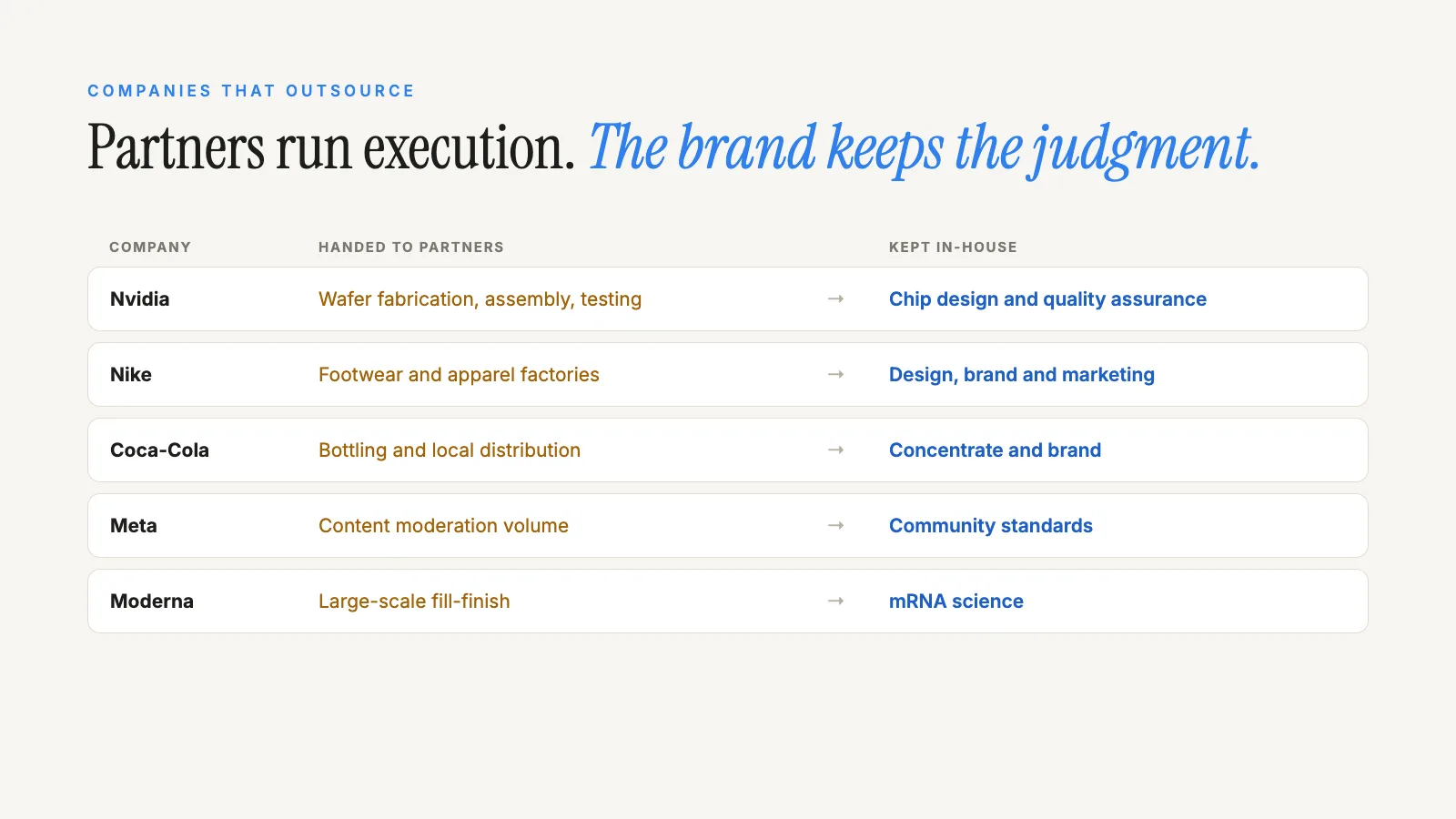
This pattern is not an old one. Deloitte's 2024 Global Outsourcing Survey of more than 500 executives found that 80 percent plan to maintain or increase investment in third-party outsourcing, even as 78 percent also run their own global in-house centers. The same survey found that skilled talent and agility now sit alongside cost reduction as key reasons to outsource. Companies are not choosing between outsourcing and doing it themselves. They are deciding, function by function, which side of the line each piece of work belongs on.
Popular Outsourcing Examples We Left Out
Some stories appear in nearly every list on this topic but could not be traced to a primary source or are more nuanced than they sound.
- WhatsApp's "outsourced Russian developers". Widely repeated, but we could not verify the specifics from a primary source. What is documented is that WhatsApp ran with a small team, and Fox Business reported in 2014 that Jan Koum had said many of its engineers worked remotely.
- Skype "built by outsourced Estonians". Skype's software was written by Estonian engineers credited as part of the founding team. That is closer to a distributed founding team than a vendor relationship.
- "68 percent of US companies outsource". This figure circulates widely and is attributed to an unnamed 2021 study. Without a named source, we did not use it.
What This Means for Outsourcing Marketing, SEO and AI Visibility
The same rule applies when the work you are outsourcing is marketing. Your positioning, your product knowledge and your final approval are the "chip design" of your marketing. Execution work such as technical SEO fixes, content production, structured data, digital PR and reporting can usually be handed to specialists, because those skills are expensive to build in-house and the field is moving fast.
It matters even more for AI search. ChatGPT, Google AI Mode, Perplexity and Gemini decide whether to mention a brand partly by what they can verify about it across the web. If an outside team publishes content that describes your product inconsistently, AI models inherit that confusion. If you are new to this area, our guides on what LLM marketing actually covers and how GEO differs from SEO explain what changes when AI answers the query.
Before you hand AI visibility or SEO work to any partner, ask these questions:
- Who owns the brand facts (positioning, pricing, product claims), and who approves content before it goes live?
- How will the partner measure progress in AI answers, not only in Google rankings?
- Which work stays with your team, and which work is the partner accountable for?
- How will structured data and entity information stay consistent across your site and profiles? Our article on schema and entity optimization for LLMs covers why this matters.
- What does the partner refuse to promise? No one can honestly guarantee a mention in a specific AI answer.
At LLM's Marketing, we work the way the companies above outsource: your team keeps ownership of the brand and the decisions, and we handle the execution through AI search visibility and AI SEO and content work. For a practical starting point, read how to get your brand recommended by ChatGPT, or book a discovery call to see where your brand currently stands in AI answers.
What Else Do People Ask About Outsourcing?
Which famous companies outsource?
Well-documented examples include Nvidia (chip manufacturing through TSMC and Samsung), Apple (assembly through Foxconn and other suppliers), Nike (production through independent contract manufacturers), Coca-Cola (bottling through independent partners), Google (vendors, temporary staff and AI raters), Meta (content moderation through Accenture and others), OpenAI (data labeling through Sama), Slack (early design through MetaLab) and Moderna (vaccine manufacturing through Lonza and Catalent).
Is outsourcing the same as offshoring?
No. Outsourcing means contracting work to another company, wherever it is located. Offshoring means moving work to another country, either to a vendor or to the company's own overseas office. Many arrangements, such as Nike's contract manufacturing, are both.
Do large companies outsource core work?
They outsource work that supports the core but rarely the core itself. Nvidia outsources manufacturing but not chip design. Moderna outsourced manufacturing capacity but not its mRNA platform. Google says it reserves jobs core to its business for its own employees.
What should a company never outsource?
Based on the examples above, keep the capabilities that make customers choose you, the standards your partners must meet and accountability for the result. A partner can run the factory, the moderation queue or the SEO program, but the brand still owns the outcome.
Is your brand showing up in ChatGPT, Perplexity and Gemini?
Send me your website and I'll check how your brand appears in AI answers and search, then reply personally with the first fixes I would make.