
Will Google Ads give advertisers segmented performance reporting for ads shown in AI Overviews or AI Mode by June 30, 2027?
Why the forecast moved Numbered as on the chart · forecast last updated 24 October 2026
| # | Date | Event and reasoning | Change | Source |
|---|---|---|---|---|
| 1 | 30 Apr 2025 | Google announces PMax channel-level reporting, calling it a top-requested featureShows Google will eventually add placement breakdowns to automated campaigns after advertiser pushback, a direct precedent for AI-surface reporting. | +3.0 pts18.0% → 21.0% | Source |
| 2 | 21 May 2025 | Google Marketing Live 2025: AI Overview ads reach desktop, AI Mode ads test, no AI-specific performance dataThe ad surface grows, but Google says advertisers cannot see AI Mode or AI Overview performance separately, so a near-term breakout looks unlikely. | -1.5 pts21.0% → 19.5% | Source |
| 3 | 26 May 2025 | Google Ads Help doc: no segmented AI Overview reporting yet, more to share laterAn official line that Google is actively thinking about the future of reporting leaves the door open to a later release. | +1.5 pts19.5% → 21.0% | Source |
| 4 | 22 Sep 2025 | Still no column, opt-out or reporting for AI Mode and AI Overview adsFour months after the launch there is still no movement on reporting, which points to a slow roadmap. | -1.0 pts21.0% → 20.0% | Source |
| 5 | 6 Nov 2025 | PMax channel performance reporting extended to all Performance Max campaignsGoogle follows through on placement-level reporting for an automated product, which strengthens the precedent. | +2.0 pts20.0% → 22.0% | Source |
| 6 | 22 Dec 2025 | Ads in AI Overviews expand to 12 countriesMore spend flowing through AI Overviews raises advertiser pressure for a dedicated performance breakout. | +2.0 pts22.0% → 24.0% | Source |
| 7 | 9 Jun 2026 | After GML 2026, Google's Ads Liaison confirms AI ads are still reported as top ads, unsegmentedNew AI Mode formats launched at GML 2026 but reporting did not, and Google's position has not changed in over a year. | -4.0 pts24.0% → 20.0% | Source |
| 8 | 4 Sep 2026 | Google tests exact and phrase match text ads in AI ModeLegacy keyword campaigns now serve in AI Mode with nothing in reporting to tell that delivery apart, which raises demand for a segment. | +1.0 pts20.0% → 21.0% | Source |
| 9 | 23 Sep 2026 | Google unveils a unified AI Max Search ads journey report with no AI-surface splitGoogle's reporting investment goes into AI Max query, asset and landing-page views rather than an AI Overviews or AI Mode segment. | -1.5 pts21.0% → 19.5% | Source |
| 10 | 19 Oct 2026 | Google tests AI Mode ads for Personal Intelligence users, with no reporting announcedAI Mode ad surfaces keep growing without matching reporting, which suggests monetisation is ahead of measurement on the roadmap. | -1.0 pts19.5% → 18.5% | Source |
Expert commentary Quotes attached to the tracked events · each checked against its source
| Who | What they said | # | Source | |
|---|---|---|---|---|
| Tal AkabasDirector of Product Management, Google AdsOfficial | “Today, we’re excited to introduce new channel-level reporting in Performance Max — a top-requested feature.” | 1 | blog.google | |
| Vidhya SrinivasanVP and GM, Ads & Commerce, GoogleOfficial | “Starting today, Search and Shopping ads in AI Overviews will be expanding to desktop in the U.S.” | 2 | seroundtable.com | |
| Barry SchwartzFounder and Editor, Search Engine RoundtableIndependent | “Google will not break out the data or give controls to show or not show ads in AI Mode or AI Overviews.” | 2 | seroundtable.com | |
| Brooke OsmundsonDirector of Growth Marketing, Smith Micro Software; contributor, Search Engine JournalIndependent | “Advertisers cannot see how their ads perform specifically in AI Overviews or AI Mode.” | 4 | searchenginejournal.com | |
| Ginny MarvinGoogle Ads Liaison, GoogleOfficial | “We don't currently have segmented reporting and are still learning and actively thinking about what reporting looks like.” | 7 | officialppcchat.com | |
| Ginny MarvinGoogle Ads Liaison, GoogleOfficial | “This is a small experiment that recently kicked off.” | 8 | ppc.land |
Probability estimate by LLM's Marketing for llmsmarketing.com, not a statement by Google. Resolves YES only if, on or before June 30, 2027, Google makes generally available in the Google Ads interface, reports or API a segment, column, report or channel row that separates ad performance (at least impressions and clicks) for ads served in AI Overviews or AI Mode from other Search ad placements, confirmed by a Google Ads Help page, Google blog post or Ads Liaison statement. Closed betas, organic visibility tools and reports that do not label the AI surface do not count. Starts from a 18% base rate on 1 April 2025 and moves at each dated, sourced event; values before 24 October 2026 are reconstructed from those events, not predictions made at the time. Last updated 24 October 2026.
AI advertising now means two different jobs. The first is using AI to run your campaigns: targeting, bidding, creative and measurement. The second is newer and changes more: buying ad placements inside the AI answers people read in ChatGPT and Google Search.
Most guides cover only the first job. This one covers both, and it explains the part paid teams often miss. An ad can put you next to an AI answer, but it cannot put you inside the answer itself.
What is AI advertising?
AI advertising is the use of artificial intelligence to plan, buy, create, deliver or measure ads, together with advertising on AI-powered surfaces such as ChatGPT, Google AI Overviews and Google AI Mode.
The two sides work differently:
| AI that runs your ads | Ads inside AI answers | |
|---|---|---|
| What it is | Machine learning inside ad platforms that decides who sees what, at which price | Paid placements shown in or around AI-generated responses |
| Examples | Google Performance Max, Meta Advantage+, programmatic bidding, generative ad creative | ChatGPT ads, ads above, below or within Google AI Overviews and AI Mode |
| What you control | Goals, budgets, conversion data, creative inputs, exclusions | Mostly campaign settings; placement inside AI answers is largely automatic |
| Maturity | Established for years | Launched or expanded in 2025 and 2026, still changing month to month |
How does AI help you run ad campaigns?
Inside today's ad platforms, AI handles four tasks that people used to manage by hand.
Targeting
Models predict which users are likely to convert from signals such as search terms, page context, past behaviour and your first-party customer data. Your job shifts from picking audiences to feeding the model accurate conversion data.
Bidding and budget allocation
Automated bidding sets a price for each auction in real time against a goal such as target cost per acquisition or target return on ad spend. It works well when the conversion signal is clean and poorly when it counts the wrong actions as wins.
Creative production and testing
Generative AI drafts headlines, images, video cuts and size variations in minutes, and dynamic creative tests combinations automatically. The IAB's 2026 video ad spend report notes that generative AI use in video creative keeps accelerating, while many advertisers still want more proof of performance.
Measurement
AI models help with attribution, forecasting and anomaly alerts. They still depend on what you track, so a broken conversion tag produces confident but wrong optimisation.
The practical rule across all four: AI amplifies the inputs you give it. Clean data and clear goals compound; messy data compounds too.
Where can you advertise inside AI answers today?
Two surfaces matter most for most marketers right now: ChatGPT and Google's AI results.
ChatGPT ads
OpenAI announced its ad test on January 16, 2026, starting in the US with clearly labeled ads placed at the bottom of answers. According to OpenAI's help center, the current rules are:
- Ads show only to Free and Go users. Plus, Pro, Business, Enterprise and Edu accounts see no ads.
- Ads do not appear for users identified as under 18, in Temporary Chats, or near health, mental health or political conversations.
- Advertisers get aggregated performance data such as views and clicks, not users' chats or personal details.
In October 2026, OpenAI added a visual ad format shown during image generation, alongside measurement integrations with conversion, attribution and incrementality partners. Businesses sign up through ads.openai.com. For pricing, context hints, setup steps and measurement, see our full ChatGPT ads guide.
Google AI Overviews and AI Mode ads
Google does not run a separate product for this. Your existing campaigns become eligible. Google's Ads Help documentation states that:
- Ads can show above or below AI Overviews in every market where AI Overviews are available.
- Ads within AI Overviews come from Search, Shopping and Performance Max campaigns, currently in English in markets including the US, India, Canada and Australia.
- You cannot opt out of or directly target AI Overview placements, and segmented reporting for those ads is not yet available.
- Sensitive verticals, including finance, healthcare, gambling and politics, are excluded.
For AI Mode, Google says advertisers already running Performance Max, Shopping or Search campaigns with broad match, including AI Max for Search, are eligible to have their ads appear there. eMarketer reports that those ads can show within or beneath AI answers.
Do ads change what AI assistants recommend?
No. OpenAI states that ads do not influence ChatGPT's answers and that the ad system runs separately from the model. Ads sit beside or below the response, clearly labeled.
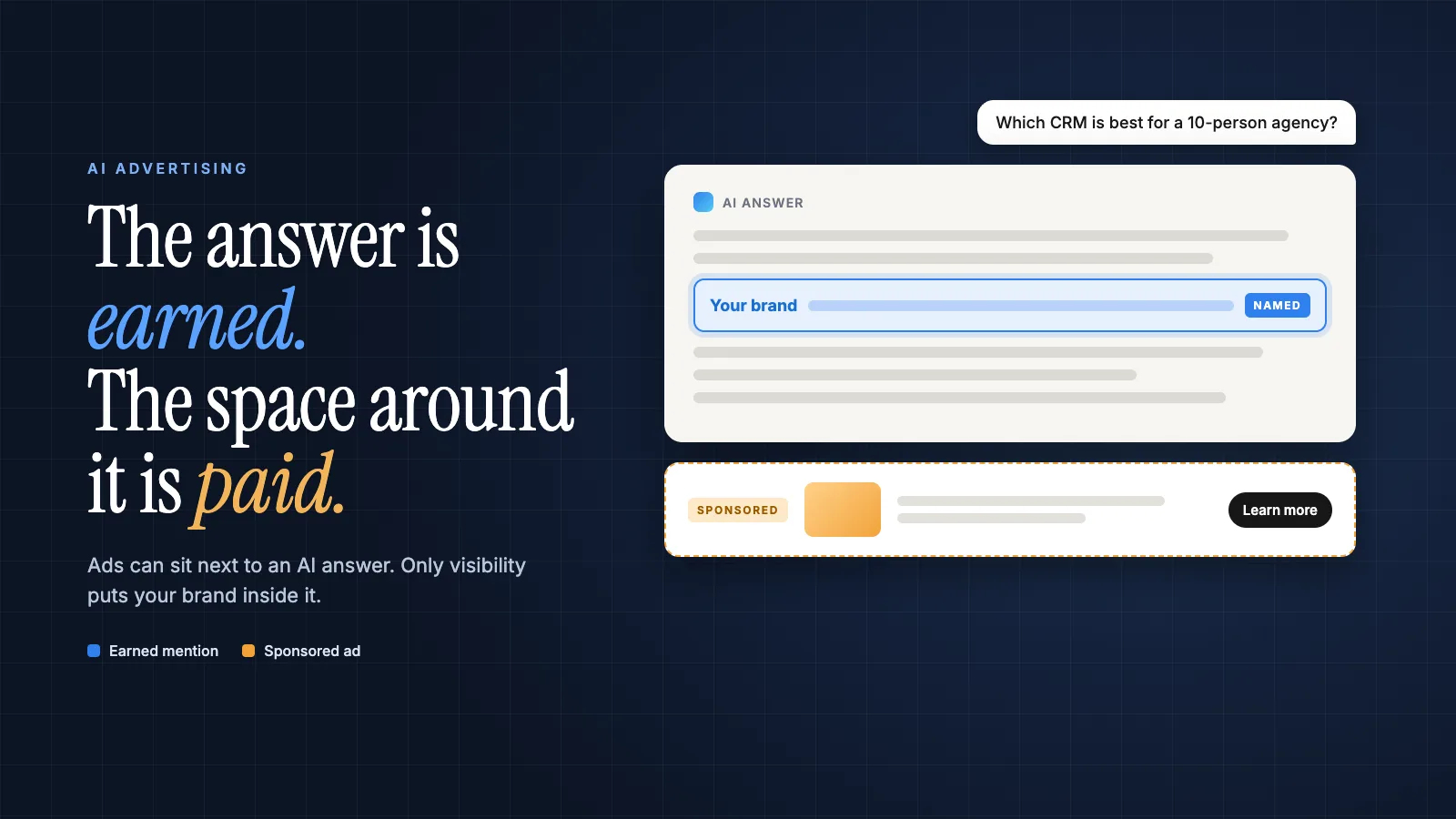
This matters for budget planning. When someone asks ChatGPT for "the best CRM for a 10-person agency", the brands named in the answer are chosen by the model, not by an auction. An ad can sit under that answer. It cannot add your name to the list.
Being named in the answer itself is an organic outcome, earned through the signals AI systems rely on: clear entity information, consistent brand mentions across trusted sources, and content that answers specific questions well. We cover that side in detail in our guide on how to get your brand recommended by ChatGPT, and the broader shift in GEO vs SEO.
Earned visibility does not need ad spend to start working. In our FitBudd case study, ChatGPT referral sessions grew 414% between February and September 2025, months before ChatGPT carried any ads.
How should you split budget between AI ads and AI visibility?
Treat AI answers as having two shelves: the answer (earned) and the space around it (paid). The best position is both, because a buyer who sees your name in the answer and your ad beneath it gets two signals in one screen.
| Surface | Paid option | Organic option | Start with |
|---|---|---|---|
| ChatGPT | Labeled ads below answers, visual ads during image generation | Being named in the answer itself | Organic audit first, then a small paid test in the US |
| Google AI Overviews | Search, Shopping and PMax ads above, below or within | Being cited as a source link | Check how your current campaigns already serve there |
| Google AI Mode | Ads within or beneath answers via PMax, broad match, AI Max | Citations and mentions in the response | Review match types and search term reports |
| Perplexity, Gemini, Claude | Limited or no self-serve ad options for most brands | Citations and mentions | Organic only for now |
A sensible default for most B2B and SaaS brands: keep proven search and social budgets running, carve out a small test budget for ChatGPT ads where you are eligible, and invest in AI search visibility so the answers themselves name you. Paid reach stops the moment spend stops; earned visibility in AI answers keeps working.
How do you start with AI advertising?
- Fix your conversion data. Confirm that tags, offline conversions and value tracking are accurate, because every AI bidding system optimises toward them.
- Check where your ads already appear. If you run Performance Max or broad match, you may already be serving next to AI answers. Review search terms and placement data before adding spend.
- Audit your organic AI presence. Ask ChatGPT, Gemini and Perplexity the questions your buyers ask and record who gets named. Our AI search visibility guide walks through this.
- Run one controlled paid test. Pick a single surface, one offer and a fixed budget, and compare cost per acquisition with your search benchmark over at least four weeks.
- Use AI for creative volume, humans for judgement. Let generative tools produce variations; let people decide what is on brand and accurate.
- Review monthly. These products change fast, so recheck eligibility, formats and reporting each month.
What are the risks and limits of AI advertising?
- Thin reporting. Google does not yet separate AI Overview ad performance in reports, so you cannot isolate results for that placement.
- Less placement control. Placement inside AI answers is mostly automatic, with no direct targeting or opt-out on Google.
- Category restrictions. Health, finance, politics and other sensitive categories are excluded or limited on both ChatGPT and Google AI answers.
- Vendor-reported results. Early case studies, such as the lower cost per acquisition OpenAI reports for some partners, come from platforms or advertisers, not independent tests. Treat them as hypotheses to test.
- Creative quality and trust. Generative creative can drift off brand or state things that are not true. Every AI-made ad needs a human check before it runs.
- Over-reliance on paid. Ads rent attention next to AI answers. They do not build the brand signals that get you mentioned inside them.
Where should you go from here?
AI advertising is no longer one topic. Use AI inside your ad platforms to work faster and bid smarter, test ads inside AI answers where they fit your audience, and build the organic visibility that decides whether AI assistants name you at all.
If you want to know where your brand stands in AI answers before you spend on AI ads, book a free discovery call with LLM's Marketing. New to the topic? Start with what LLM marketing is.
Is your brand showing up in ChatGPT, Perplexity and Gemini?
Send me your website and I'll check how your brand appears in AI answers and search, then reply personally with the first fixes I would make.