
Most marketing teams already use AI to write. Far fewer use it to do: pull last week's ad data, spot the campaign that is burning budget, draft the fix, route a hot lead to sales or post a blog to five channels without someone copying and pasting. That is the gap AI agents are meant to close, and it is also where the hype runs furthest ahead of reality.
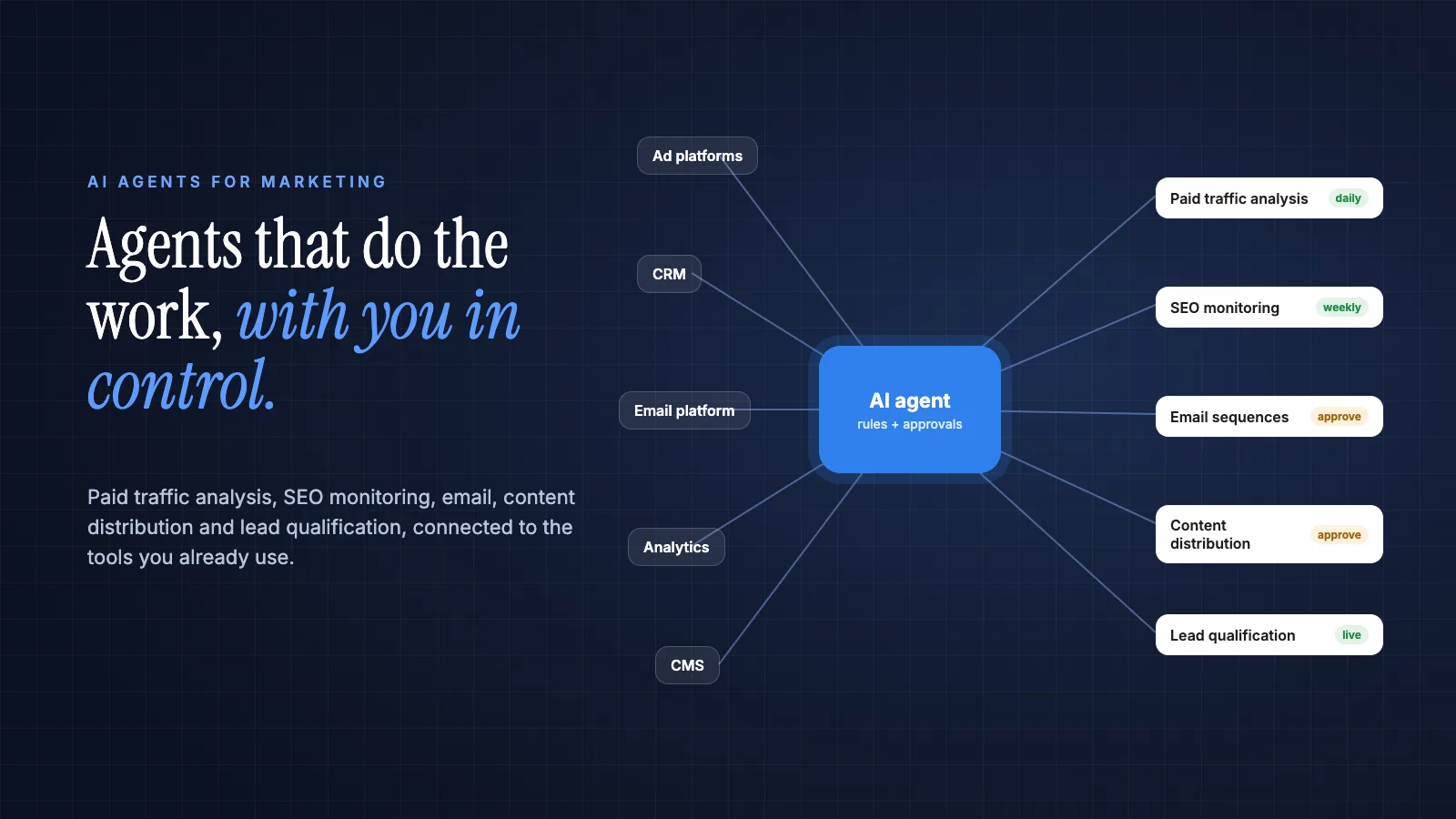
AI agents for marketing are AI systems that can take actions across your marketing tools, not just generate text. Connected to your ad accounts, CRM, email platform, analytics and CMS, an agent can gather data, decide on next steps within rules you set and carry them out, such as analyzing paid traffic, qualifying leads, drafting and scheduling emails or distributing content. The best results come from narrow, well-defined jobs with human approval on anything customer-facing or budget-related.
This guide explains what marketing agents are, where they work today channel by channel (SEO, PPC, email, social, content distribution, leads and reporting), the kinds of platforms teams and agencies use, the rules that still apply when software sends your emails, and a 90-day plan to deploy your first agent safely.
What AI Agents for Marketing Actually Are
The word "agent" gets stretched to cover almost any AI feature. A useful definition comes from Anthropic's engineering guide to building effective agents, which separates two patterns:
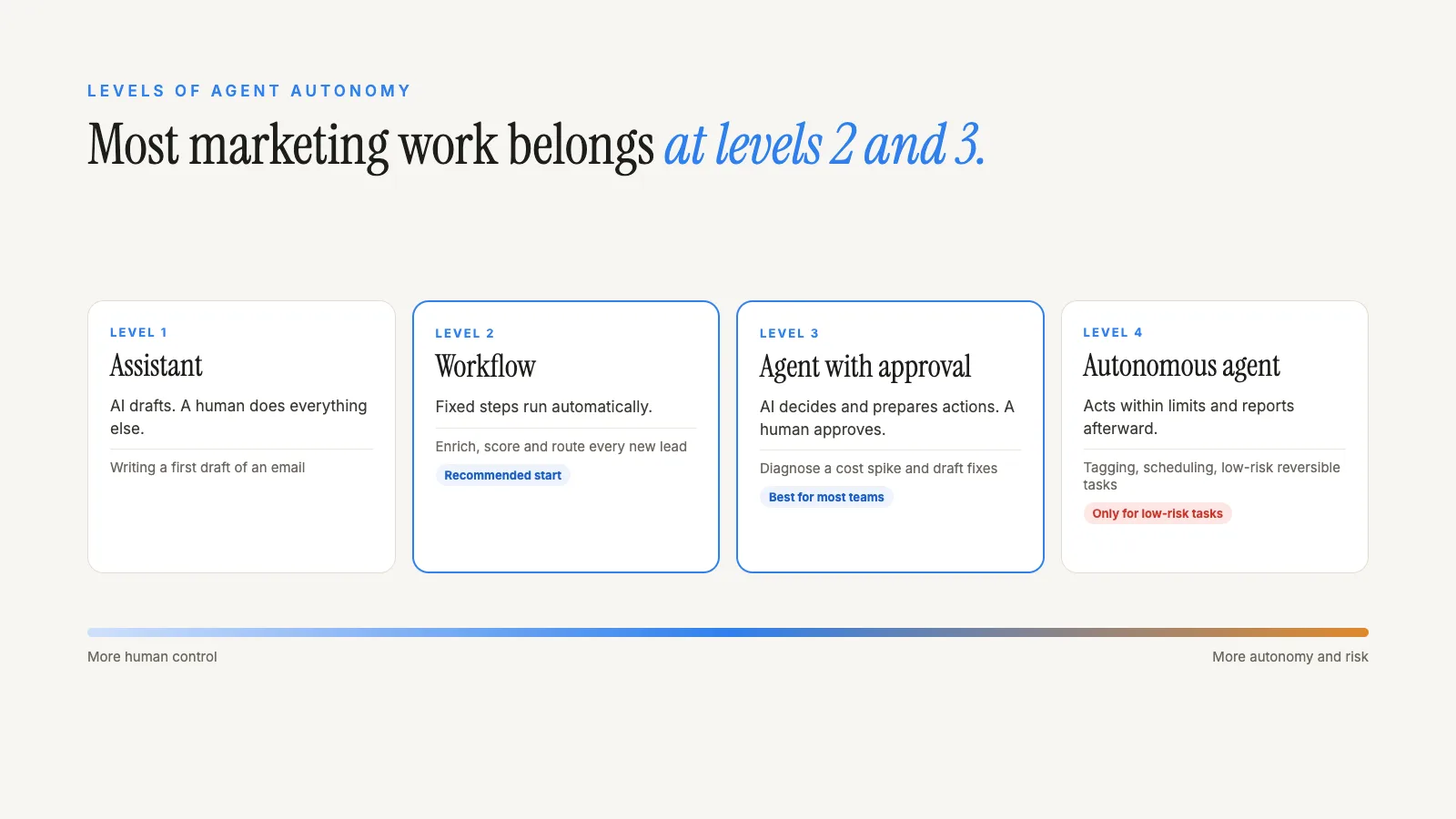
- Workflows are systems where AI models and tools follow predefined steps. Example: every new form fill is enriched, scored and sent to the CRM in the same order.
- Agents are systems where the AI decides its own process and which tools to use. Example: "find out why cost per lead rose last week," where the steps depend on what the data shows.
The same guide recommends finding the simplest solution possible and adding complexity only when it demonstrably improves outcomes. For marketing teams, that means many "agent" projects should start as reliable workflows, with true agentic decision-making reserved for open-ended problems such as diagnosis and research.
How agents differ from traditional marketing automation
Traditional marketing automation follows fixed rules: if a contact downloads the guide, send email two after three days. An AI agent can handle ambiguity: read a reply, judge whether it is a sales inquiry, a support issue or an unsubscribe request, and act accordingly. In practice, the strongest systems combine both, with rules for the predictable parts and AI judgment where inputs vary.
AI Agents by Marketing Channel
Here is where agents are genuinely useful today, what they do and where a human should stay in the loop.
| Channel | What an agent can do | Keep a human on |
|---|---|---|
| PPC and paid social | Pull spend and conversion data daily, flag anomalies, explain changes, draft bid, budget and negative keyword changes | Approving budget changes and new ad copy |
| SEO | Monitor rankings and Search Console data, find decaying pages, draft briefs and internal link suggestions | Final content, technical changes to the live site |
| Segment lists, draft sequences, personalize from CRM data, sort replies | Sending to large lists, anything with offers or claims | |
| Content distribution | Turn one article into channel-specific posts, schedule them, track performance | Brand voice and sensitive topics |
| Social listening | Track brand and competitor mentions, summarize themes, alert on spikes | Public replies in tense situations |
| Lead qualification | Answer inquiries, ask qualifying questions, book calls, update the CRM | Pricing exceptions and complex deals |
| Reporting | Assemble weekly reports across tools and explain what changed and why | Conclusions that drive budget decisions |
Paid traffic analysis agents
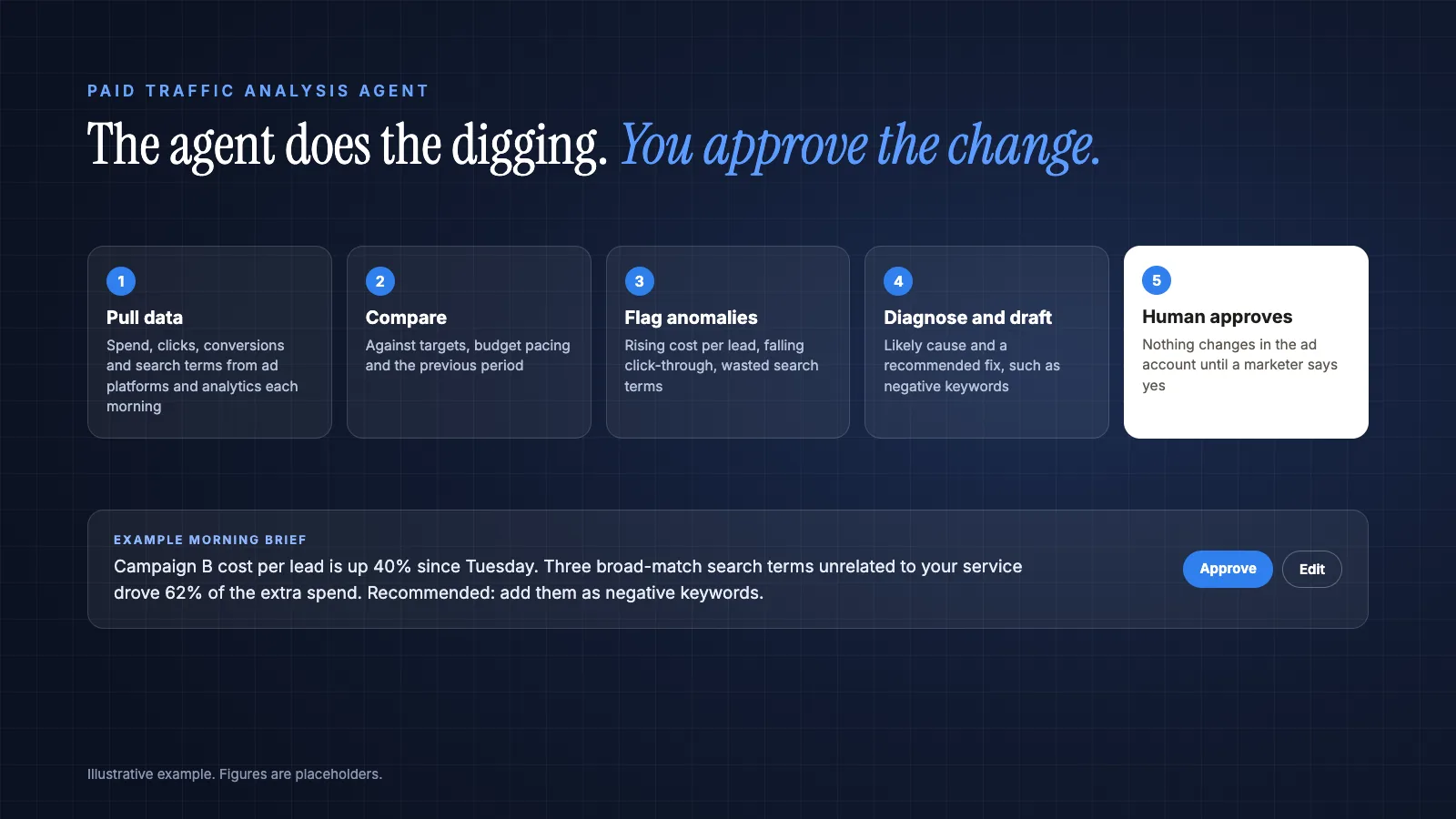
Paid traffic analysis is one of the clearest wins, because the work is repetitive, data-heavy and time-sensitive. A paid traffic agent typically runs on a schedule, connects to your ad platforms and analytics, and produces a short daily or weekly brief.
What it checks
Spend against budget pacing, cost per lead or acquisition by campaign, search terms triggering ads, landing page conversion rates and sudden changes in click-through rate.
What it produces
A plain-language summary ("Campaign B's cost per lead rose 40% since Tuesday, driven by three broad-match search terms unrelated to your service"), plus drafted fixes such as negative keywords or budget shifts.
What it should not do alone
Increase budgets, launch new campaigns or publish new ad copy without approval. Spend mistakes compound quickly.
SEO agents
An AI SEO agent works best as an analyst and drafter: watching Search Console for pages losing clicks, comparing them with competing pages, drafting refresh briefs and suggesting internal links. Publishing should stay with a human editor, because search engines reward helpful, trustworthy content, not volume. Google's helpful content guidance also suggests considering a disclosure of AI or automation use when readers would reasonably expect it. Our AI SEO and content service uses agents this way, with editors approving every change.
Email marketing AI agents
Email agents can segment audiences, draft sequences, personalize messages from CRM fields and triage replies. They also carry legal responsibility you cannot hand off. The FTC's CAN-SPAM compliance guide requires accurate sender information, subject lines that match the content, a valid physical postal address, a clear way to opt out and opt-outs honored within 10 business days. It also states that you cannot contract away your legal responsibility when someone else sends email on your behalf, and an AI agent is no exception. Each violating email can draw a penalty of up to $53,088.
Build these rules into the agent's instructions and the sending platform, and keep a human approval step for large sends. Our email marketing service sets up sequences with these checks built in.
Content distribution agents
A content distribution agent takes a published article or video and turns it into channel-specific versions: a LinkedIn post, a short X thread, an email newsletter blurb and social captions, each in the right length and tone. It can then schedule them and report which channels drove traffic. The value is consistency: every piece of content actually gets distributed, not just the ones someone had time for. Before handing social posting to an agent, set up the human review and labeling steps in our guide on how to use AI for social media.
Lead qualification agents
Lead agents answer inquiries immediately, ask qualifying questions, book meetings and update the CRM. Speed matters most here, because a reply in minutes beats a reply tomorrow. This is what our AI lead agents service builds, connected to your calendar and CRM through marketing automation.
AI Marketing Platforms Teams and Agencies Use
Rather than a ranked list of tools (which changes monthly), it helps to understand the four categories most teams and agencies combine.
| Platform type | Examples | Best for | Watch out for |
|---|---|---|---|
| AI inside your CRM or marketing suite | Agent features in HubSpot or Salesforce | Teams standardized on one suite | Limited reach into tools outside the suite |
| Workflow automation platforms | Zapier, Make, n8n | Connecting many tools with AI steps in between | Complex flows can become fragile without documentation |
| Agent builders | Platforms for building custom agents with tools and memory | Multi-step, judgment-heavy tasks | Needs testing, monitoring and clear limits |
| Model APIs | Claude, GPT and Gemini APIs | Custom agents built by developers or agencies | Requires engineering and ongoing maintenance |
Most small and mid-sized teams start with the AI built into their existing suite plus one workflow platform. Choosing the underlying model matters too; our guide to the best LLM for business and marketing explains how to compare Claude, ChatGPT and Gemini for your tasks.
Productized AI marketing automation packages
Many agencies, including AI content agencies, now sell productized packages: a fixed scope, such as "lead response agent plus CRM integration" or "weekly paid traffic analysis agent," at a set price. These can be a fast way to start. Before buying, ask which tools the agent uses, who owns the accounts and data, what it can do without approval, how errors are caught and what happens if you leave. Our guide to vetting an SEO company has a scorecard that applies just as well to AI agencies.
Guardrails Every Marketing Agent Needs
Approval thresholds
Define what the agent can do alone (draft, analyze, tag) and what needs a human (send, spend, publish). Start strict and loosen only with evidence.
Least-privilege access
Give each agent only the permissions its job needs. A reporting agent needs read access to ad accounts, not the ability to edit budgets.
Logs and review
Keep a record of every action and decision so you can audit what happened and why.
Truthful claims
Agents must not invent product claims, testimonials or reviews. The FTC's rule on consumer reviews, effective October 21, 2024, prohibits fake reviews, and the FTC has said AI-generated fake reviews are covered.
Data protection
Use business accounts with clear data terms, and keep sensitive customer data out of tools that do not need it.
A 90-Day Plan to Deploy Your First Marketing Agent
Days 1 to 30: pick one job
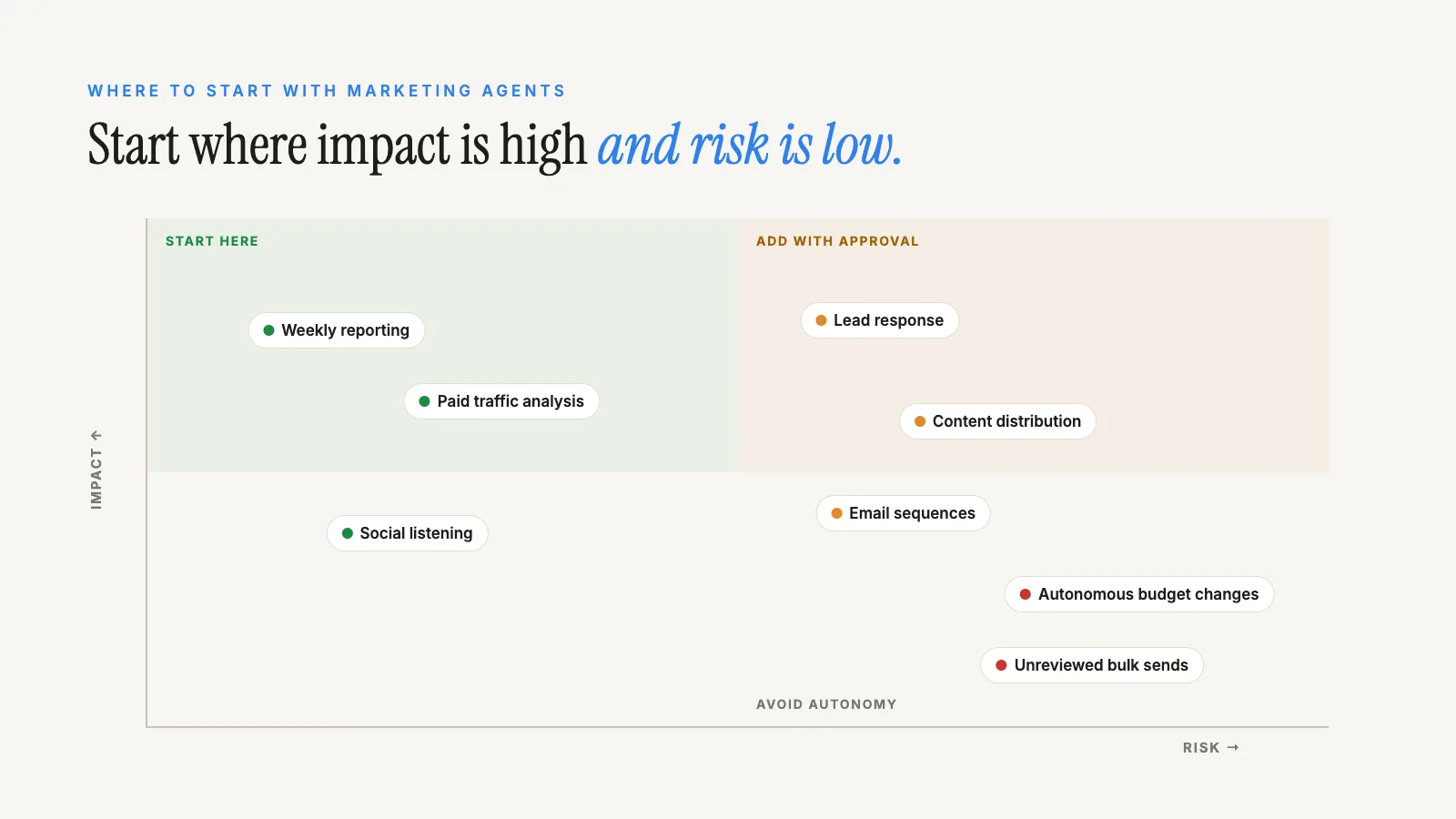
Choose one repetitive, measurable task with low risk, such as weekly reporting or paid traffic analysis. Write down how long it takes today and what a good output looks like. Build it as a simple workflow first.
Days 31 to 60: add judgment and approval
Let the agent diagnose and recommend, with a human approving any action. Compare its recommendations with what your team would have done and track time saved.
Days 61 to 90: expand carefully
If quality holds, add a second use case, such as lead response or content distribution. Loosen approvals only for low-risk, reversible actions, and keep logs for everything.
AI Agents and Your Visibility in AI Answers
There is a second side to AI agents: buyers are starting to use them too, asking assistants to research and shortlist vendors. When an AI agent compares options in your category, your brand needs to be easy to find, understand and cite. That is generative engine optimization, covered in our guides on getting recommended by ChatGPT, what LLM marketing covers and AI advertising, and delivered through our AI search visibility service.
Frequently Asked Questions
What are AI agents for marketing?
AI agents for marketing are AI systems that can take actions across marketing tools, such as ad platforms, CRMs, email platforms and analytics, rather than only generating text. They can gather data, decide on next steps within set rules and carry out tasks like analyzing paid traffic, qualifying leads or distributing content, ideally with human approval for customer-facing or budget decisions.
What are the best AI agents for marketing?
The best choice depends on your stack and use case. Teams on one marketing suite often start with its built-in agent features, while teams with many tools use workflow platforms or custom agents built on model APIs. Start with one well-defined job, measure the time saved and quality, then expand.
Can AI agents run PPC campaigns?
They can analyze performance, flag problems and draft changes very effectively. Letting them change budgets or launch campaigns without approval is risky, because spending mistakes compound quickly. Most teams use agents for analysis and recommendations with a human approving changes.
Do email marketing AI agents have to follow CAN-SPAM?
Yes. The sender remains legally responsible for commercial email, whoever or whatever sends it. Messages need accurate headers and subject lines, a valid physical address and a working opt-out honored within 10 business days, according to the FTC's CAN-SPAM compliance guide.
Will AI agents replace marketing teams?
They replace repetitive tasks more than roles. Strategy, positioning, creative judgment, relationships and accountability for claims and spend stay with people. Teams that use agents well spend less time copying data between tools and more time on decisions.
Start Small and Keep Control
AI agents can take hours of repetitive work off a marketing team every week, but only when they have a clear job, the right access and a human checkpoint where mistakes would be costly. Pick one task, build it simply, measure the result and expand from there.
If you want help choosing and deploying your first marketing agent, book a free call, reach us through the contact page or send your details below. Our founder, Mohd Adil Kazmi, will reply personally. You can also explore all our services, case studies or the industries we work with.
Which marketing task should your first AI agent take over?
Tell me about your marketing stack and the work that eats your team's week, and I'll reply personally with the first agent I would build and how to keep it safe.