
ChatGPT now carries ads, and any US business can buy them from a self-serve dashboard with a $25 daily budget. That makes ChatGPT a paid channel worth testing, but it does not work like Google Ads. There are no keywords to bid on, the ad never appears inside the answer, and what you pay for is a chance to be shown next to a conversation, not a ranking. This guide explains how ChatGPT ads work, what they cost, how to set up a first campaign and how to decide whether they are right for your business.
ChatGPT ads are sponsored placements that OpenAI shows beneath ChatGPT's responses to logged-in adult users on the Free and Go plans. Advertisers buy them in ChatGPT Ads Manager at ads.openai.com, paying per thousand impressions (CPM) or per click (CPC), and guide placement with "context hints" that describe what they offer rather than keywords. OpenAI says ads are clearly labeled and do not influence ChatGPT's answers.
Everything below comes from OpenAI's help center, developer documentation and announcements, plus trade reporting where OpenAI has not published details. The platform is in beta and changes monthly, so we date each fact. Facts are current as of October 31, 2026.
ChatGPT Ads at a Glance
| Question | Answer (October 2026) |
|---|---|
| Where ads appear | Below ChatGPT's responses, labeled as sponsored |
| Who sees them | Logged-in adults on the Free and Go plans. Plus, Pro and Enterprise are ad-free |
| Where to buy | ChatGPT Ads Manager (ads.openai.com), the Advertiser API or technology partners |
| Markets | 89 countries, including the US |
| Pricing | Auction, bought on CPM or CPC |
| Minimum budget | $25 a day per campaign in the US |
| Targeting | Context hints, location, platform (iOS, Android, web) and custom audiences |
| Measurement | Measurement pixel, Conversions API and image tag |
| Formats | Single-image and multi-image ads, with image-generation ads and Sponsored Agents in US testing |
How ChatGPT Ads Work
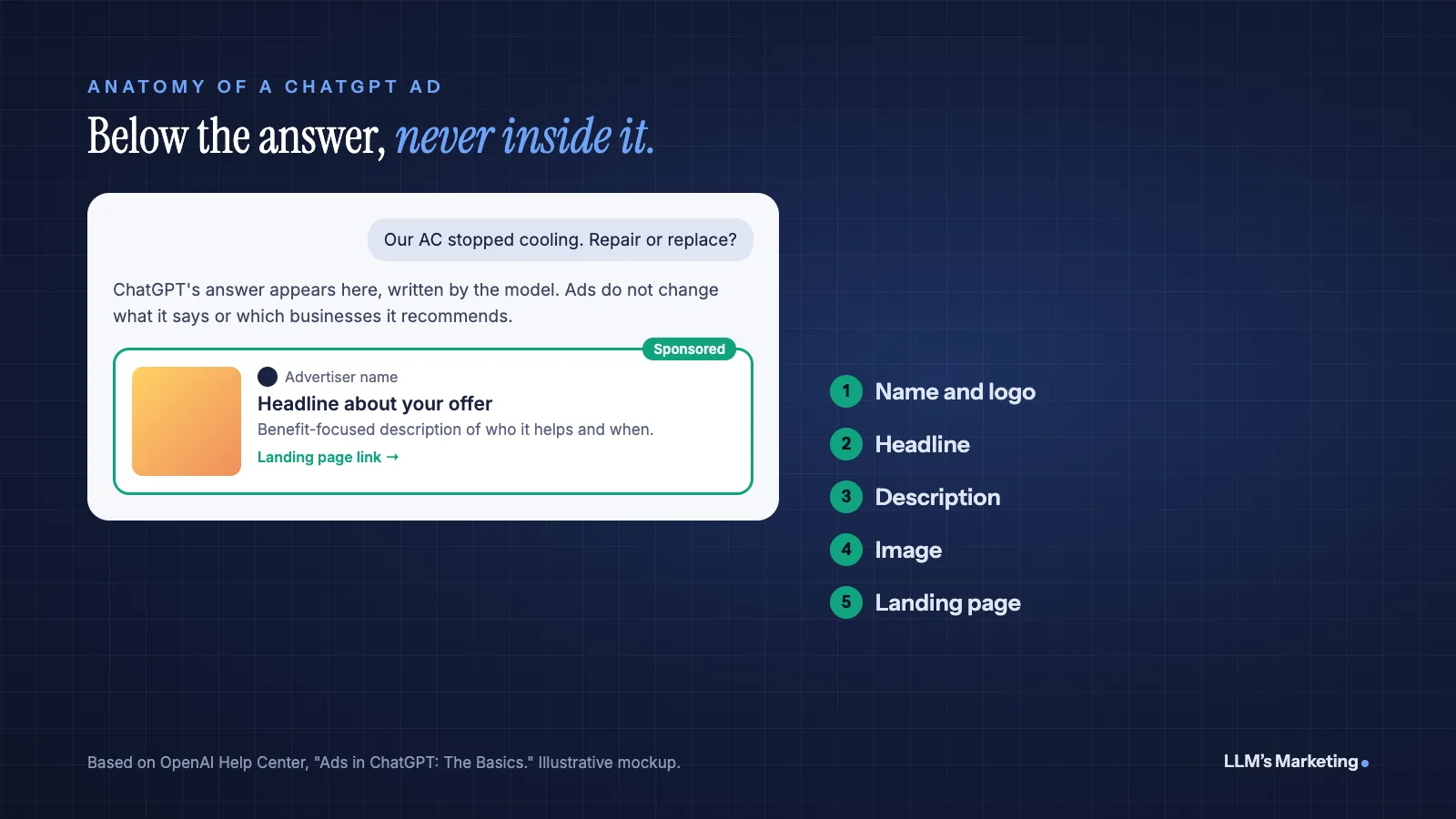
An ad shows the advertiser's name and logo, a headline, a description, an image and a link to a landing page, and it sits beneath ChatGPT's response (OpenAI Help Center). It is never part of the answer text.
The key difference from search ads is how an ad gets matched. Google Ads matches ads to the words someone types. ChatGPT matches ads to the conversation. A conversation can run for several turns, so the system has more context about what the person is trying to do. In OpenAI's own example, a user planning meals for marathon training could be shown a grocery delivery service they had not considered (PPC Land).
OpenAI has committed to a set of ad principles. The two that matter most for advertisers are these (OpenAI Help Center):
- Answer independence. Ads do not influence the answers ChatGPT gives. They are always separate and clearly labeled.
- Conversation privacy. Advertisers never see chats, chat history, memories or personal details. They receive aggregated performance data such as views and clicks.
The practical consequence: an ad can sit under an answer that recommends three of your competitors, but it cannot put your brand into that answer. Being named in the response is an organic outcome. We cover how to earn it in our guide on how to get your brand recommended by ChatGPT.
Who Sees ChatGPT Ads
Ads appear only on ChatGPT's Free and Go plans. Plus, Pro and Enterprise subscriptions stay ad-free (OpenAI, October 21, 2026). OpenAI also excludes several groups and situations (OpenAI Help Center):
- Accounts identified or predicted as belonging to users under 18.
- Temporary Chats.
- Conversations about sensitive topics, including personal health and mental health. Political advertising is not currently allowed.
Users can turn off ad personalization and clear the data used for ads. Personalized ads were not initially offered in the European Economic Area or Switzerland. For a US advertiser, the takeaway is that your reach is the free and lower-cost tiers, which skew toward consumers more than toward enterprise buyers on paid workplace plans.
How ChatGPT Ads Got Here
The channel moved from a closed pilot to a global self-serve product in about nine months:
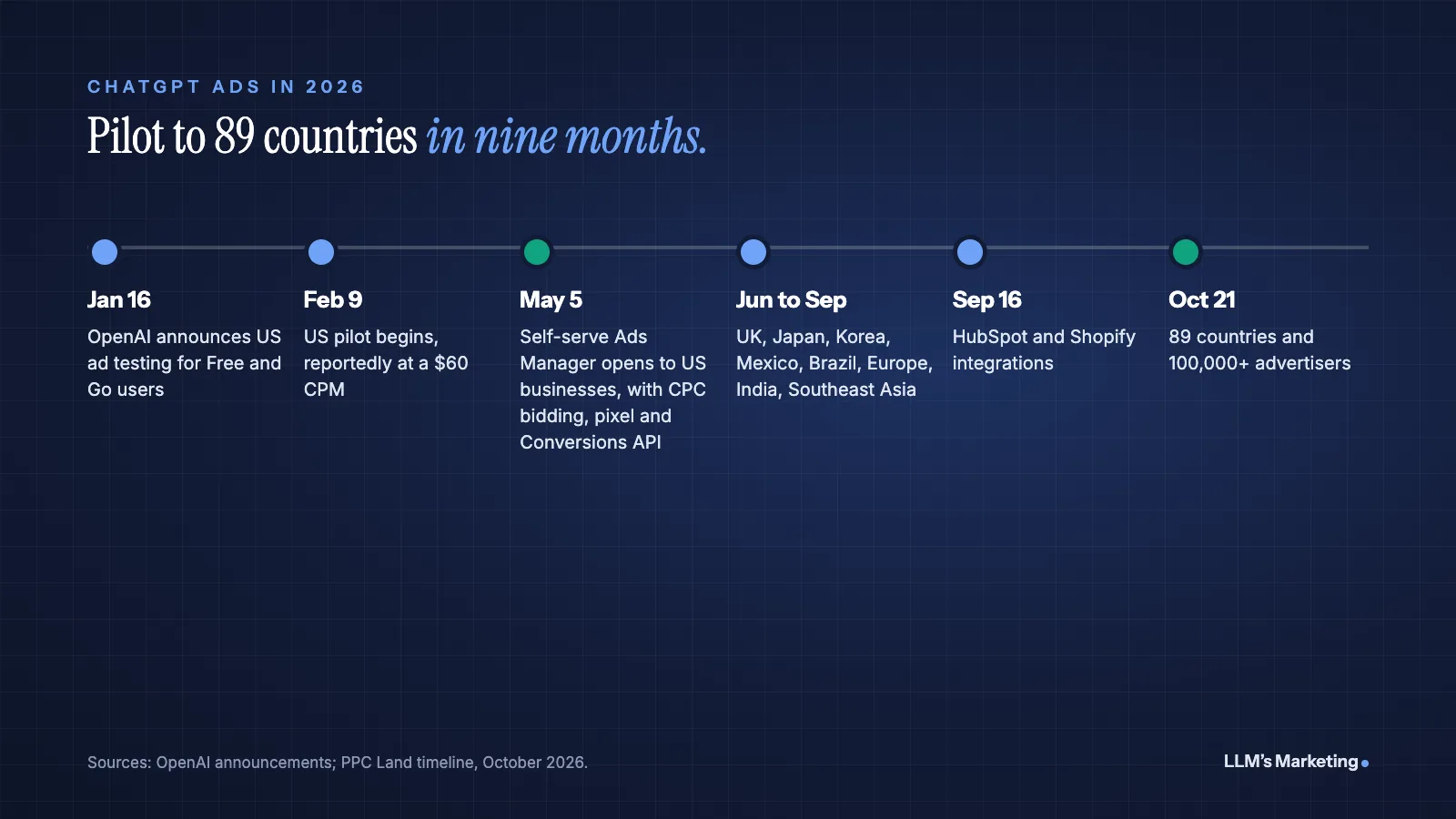
- January 16, 2026: OpenAI announces it will test ads in the US for logged-in adult Free and Go users (OpenAI).
- February 9, 2026: The US pilot begins, reportedly at a $60 CPM with large minimum commitments for early brand partners.
- May 5, 2026: The self-serve Ads Manager opens to all US businesses, adding cost-per-click bidding, a measurement pixel and a Conversions API.
- June to September 2026: Ads launch in the UK, Japan, South Korea, Mexico, Brazil, 31 European markets, India, Southeast Asia and Taiwan. HubSpot and Shopify integrations arrive in September.
- October 21, 2026: OpenAI adds 26 countries, bringing ChatGPT ads to 89, and says more than 100,000 advertisers have run campaigns (OpenAI).
Dates without an OpenAI link come from PPC Land's compiled timeline, which cites OpenAI's announcements.
ChatGPT Ad Formats
- Single-image ads. The standard unit: logo, headline, description, one image and a link.
- Multi-image ads. Four to six square (1:1) images in one ad, useful for showing a product range. OpenAI's help center says this format opened in beta in late October 2026 (OpenAI Help Center).
- Image-generation ads. A larger, more visual unit shown while people use ChatGPT to create images. OpenAI began testing it in the US in October 2026 (PPC Land).
- Sponsored Agents. In a US test, a user who clicks an ad can open a separate, labeled conversation with the advertiser's own AI agent (PPC Land).
OpenAI also offers optional creative enhancements that can rewrite headlines and descriptions, resize images, optimize destination URLs and translate ads. Its guidance is to write practical, benefit-focused copy that explains what you offer, who it is for and when it helps, rather than a catchy slogan (OpenAI Help Center). That fits the setting: your ad appears right after a detailed, helpful answer, and vague copy looks weak next to it.
How Much Do ChatGPT Ads Cost?
ChatGPT ads are sold by auction, so there is no fixed price. You choose how you pay and set a budget:
- Bidding: cost per thousand impressions (CPM) or cost per click (CPC). Click and conversion-optimized campaigns are billed per click (OpenAI Advertiser API docs).
- Minimum budget: $25 a day per campaign in the US. Other currencies have their own floors, such as 15 EUR or 15 GBP (OpenAI Help Center).
- Pacing: the daily budget is an average over seven days, not a hard cap. A campaign can spend up to twice the daily budget on a given day, but no more than seven times the daily budget over seven days. If you need a firm ceiling, use a campaign total budget instead.
OpenAI does not publish average CPMs or CPCs. The early pilot was widely reported at a $60 CPM, and agency reports since self-serve launched suggest lower and more variable prices, but none of those figures are official. The reliable way to learn your cost is a small, controlled test.
| Monthly test budget | Daily budget | Good for |
|---|---|---|
| About $750 | $25 (the minimum) | One campaign, one offer, learning real CPCs |
| About $1,500 | $50 | Two ad groups with different context hints |
| About $3,000 | $100 | Enough clicks to judge conversion rate for most lead-gen offers |
These tiers are our planning guidance, not OpenAI benchmarks. Monthly figures assume 30 days at the stated daily budget.
How to Set Up a ChatGPT Ads Campaign
ChatGPT ads follow a familiar structure: account, campaign, ad group, ad. Budget and objective live at the campaign level. Context hints, targeting and bids live at the ad group level (OpenAI Advertiser API docs).
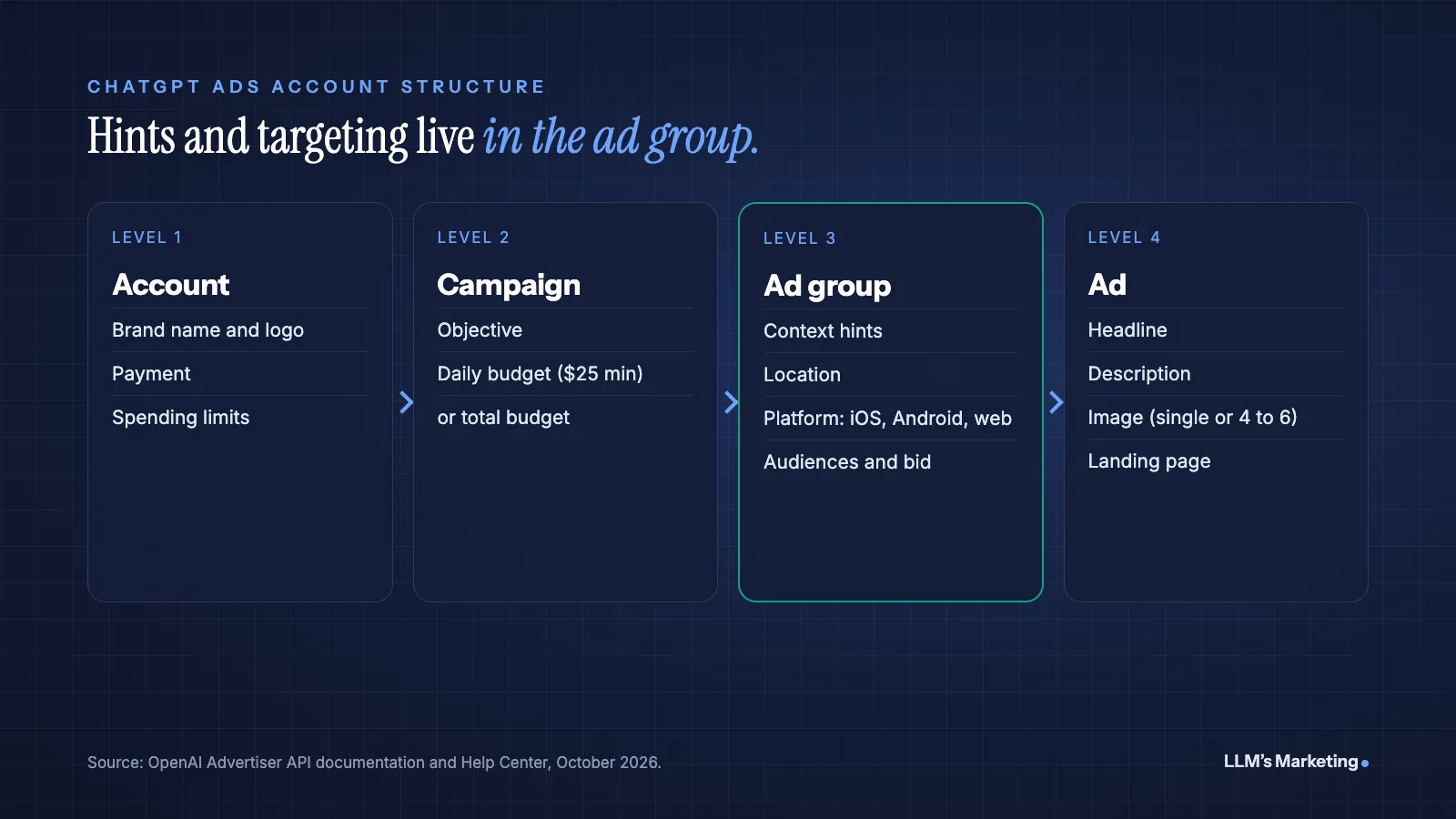
- Create your account. Sign up at ads.openai.com, add your brand name and logo, and set payment details and any account spending limit.
- Install measurement first. Add the measurement pixel to your site, or send events server to server with the Conversions API. If you cannot run JavaScript, use the image tag. Do this before launch so the first clicks are tracked.
- Create a campaign. Pick the objective (for example clicks or conversions) and a daily or total budget.
- Build an ad group. Write context hints, set the location (country, region or market) and choose platforms: the iOS app, the Android app, the web or all three.
- Write the ad. Use a clear headline and a benefit-focused description, add a strong image and point it at a landing page that answers the question the conversation was about.
- Launch and wait. Give the campaign at least two weeks before changing hints or bids, since budgets pace over seven days.
If you already run HubSpot or Shopify, you can also launch ChatGPT ads from those platforms instead of Ads Manager.
How to Write Context Hints
Context hints are the closest thing ChatGPT ads have to keywords, and they are where most new advertisers go wrong. OpenAI describes them as phrases at the ad group level that help the system judge when an ad is relevant. The best hints are clear and specific about what you offer, who it helps and when it may be useful. They are not exact-match keywords or targeting rules, and they do not guarantee delivery (OpenAI Help Center).
OpenAI also warns against putting delivery instructions in hint text. "Show this ad only to people in Chicago" belongs in the location setting, not in a hint. Here is how that plays out for a hypothetical HVAC company in Phoenix:
| Weak hint | Why it is weak | Stronger hint |
|---|---|---|
| AC repair | A bare keyword with no context about who it helps | Same-day air conditioner repair for homeowners whose AC stopped cooling in summer heat |
| Best HVAC company | A generic claim, not a description of the offer | Comparing the cost of repairing versus replacing an older central air system |
| Only show in Phoenix | A delivery instruction, which belongs in location targeting | Set the location to the Phoenix area and describe the service in the hint instead |
Write several hints per ad group, each describing a different situation where your offer helps. Group similar situations together, and split very different ones into separate ad groups so you can compare them.
Measuring ChatGPT Ads
ChatGPT Ads Manager reports impressions, clicks, spend, click-through rate, average CPC, average CPM and conversions. Conversions come from three sources (OpenAI Advertiser API docs):
- Measurement pixel: a JavaScript tag that sends conversion events from your web pages.
- Conversions API: server-to-server events, which are more reliable when browsers block scripts and which suit offline sales or CRM stages.
- Image tag: a fallback for pages that cannot run JavaScript.
Expect some conversions to happen without a click. OpenAI reported that in an early analysis, 52.7% of eligible one-day view-through conversions happened within an hour of the matched ad impression (OpenAI Ads). Someone may see your ad, keep chatting and then search for your brand. Watch branded search volume and direct traffic during a test, and tag every ad URL with UTM parameters so ChatGPT traffic is easy to separate in Google Analytics 4.
ChatGPT Ads vs Google Ads
| ChatGPT ads | Google Search ads | |
|---|---|---|
| Matching | Conversation context and context hints | Keywords and search terms |
| Placement | Below the AI answer | Above and below results, and in or around AI Overviews |
| Audience | Free and Go ChatGPT users | Nearly all Google searchers |
| Search term data | None. Advertisers do not see conversations | Search terms report |
| Maturity | Beta, changing monthly | Mature, with years of benchmarks |
| Best use today | Testing and reaching people earlier in research | Capturing demand from people ready to buy |
For most US small businesses, ChatGPT ads should be a test budget on top of search, not a replacement. Our AI advertising guide covers how ads inside Google's AI Overviews and AI Mode work, and how to split budget between paid AI placements and organic AI visibility.
Should You Advertise on ChatGPT?
ChatGPT ads are a good fit if:
- People research your product or service in long conversations before buying, for example home services, software, travel, education or considered consumer purchases.
- You can measure conversions properly with the pixel or Conversions API.
- You have a landing page that answers the questions people ask, not just a homepage.
- You can afford a test of at least a few weeks without needing an immediate return.
Wait if your category falls under OpenAI's sensitive topics (health, mental health or politics), if you sell mainly to enterprise users on ad-free plans, or if your Google Ads and SEO basics are not yet working. A new, beta channel will not fix a weak offer or landing page.
Whatever you decide on ads, the bigger opportunity in ChatGPT is still the answer itself. Brands get named in responses through clear entity information, consistent mentions across trusted sources and content that answers specific questions. Read our guides on GEO vs SEO and schema and entity optimization to build that visibility alongside any paid test.
Common Mistakes With ChatGPT Ads
- Treating context hints like keywords. One-word hints give the system little to work with.
- Launching without measurement. Without the pixel or Conversions API, you can only judge clicks.
- Judging results too soon. Budgets pace over seven days, so daily numbers are noisy.
- Sending clicks to a generic homepage. The person just read a detailed answer. Send them to a page that continues it.
- Expecting ads to change the answer. They cannot. If ChatGPT recommends competitors and not you, that is an organic visibility problem.
Frequently Asked Questions
How do I advertise on ChatGPT?
Sign up for ChatGPT Ads Manager at ads.openai.com, add your brand details and payment method, install the measurement pixel or Conversions API, then create a campaign with a budget, an ad group with context hints and location targeting, and an ad with a headline, description, image and landing page. Businesses can also buy through the Advertiser API, technology partners, HubSpot or Shopify.
How much do ChatGPT ads cost?
ChatGPT ads are priced by auction on a cost-per-thousand-impressions or cost-per-click basis, so there is no fixed rate. The minimum daily budget in the US is $25 per campaign, which is about $750 over a 30-day month. OpenAI does not publish average CPMs or CPCs.
Do ChatGPT ads influence ChatGPT's answers?
No. OpenAI says ads do not influence the answers ChatGPT gives and are always shown separately and clearly labeled beneath the response. Paying for ads does not get your brand mentioned or recommended inside the answer.
Who sees ads in ChatGPT?
Logged-in adult users on the Free and Go plans see ads. Plus, Pro and Enterprise subscribers do not. Ads are not shown to users identified as under 18, in Temporary Chats or near sensitive topics such as health, mental health and politics.
Can I target keywords with ChatGPT ads?
Not in the Google Ads sense. ChatGPT ads use context hints, which are descriptive phrases about what you offer, who it helps and when it is useful. OpenAI says hints are not exact-match keywords and do not guarantee delivery. You can also target by location, platform and custom audiences.
Where to Start
If ChatGPT ads fit your business, start small: one campaign at the $25 daily minimum, one clear offer, three to five specific context hints, a dedicated landing page and the pixel installed before launch. Run it for two to four weeks, compare cost per lead with your Google Ads, and only then scale. At the same time, check whether ChatGPT already mentions your brand when people ask about your category, because that organic answer is what most users will read first.
If you would like help, book a free call, reach us through the contact page or send your details below. Our founder, Mohd Adil Kazmi, will review how ChatGPT currently talks about your brand and whether a paid test makes sense for you. You can also explore our AI search visibility service or all services.
Thinking about advertising on ChatGPT?
Send your website and I'll check how ChatGPT talks about your brand today and whether a paid test makes sense, then reply personally with a plan.